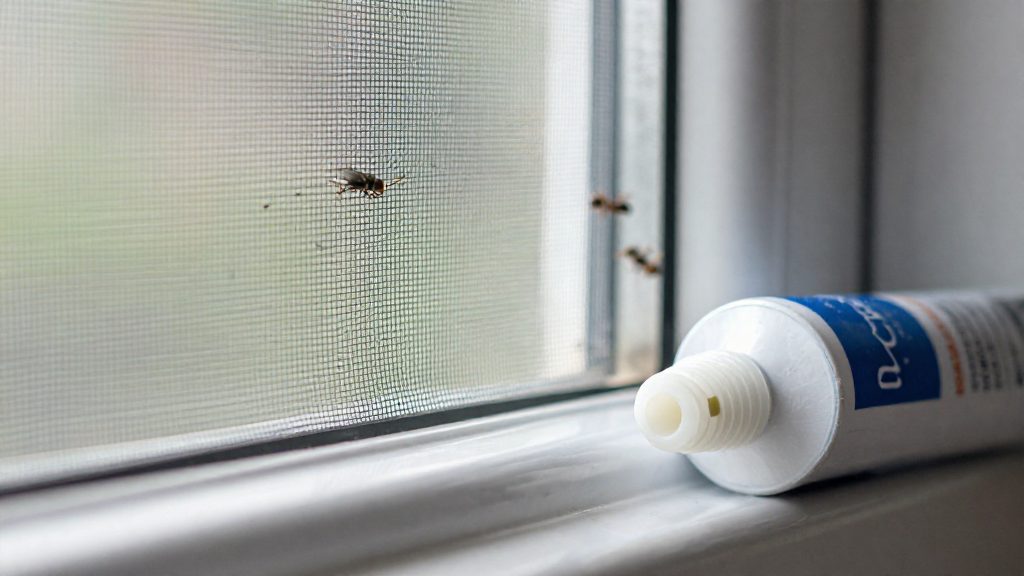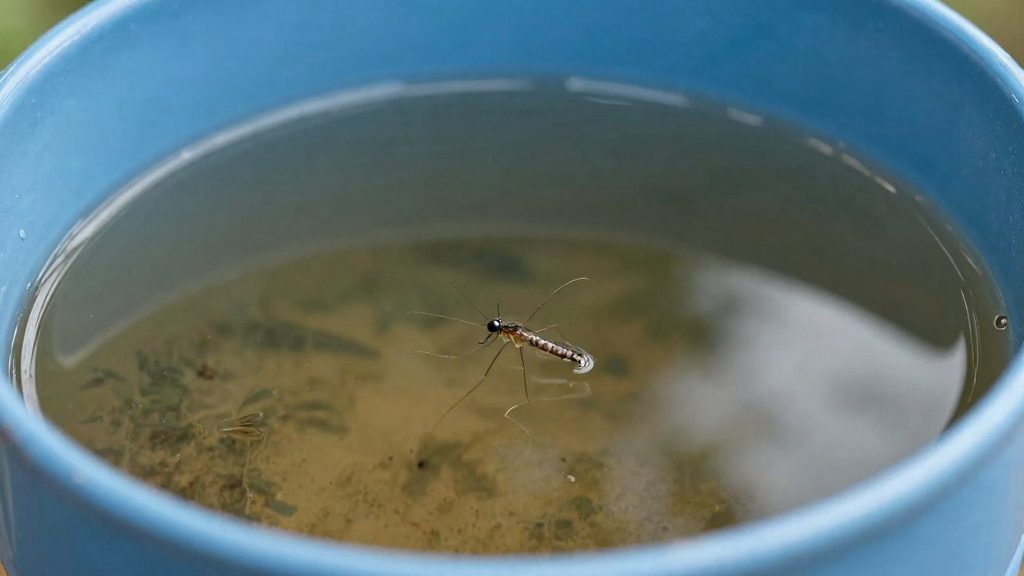
Why do mosquitoes lay eggs in a rain barrel?
A rain barrel collects rainwater and holds it still, which is the habitat mosquitoes need. Females lay their eggs on the water surface, and the larvae hatch, feed and develop entirely in the water. A barrel left untreated for about three weeks can therefore produce a new generation of flying adults, since that is roughly how long larvae take to mature.
Standing time is the key factor. According to Rutgers NJAES Cooperative Extension (United States), water that remains in a barrel for more than 72 hours should be checked for larvae. Emptying the barrel or refilling it with fresh rainwater before that point limits the risk.
Two physical measures interrupt the cycle:
- A fitted mesh screen covering the barrel opening prevents adults from entering to lay eggs. The screen must cover the whole opening.
- A film of cooking oil, about 1/8 inch (roughly 3 mm) thick, stops larvae from reaching the air at the surface, where they need to breathe.
For larvae already present, Bti (Bacillus thuringiensis israelensis) is the method Garantia, a European rain barrel manufacturer, identifies as most effective. It is sold as tablets or liquid and, according to Garantia, does not harm beneficial insects, people or plants. Rutgers notes that Bti sold as Mosquito Dunks is labelled for rain barrels. In Quebec, Bti is registered by the Pest Management Regulatory Agency (ARLA) of Health Canada, according to the City of Trois-Rivières (2024).
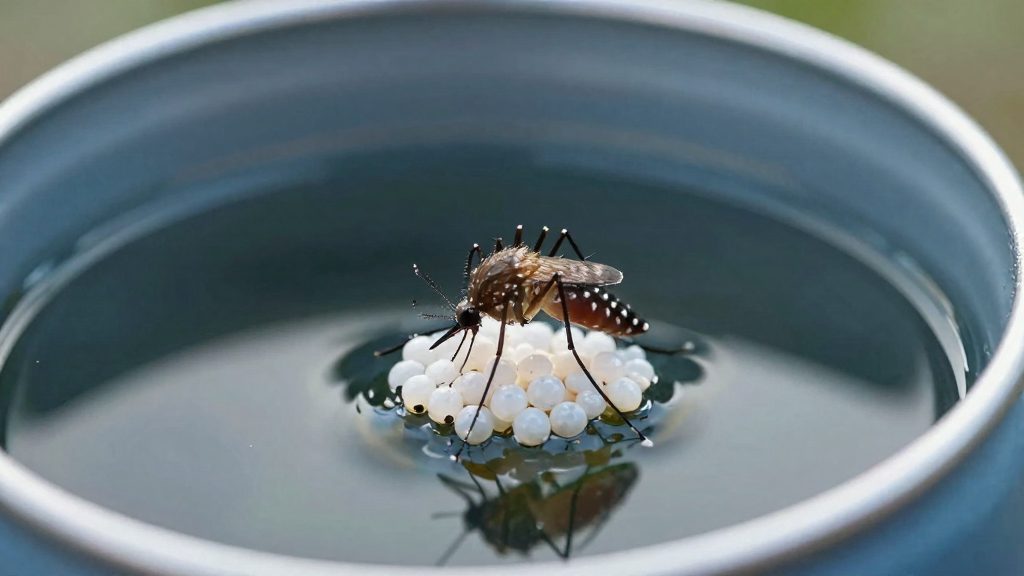
How to Recognise Mosquito Larvae in Rain Barrel Water
Inspect the water in the barrel directly, because larvae develop in standing water. Water that stays in the barrel for more than 72 hours is the point at which you should check for larvae.
- Log the water age. Note when the barrel was last emptied or refilled. Water older than 72 hours should be inspected.
- Check the surface and sides. Lift the lid and shine a torch across the water. Larvae must reach the surface to breathe air, so look there first.
- Check the mesh. A well-fitted mesh should cover the whole opening of the barrel, with no gaps around the rim.
- Act within the development window. If you find larvae, treat the barrel before they become flying adults.
| Parameter | Value | Practical use |
|---|---|---|
| Standing time before inspection | More than 72 hours | Trigger for checking the barrel |
| Larval development to flying adult | About three weeks | Deadline for treatment |
| Oil film thickness | About 1/8 inch | Stops larvae reaching air at the surface |
The oil film method works because it blocks larvae from reaching air at the surface. Cooking oil is the option named in the source.
Bti (Bacillus thuringiensis israelensis) is the most effective treatment for larvae, according to Garantia, a European barrel and rain-collector manufacturer. It comes as tablets or liquid and does not harm beneficial insects, people or plants. The product Mosquito Dunks is labelled for rain barrels, according to Rutgers NJAES Cooperative Extension (United States). In Quebec, Bti is approved by the Pest Management Regulatory Agency (ARLA) of Health Canada, according to the City of Trois-Rivières (2024).
Covering the barrel: the best prevention
Covering the barrel stops adult mosquitoes from reaching the water, and the rest of the prevention relies on what happens in the water itself. Mosquito larvae need about three weeks to develop into flying adults, so any barrel that already holds larvae has to be treated within that window.
Sealing the opening with a mesh screen
A mesh screen must be well fitted and cover the entire barrel opening, with no gaps where an adult can enter. Check the screen regularly for tears, since a damaged mesh gives adults the same access as no mesh at all.
Checking standing water
If water stays in the barrel for more than 72 hours, inspect it for larvae. Water that is drained and refilled on a regular schedule rarely reaches that threshold, which makes this check a simple way to catch breeding early.
Using Bti as a larvicide
Bti (Bacillus thuringiensis israelensis) is the most effective method according to Garantia, a rain barrel manufacturer. It is sold as tablets or as a liquid, and Garantia states that it does not harm beneficial insects, people or plants. Rutgers NJAES Cooperative Extension (United States) lists Bti under the name Mosquito Dunks, labeled for rain barrels. In Quebec, the City of Trois-Rivières (2024) reports that Bti is registered by the Pest Management Regulatory Agency (ARLA) of Health Canada.
Adding a thin oil film
A thin layer of cooking oil, about 1/8 inch thick, stops larvae from reaching the air at the surface, where they breathe. Rutgers NJAES Cooperative Extension cites this method as a way to stop larvae from reaching the air at the surface.
Is Bti safe to use in a rain barrel?
Bti (Bacillus thuringiensis israelensis) is sold as tablets or as a liquid. According to Garantia (a manufacturer of barrels and rain collectors, Europe), it is the most effective method against mosquito larvae and does not harm beneficial insects, people or plants. This makes it suited to water that is stored for household or garden use.
Timing is the main constraint. Mosquito larvae need about three weeks to become flying adults, so the barrel should be treated within that window. According to Rutgers NJAES Cooperative Extension (United States), water that stays in a barrel for more than 72 hours should be checked for larvae.
Choosing a product
Bti is sold under the name Mosquito Dunks. Rutgers NJAES Cooperative Extension states that this product is labelled for rain barrels.
In Quebec, Bti is registered by the Pest Management Regulatory Agency (ARLA) of Health Canada, according to the City of Trois-Rivières (2024).
Application steps
- Choose a Bti product registered for your region and check its label.
- Add the tablet or liquid to the water at the dose and in the manner the label specifies.
- Fit a mosquito screen over the barrel opening. Rutgers NJAES Cooperative Extension notes that the screen must be well fitted to cover the entire opening.
- Check the water after 72 hours for remaining larvae, and repeat treatment as the label directs.
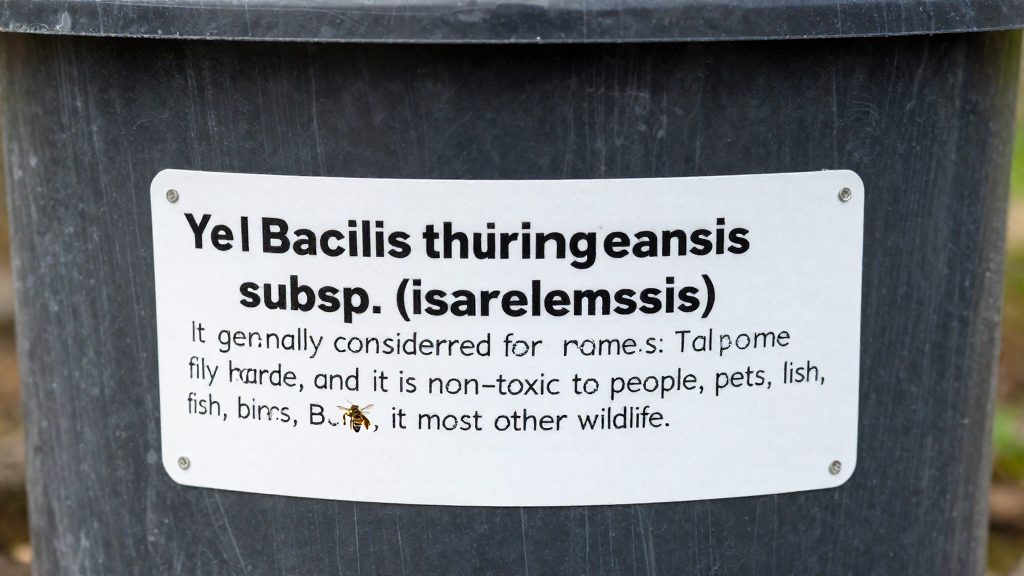
Bti, oil film or mesh screen: which method to choose?
Among the options that suit a rain barrel, Bti (Bacillus thuringiensis israelensis) is the one the reference material rates most effective. Garantia, a barrel and rain-collector manufacturer in Europe, reports that it comes as tablets or liquid and does not harm beneficial insects, people or plants. Rutgers NJAES Cooperative Extension notes that the product sold as Mosquito Dunks is labeled for rain barrels.
The table below sets out the points that matter for choosing a method.
| Measure | Key detail |
|---|---|
| Bti tablets or liquid | Most effective method according to Garantia |
| Mosquito Dunks | Bti product labeled for rain barrels (Rutgers NJAES) |
| Cooking-oil film | Roughly 1/8 inch thick; stops larvae reaching surface air |
| Fitted mesh cover | Must cover the full opening of the barrel |
| Treatment window | About three weeks, the time larvae need to become flying adults |
| Standing-water check | Look for larvae if water stays in the barrel beyond 72 hours |
An oil film is a physical barrier, not a larvicide. It stops larvae from reaching the air at the surface, according to Rutgers NJAES Cooperative Extension. It does not keep adults out, so it does not replace a fitted mesh screen. Treat the barrel within the three-week development window, and avoid relying on any product not labeled for rain barrels.
Maintaining the Barrel: Bti, Screen, Oil Film and Monitoring
Maintenance aims to stop mosquito larvae from becoming flying adults. Larvae need about three weeks to complete development, so a rain barrel that holds water should be treated or inspected within that window. Treatment and physical barriers work together: a treated barrel with an open top still needs a cover.
Treating the Water with Bti
Bti (Bacillus thuringiensis israelensis) is the most effective method, according to Garantia, a European manufacturer of rain barrels and water collectors. It comes as tablets or as a liquid and does not harm beneficial insects, people, or plants. Rutgers NJAES Cooperative Extension (United States) notes that Bti is sold as Mosquito Dunks and is labelled for rain barrels. In Quebec, Bti is registered by the Pest Management Regulatory Agency (ARLA) of Health Canada, according to the City of Trois-Rivières (2024).
Covering and Sealing the Barrel
A mosquito screen must fit the barrel opening completely. Any gap leaves a path for adult insects to reach the water.
Applying an Oil Film
Where treatment is not practical, a thin layer of cooking oil on the surface blocks larvae from reaching air. The film should be about 1/8 inch (roughly 3 mm) thick. Check that the film still covers the surface when you inspect the barrel.
Monitoring Standing Water
| Check | Threshold |
|---|---|
| Standing water in the barrel | Over 72 hours: inspect for larvae |
| Treatment window | About three weeks, the larval development period |
| Screen coverage | Must cover the full opening |
| Oil film thickness | About 1/8 inch |
Inspect the water with a flashlight, looking for wriggling larvae near the surface. Remove any larvae found and repeat the treatment.
Frequently asked questions
How long can water sit in a rain barrel before I need to check it?
Check for larvae once water has been standing for more than 72 hours, according to Rutgers NJAES Cooperative Extension. Emptying or refilling the barrel before that point reduces the chance that larvae complete their development.
Is Bti safe for pets, bees and vegetable gardens?
Garantia, a European rain barrel manufacturer, states that Bti does not harm beneficial insects, people or plants. This is a manufacturer claim rather than independent testing, so check the product label before using it near edible crops or water you drink.
Do I need both a mesh screen and an oil film?
They act at different stages. A fitted mesh screen that covers the entire opening stops adult mosquitoes from laying eggs, while a film of cooking oil about 1/8 inch (roughly 3 mm) thick keeps larvae from reaching surface air. Using both gives protection against adults and larvae.