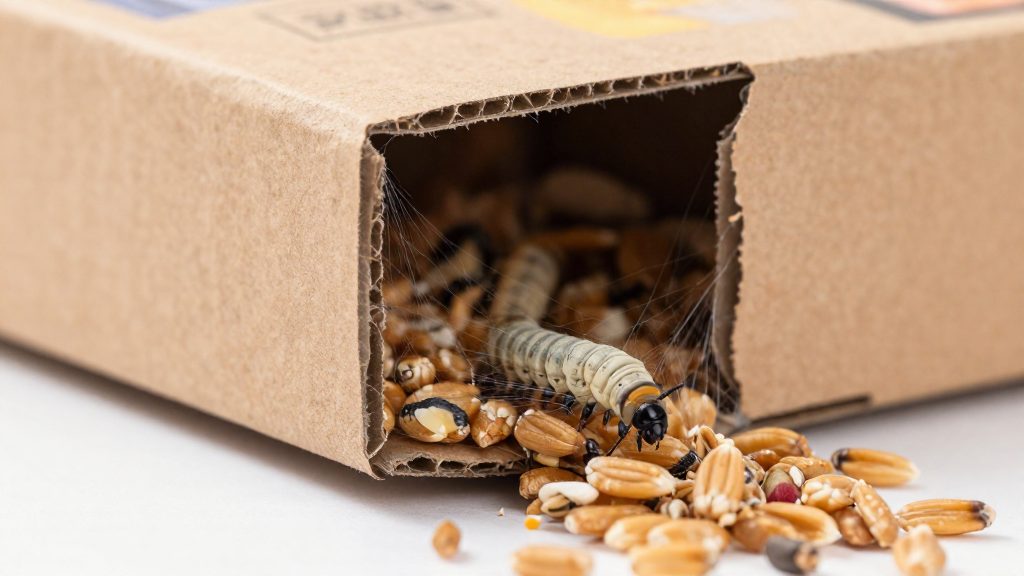
Carpet beetle larvae and clothes moth larvae are easily confused, but they feed differently and need different responses. A clothes moth larva is a small, creamy-white, caterpillar-like grub that spins silk tubes into the fibres it eats. A carpet beetle larva is a bristly, elongated grub, usually brown or mottled, that crawls across the surface rather than retreating into silk. Checking the rear end, the body shape and the damage pattern settles most identifications.
Is it carpet moth larvae or carpet beetles?
Body features
Start with the rear end, the most reliable check. A carpet beetle larva carries a tail tuft of bristles, a brush-like plume that is the feature most often used to recognise it. A clothes moth larva has no such plume: its body tapers to a plain end.
| Feature | Clothes moth larva | Carpet beetle larva |
|---|---|---|
| Body shape | Soft, caterpillar-like, creamy white | Elongated, bristly, brown or mottled |
| Rear end | No tail tuft | Visible tail tuft of bristles |
| Movement | Mostly stays inside its silk tubes | Crawls freely across the surface |
Feeding damage and frass
Clothes moth larvae feed in sheltered areas and bind their feeding sites with silk tubes and webbing, so damage appears as fine, clustered holes with silk threads still attached to the fibres. Carpet beetle larvae feed more openly and leave irregular, patchy areas of loss, often near edges or under furniture.
The waste also differs. Clothes moth larvae leave fine, granular frass that is usually trapped in the silk tubes. Carpet beetle larvae leave small, pellet-like droppings and shed larval skins, which are often found scattered near the damaged area.
Where do clothes moth larvae hide in carpet?
Clothes moth larvae stay in the parts of a carpet that are rarely disturbed and where hair and lint build up. In practice, that means the areas under furniture, the strips along walls, dense pet-hair pockets, and the layer under the pile. Each needs a different check.
Furniture-covered zones and wall-adjacent floor areas
- Under sofas, beds, wardrobes and heavy armchairs, where the carpet is seldom moved or vacuumed.
- Strips along skirting boards and wall edges. According to eXtension (2017), pet hair and insects collect along carpet edges.
- Check method: move the furniture, then run a flashlight along each edge and under each leg. Look for larvae and debris before you vacuum.
Dense pet hair and lint accumulation zones
- Pet resting and feeding spots, where hair falls most heavily and stays in the pile.
- Corners and gaps where lint collects and is missed during routine cleaning.
- Check method: part the pile by hand in small sections. Dense hair clumps are the spots to check first and vacuum most thoroughly.
Carpet padding beneath the pile
- The padding layer sits directly under the pile, where debris that works down through the carpet can settle.
- Check method: lift a corner of the carpet at an edge where the pad is exposed. Inspect the pad surface for larvae and debris, then vacuum the exposed area.
- Do not lift the carpet across large areas without need. Lifting a corner is enough for an inspection.
How do you kill moth larvae in carpet with vacuuming and cleaning?
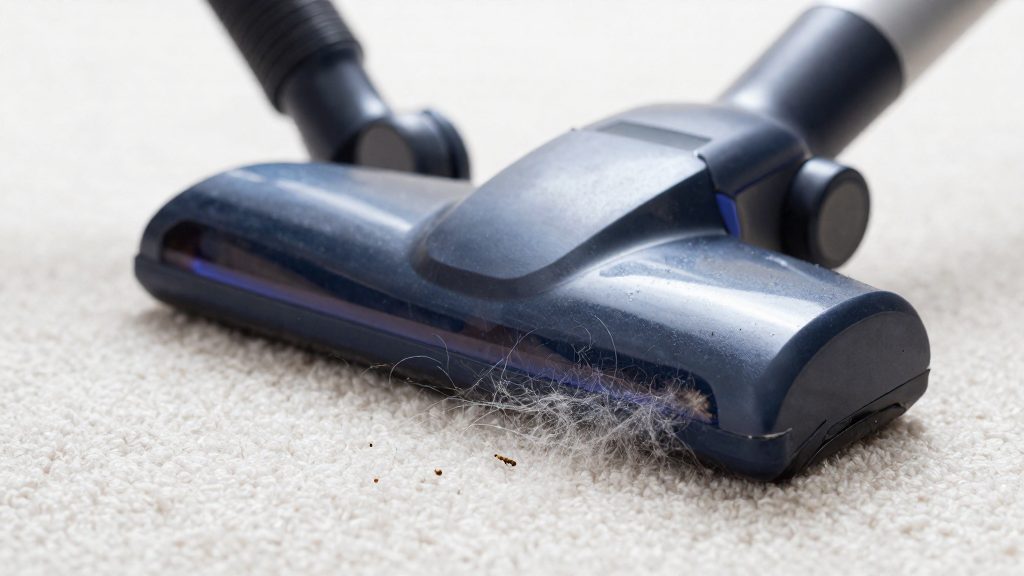
Vacuuming physically removes clothes moth larvae and debris from carpet fibres, so it is a first step rather than a complete treatment. According to eXtension (2017-03-01), thorough vacuuming of susceptible rugs and storage areas helps control clothes moths. Because the larvae are removed rather than poisoned, the result depends on how completely the floor is covered and how the collected debris is handled afterwards.
Vacuuming susceptible areas
- Work slowly over the whole carpet, making several passes over high-traffic zones.
- Concentrate on carpet edges.
- Use a crevice tool along skirting boards and around the legs of heavy furniture, where debris builds up.
- Vacuum storage areas, such as closets and cupboards, using the same method.
Emptying the vacuum bag or canister
- Empty the bag or canister outdoors, because larvae can survive for months, according to Consumers’ Checkbook (undated).
- Seal the debris in a plastic bag before placing it in the outdoor bin.
- Wiping the canister and brush head afterwards is a sensible extra precaution, though the sources do not mention it.
Beating, shaking and sunlight for rugs
- Take loose rugs and blankets outside, then beat or shake them to dislodge larvae and debris.
- Lay them in bright sunlight for several hours, as recommended by eXtension (2017-03-01).
- Vacuum the rug again once it is back indoors to remove anything dislodged during beating.
Can freezing kill clothes moth larvae in small items?
The sources give no guidance on steam or heat treatment of rugs. Freezing is the documented option for valuable small items, not for installed carpet. According to eXtension (2017), such items can be frozen for 7 to 14 days to kill clothes moths. The same source states that freezing is less destructive than heating, so heat is the harsher option when the condition of the item matters.
How to freeze a small item
- Choose a valuable small item that fits in a household freezer. Each item should be treated separately.
- Seal the item inside an airtight polyethylene bag before it goes into the freezer. Sealing first is part of the method itself, not an optional extra.
- Leave the sealed item in the freezer for 7 to 14 days.
- Keep the bag closed throughout, so the item stays in the sealed environment for the whole period.
Sealing before freezing limits ice and moisture buildup on the item. Because the guidance covers only small items, freezing is not a method for treating an entire rug. For a carpet, the steps described in the other sections of this guide apply instead.
Which insecticide sprays are safe for carpets?
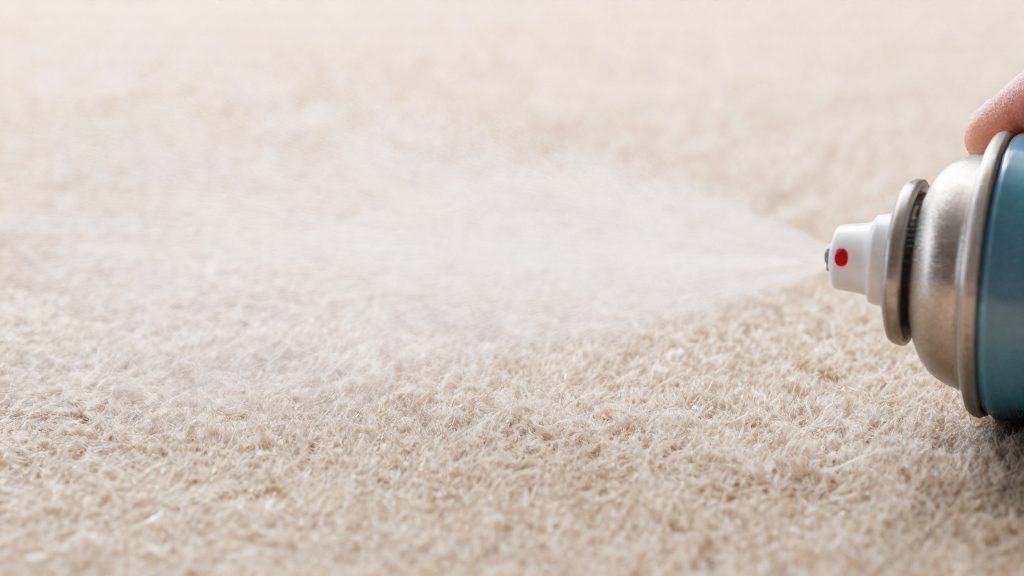
The practical choice for carpets is a residual spray, which is left on the surface to remain active rather than released into the air. According to eXtension Ask an Expert (2017), residual sprays can be applied along carpet edges and to the undersides of carpets or carpet pads. These are the spots where insects collect, so treating them concentrates the product where clothes moth larvae are most likely to be present. Check the product label for use on carpet before applying it.
How to apply residual spray
Work through the treatment areas in this order:
- Carpet edges: Spray along the perimeter where the carpet meets the floor or wall.
- Undersides of carpets: Lift the carpet at its edge and treat the backing.
- Carpet pads: Treat the pad beneath the carpet, using the same access point.
Why aerosol bug bombs are not used
Aerosol “bug bombs” are not very effective against clothes moths, according to eXtension Ask an Expert (2017). They fill the air of a room but do not reach the edges, undersides and pads where larvae hide. A residual spray applied directly to these zones is the more targeted option.
Do mothballs and pheromone traps work?
Mothballs can kill clothes moths and their larvae, but Consumers’ Checkbook advises against using them at all. Their vapors also harm people, pets and wildlife, and Consumers’ Checkbook advises against using them. Pheromone traps catch some adult moths but do not eliminate an infestation, so they cannot clear larvae already living in a carpet.
| Method | Stage affected | Documented effect | Main limitation |
|---|---|---|---|
| Mothballs | Adult moths and larvae | Release naphthalene and paradichlorobenzene vapors that kill moths and larvae | Vapors can harm people, pets and wildlife |
| Pheromone traps | Adult moths | Catch some adult moths | Do not eliminate an infestation |
Mothballs: effective against larvae, but hazardous
Naphthalene and paradichlorobenzene are the active chemicals in mothballs. Their vapors are the source of the killing effect, and they spread through the air rather than staying where the ball is placed. That same property is the problem: the vapors can affect anyone breathing them in the same room, and they can reach pets and wildlife. Consumers’ Checkbook advises against mothball use for this reason, according to its published guidance.
For carpets, this means mothballs cannot be treated as a safe, targeted tool. Any treatment that relies on vapor needs to be weighed against the people and animals sharing the home.
Pheromone traps: useful for monitoring, not control
Pheromone traps attract adult moths and hold them on a sticky surface. Because they target adults, they do not reach the larvae feeding in the carpet fibres. Consumers’ Checkbook presents them mainly as a monitoring tool: a trap that catches moths shows that adults are present.
Traps are most useful when placed alongside a direct treatment of the carpet, so that the adult catch confirms whether the problem is still active after treatment.
When should you call a professional?
Call a professional when a carpet infestation cannot be contained by home methods. Three situations justify it: the infestation spreads beyond one room, the affected rug is valuable or antique, or the infestation returns after a thorough do-it-yourself treatment.
Infestation spreading beyond one room
If clothes moth larvae or adults appear in several rooms or in adjacent storage areas, a treatment limited to one room is unlikely to succeed.
Valuable or antique rugs
For valuable wool or silk rugs, Consumers’ Checkbook advises having a professional apply a moth-killing treatment before washing. Checkbook gives no home method for these rugs, so professional treatment is the advised route. Freezing suits only small items and is not practical for a full rug, so a professional is the realistic route for high-value pieces.
Repeated infestation after DIY treatment
Larvae can survive for months, so a rug that looks clear after one round of vacuuming or other home treatment may still harbour a live population. If moths or larvae reappear after a thorough home treatment, the infestation is probably not fully removed. At that stage, a professional assessment is the logical next step, and it should be requested before the rug is discarded or repeatedly treated at home.
How to prevent moths from coming back
Preventing a return depends on removing the fibres and hair that larvae feed on and checking the same areas on a fixed schedule. Consistency matters more than intensity: a fixed schedule that is kept reliably will catch debris before it builds up.
Scheduled vacuuming of high-risk areas
Set the interval by how much the room is used and whether pets live there, and shorten it in busy or pet-occupied rooms. Prioritise these zones in each session:
- Carpet edges and corners
- Areas under beds, sofas and heavy furniture, which are moved least often
- Pet resting and feeding spots
- The undersides of rugs, which should be lifted periodically to vacuum the pad
Monitoring for early larval signs
Inspect the same zones during every vacuuming session rather than only during deep cleans. Look for live larvae, and for fibres that appear chewed or thinned, particularly along edges and under furniture. Record each finding with its exact location. If activity keeps appearing in one spot, the problem is concentrated there and the vacuuming frequency for that spot should rise.
Reducing lint and pet hair build-up
Pet hair and lint are the material that accumulates between full cleanings, so remove them as they appear. Spot-vacuum visible hair along edges after pets have been in a room, and keep rooms where pets sleep under a tighter routine than the rest of the house.
Where a residual spray is used along carpet edges and under carpets or carpet pads, let it dry completely before the area is walked on, as the same Ask an Expert guidance advises.
Frequently asked questions
Can freezing kill clothes moth larvae in a small item?
According to eXtension Ask an Expert (2017), valuable small items can be frozen for 7 to 14 days in sealed, airtight polyethylene bags to kill clothes moths. Freezing is less destructive than heating, but the bag must be sealed to limit the ice and moisture that would otherwise build up on the item.
Are mothballs a safe way to remove larvae from carpet?
Mothballs release naphthalene and paradichlorobenzene vapours that kill moths and larvae, but the same vapours can harm people, pets and wildlife. Consumers’ Checkbook advises against using them.
What should I do with a valuable wool or silk rug?
Consumers’ Checkbook advises having a professional apply a moth-killing treatment before the rug is washed. When you vacuum the rug, empty the bag or canister outdoors, because larvae can survive inside it for months.