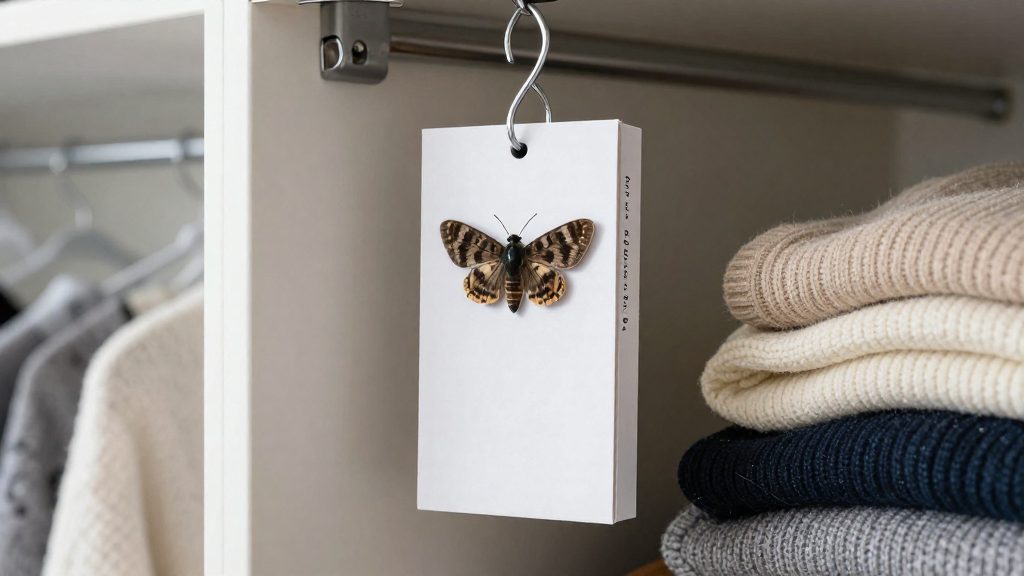
Pheromone-baited sticky traps catch far more adult clothes moths than unbaited ones.
Do clothes moth traps for closets actually work?
Pheromone versus unbaited capture
The ICUP (1996) comparison shows the gap between the two trap types. Sticky traps baited with a synthetic two-component pheromone lure caught about 20 times as many moths as similar sticky traps with no lure. The study tested webbing clothes moths, so the figure applies directly to that species.
Limits of unbaited sticky traps for detection
The same ICUP (1996) abstract states that unbaited sticky traps are not always very effective for detecting adults. A closet trap without a lure can therefore fail to catch moths that are present. Low or zero catches from an unbaited trap do not show that the area is free of adults.
What a catch indicates about infestation
A trap catch confirms that adult moths are present at that location. It does not show how widespread the infestation is. Several catches in one closet point to adult activity there, while a single catch in one trap says little about the rest of the room or the house.
The study cited below compared baited and unbaited sticky traps for webbing clothes moths (Tineola bisselliella), according to the International Conference on Urban Pests (1996).
| Trap type | Relative catch of webbing clothes moths | Detection of adults |
|---|---|---|
| Sticky trap with synthetic two-component pheromone lure | About 20 times as many moths as unbaited traps | Baited traps caught substantially more moths |
| Sticky trap without bait (baseline) | 1× (reference) | Not always very effective |
How pheromone clothes moth traps work
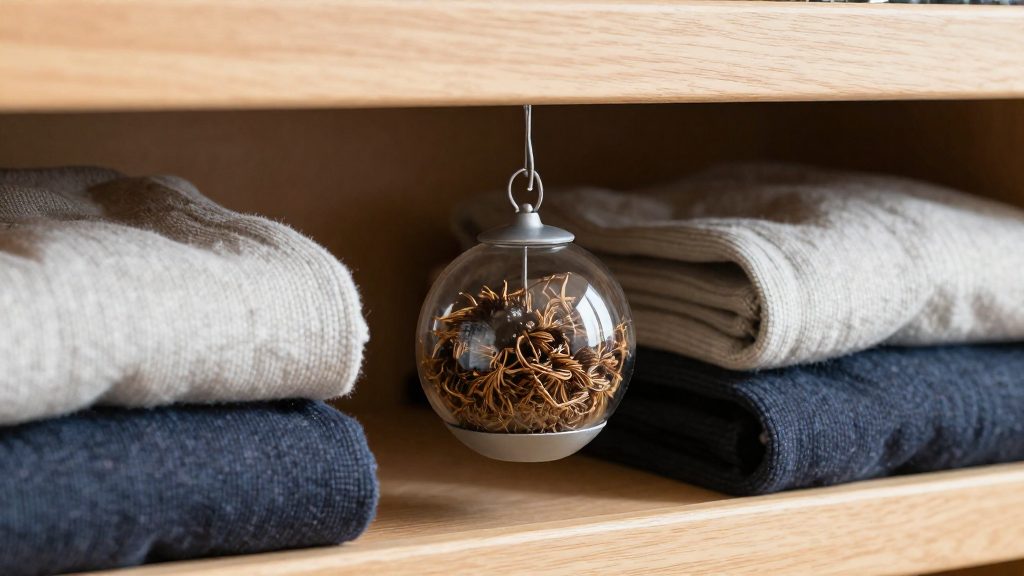
A pheromone clothes moth trap combines a chemical lure with a sticky surface. The lure is a synthetic two-component pheromone blend that imitates the chemical signal adult webbing clothes moths (Tineola bisselliella) use to locate one another. Because the blend is synthetic, it can be loaded into a lure and placed in a closet or drawer without any food or fabric bait.
The sticky board is the capture element. Moths drawn toward the lure land on an adhesive surface that holds them in place, so the trap records how many adults are present in the area. Since the trap catches adults, not larvae, it indicates adult moth activity.
The lure and the adhesive work together. A baited trap draws moths to the surface, while an unbaited sticky trap relies on chance encounters and catches far fewer adults. A trap with no lure is therefore a weak detection tool, and a baited trap is the appropriate choice for monitoring webbing clothes moths.
Keep the sticky surface in place while monitoring, and renew it only when it is full or dusty, as described below.
Where to place traps in a closet
Clothes moth traps only work when they sit in the path of adult moths.
Height and position relative to stored garments
Place the trap at the level of the stored fabrics, on a shelf or hung from a hook, rather than on the closet floor. Position it close enough to the garments that moths leaving them will pass over the sticky surface. Keep the adhesive face clear of fabric so that the trap stays open and visible.
Distance from walls, corners and dark recesses
Set traps in corners and along the back of the closet, where stored clothing is least disturbed. Avoid placing a trap in the middle of an open area, where it is more likely to be knocked or covered. Check the dark recesses under the lowest shelf and at the back of drawers, since these areas are easy to overlook during routine inspection.
Keeping traps clear of stacked clothing
Do not slide traps under or between stacks of folded garments. Stacked clothing covers the sticky surface and hides the trap from the moths it is meant to catch. Leave open space on the shelf around each trap, and move stacks aside when you check the trap so the full surface stays exposed.
How many traps do you need?
The ICUP source does not say how many traps a closet needs, so follow the product label. As a practical approach, you can think in terms of separate storage zones within a closet. A zone is any space that is physically cut off from the rest of the closet by a door, divider, drawer front or lid. Examples include a hanging section behind its own door, each drawer, a shelf stack separated by a partition, and a sealed box or garment bag. Each zone is counted once, and each receives one trap.
To count zones:
- Divide the wardrobe by its physical boundaries. Start with doors, vertical dividers and horizontal shelf partitions.
- Count every drawer and sealed container separately if it holds stored wool, silk, fur or other natural fibers.
- Add one trap for each zone identified in steps 1 and 2.
Large or multi-section wardrobes need more traps than a single-door closet of similar floor area, because each additional door or drawer bank creates another zone. For example, a wardrobe with three doors and a four-drawer unit contains seven zones under this method (three door sections plus four drawers), so it needs seven traps rather than one. Recount after any reorganization, since moving garments between compartments changes which zones hold stored textiles.
When a home has several closets, treat each closet as a separate unit and count its zones independently. Keep a monitoring log that records the trap count for each closet and the date each trap was checked. Comparing results across closets over time shows which spaces are active. A catch in a closet that holds no natural-fiber items shows adults are present there, so inspect that closet and neighbouring spaces as well.
How often should you replace the lure?
The replacement interval for a clothes moth pheromone lure is set by the manufacturer’s label, and that label is the reference to follow. The lure is the part that attracts adult webbing clothes moths (Tineola bisselliella) to the trap. A lure that has weakened reduces the trap’s ability to detect moths, even when the trap looks unchanged.
Lure effectiveness declines over time, so a trap can keep its appearance while attracting fewer moths. Check the trap against the following signs:
- The number of moths caught drops compared with earlier checks in the same location. This can mean a weaker lure or fewer moths, so rely on the label interval rather than catches alone.
- The date the lure was installed has passed the period printed on the label.
- The date the lure was installed is unclear or the label interval has been exceeded, in which case replace it regardless of catches.
Replacing the lure with the sticky surface
Once the sticky surface is covered with insects or debris, it no longer holds moths, and the trap should be renewed. How you renew it depends on the design:
- Separate lure and liner: replace the sticky liner and the lure together, so the new surface and the new attractant work at the same time.
- Lure built into the trap: replace the entire trap, since the lure cannot be changed on its own.
Replacing the lure on its labelled schedule, rather than waiting for catches to fall, keeps the trap working as intended.
Why am I still seeing moths with a trap in place?
A trap that still catches moths usually points to one of three causes: moths already developing in the room, adults arriving from elsewhere, or insects that are not clothes moths. Separating these causes matters, because a trap only catches adults that fly into it.
Moths from larvae and existing damage
Adults seen in a closet often hatched from larvae that were already there. Check stored garments, cuffs, collars and the back of drawers for holes, silky tubes or fine debris. If you find existing damage along with live larvae, silky tubes or fresh debris, the infestation is likely active.
Adults flying in from outside
Moths can enter a home from other rooms or from outside, so a catch in one closet does not prove that the closet is the only source. Use pheromone-baited traps in neighbouring spaces to find where adults are coming from.
Misidentified insects
Not every small flying insect near a closet is a clothes moth. Other small flying insects can be mistaken for them, and misidentified insects will keep a trap busy while the real problem goes unaddressed. Examine what the trap catches: clothes moths are small and have narrow, fringed wings, and they are usually found near fabrics rather than at windows or light sources. If the specimens show no link to textile damage, identify them before assuming the trap has failed. Keep a few specimens on the sticky card and compare them with a reliable identification guide or ask a pest control professional.
What to do after trapping: cleaning and prevention
Traps catch adult moths, but the larvae that damage fabric stay in the closet unless the textiles and surfaces are treated. Remove every garment and fabric item from the affected area, and check cuffs, collars, seams, and folds for silken tubes, larval casings, or chewed fibres.
Laundering or freezing before storage comes first. Wash washable items on the hottest setting the care label allows, and dry-clean items that cannot be washed. If you freeze items, follow a reliable extension-service guide for the temperature and duration. Treat every piece that was stored near the infestation, not only the damaged ones, before it goes back into the closet.
Vacuuming is the next step. Empty the closet completely, then vacuum shelves, corners, rail brackets, drawer runners, and the seams of shelf liners. Lint and hair collect in these spots and feed larvae, so pay particular attention to them. Seal the vacuum bag or empty the canister outside the home right away.
For storage, place clean garments in sealed containers, such as airtight plastic bins or vacuum-sealed bags. Keep the containers closed and inspect them regularly, since an opened container is an easy route back into storage.
Monitoring supports these steps. Keep baited traps in use after cleaning.
Frequently asked questions
Do pheromone clothes moth traps kill the moths or only catch them?
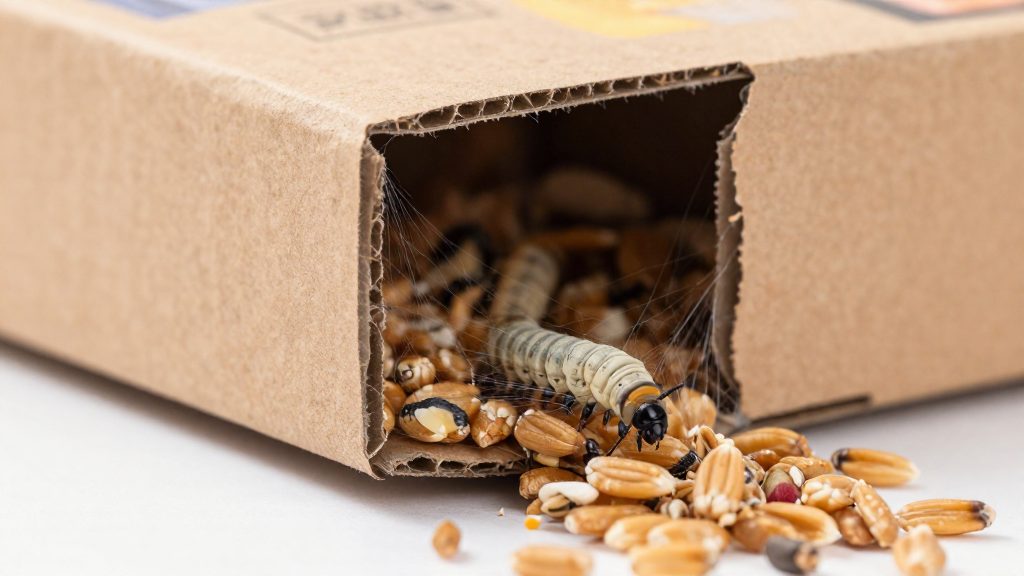
The traps in the ICUP (1996) study are sticky traps, so they hold adult moths on an adhesive surface. They target adult moths only. Clothes moth larvae, which feed on wool, silk and other keratin fabrics, are not captured, so a trap does not remove an existing larval population.
Does the 20-times catch figure apply to every clothes moth species?
Not automatically. The ICUP (1996) comparison tested only the webbing clothes moth (Tineola bisselliella), so the result applies to that species. Other clothes moth species were not part of that study.
How often should the lure be replaced and where should the trap go?
Lure replacement intervals and placement depend on the product, so follow the manufacturer’s label for both.