Which mosquito repellents are safe for toddlers?
Mosquito repellents for toddlers should be chosen by two checks: the active ingredient printed on the label, and the label itself. Four active ingredients appear in the reference data for children: DEET, picaridin, oil of lemon eucalyptus (OLE) and permethrin. Each has a different place in a toddler’s routine, so the label determines whether a product goes on skin or on clothing.
Read the label before every use
The EPA says to read the product label before each use of a repellent, not only at purchase. Check the active ingredient and the intended use on the label before applying anything to a child.
Filter by active ingredient
The EPA repellent search tool lets you filter products by active ingredient. Start from the ingredient rather than the brand name, then confirm that the product on the shelf matches the ingredient and use listed on its label.
| Active ingredient | Intended use in the reference data |
|---|---|
| DEET | Skin repellent |
| Picaridin | Skin repellent |
| Oil of lemon eucalyptus (OLE) | Skin repellent |
| Permethrin | Clothing and gear only |
Treat permethrin as a clothing product
Permethrin-treated clothing should be avoided for young children, who may chew on it.
Sorting checklist
- Identify the active ingredient on the label.
- Confirm the label allows skin use if you plan to apply it to the child.

DEET for toddlers: what concentration?
For toddlers, DEET is listed as safe from 2 months of age at concentrations between 10% and 30%, according to KidsHealth (Nemours, 2026). Within that range, the concentration determines how long protection lasts: higher DEET concentrations last longer. Choosing a strength is therefore a question of matching the product to the time your child will spend outdoors. A product at the top of the range suits longer exposure, while the lower end of the range is adequate for shorter periods.
The concentration does not change the rules on frequency. DEET should be applied no more than once a day, whatever its strength. A stronger product is not a reason to apply it more often, and a child’s exposure time does not change that daily limit.
When comparing products, check the percentage of the active ingredient on the label, not only the brand name or the product’s marketing claims. Make sure the label states the age range your child falls within, since the 2-month minimum applies only to the DEET range listed above.
Is picaridin okay for a toddler?
According to KidsHealth (Nemours, 2026), picaridin at 5% to 10% is listed as safe for children from 2 months of age. Products outside that concentration range, or used on infants younger than 2 months, fall outside the guidance cited here.
Concentration range
Picaridin products with an active ingredient between 5% and 10% fall within the listed range.
Minimum age
The listed minimum age is 2 months (KidsHealth (Nemours, 2026)). For a child under that age, no picaridin strength is listed as safe in this guidance, so other protection methods apply.
Why oil of lemon eucalyptus waits until age 3
Oil of lemon eucalyptus (OLE) is listed for children aged 3 and up, according to KidsHealth (Nemours, 2026). Parents should treat this as a minimum age, not a guideline: a product that lists OLE should not be used on a younger child.
The same restriction applies to PMD. According to the CDC (2026), products containing OLE or PMD must not be used on children under 3 years old. The rule depends on the ingredients a product contains, not on its name or marketing, so a product can fall under it even if its label does not say “oil of lemon eucalyptus.”
For every toddler, this check applies:
- Check the active ingredient list for OLE or PMD. If either appears and the child is under 3, choose a different product.
How to apply repellent on a toddler safely
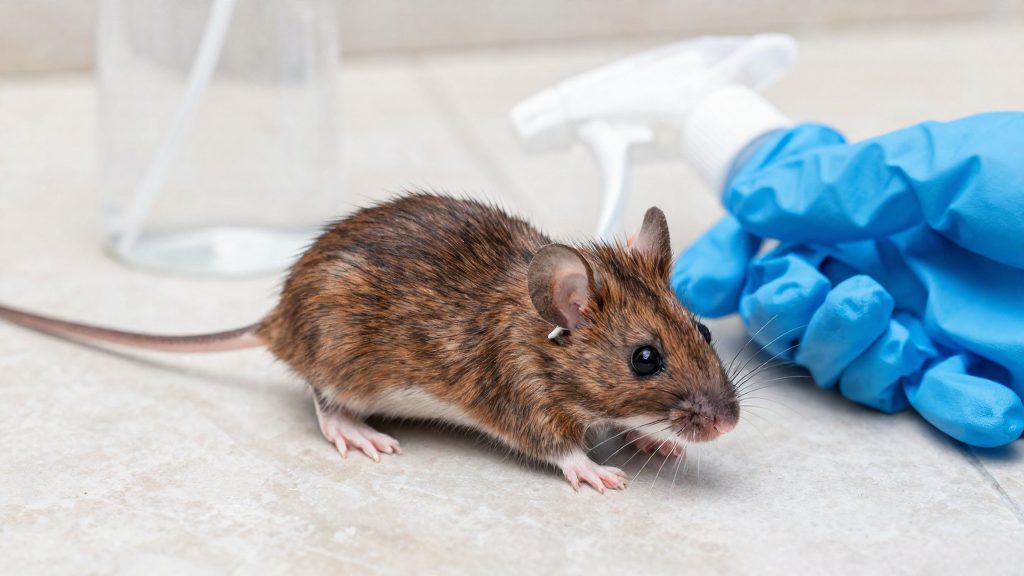
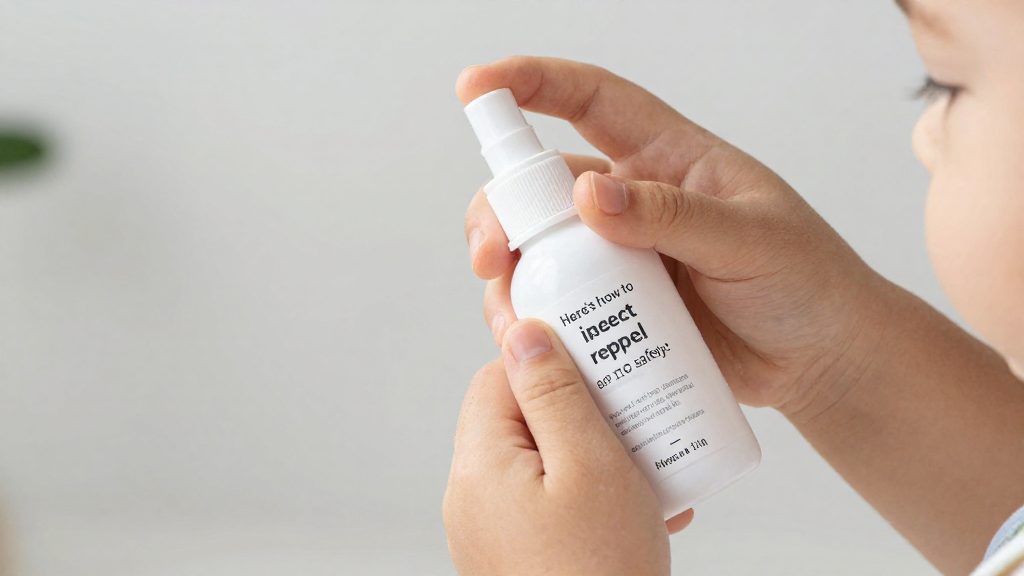
Repellent application for a toddler follows a fixed order, and the face needs the most care. According to KidsHealth (Nemours) (2026), the safer method for a child’s face is indirect: spray the repellent into your own hands first, then apply it to the child. This keeps spray away from the eyes and mouth, the areas a toddler is most likely to touch or rub.
Follow this sequence:
- Sunscreen first, repellent second. If you use sunscreen, apply it before the repellent, as stated by the CDC (2026).
- Keep the spray off the child’s hands. Apply the product to your palms, then rub it onto exposed skin. Do not let the child handle the spray bottle or touch the treated area before it dries.
- Avoid the mouth, eyes, and broken skin. Keep repellent away from the child’s mouth and eyes, and from cut or irritated skin.
- Never apply under clothing. Repellent goes only on exposed skin.
- Reapply only when needed. Reapply only if the child gets wet or sweats heavily, not on a fixed timer. DEET should be applied no more than once a day, so the once-a-day limit still applies even if the child gets wet or sweats. If DEET has already been applied that day, do not reapply it. Rely on clothing that covers arms and legs and on mosquito netting instead, and follow the label.
- Wash indoors. Once the child is back inside, wash the treated skin with soap and water, as KidsHealth (Nemours) (2026) advises.
Can you use permethrin around toddlers?
Permethrin is a treatment for clothing and gear only. It is never applied directly to skin, so it should not be sprayed on a toddler’s arms, legs, face, or hands. According to KidsHealth (Nemours) (2026), it is never applied directly to skin.
Because permethrin is used on fabric and equipment, the risk comes from contact. Treated clothing should be avoided for young children who may chew on it. Toddlers often mouth sleeves, collars, hoods, and straps, so a treated garment that a child can reach and chew is a direct route for exposure. Keep treated items away from toddlers, and do not let a child wear them or play with them.
The same caution applies to gear. Tents, backpacks, and other equipment treated with permethrin should be kept where a toddler cannot reach or mouth them.
To confirm whether a product contains permethrin, check the label for the active ingredient, then check the product’s listed uses. A product labeled for clothing or gear is not suitable for a toddler’s skin.
For skin protection, use a repellent labeled for skin application instead.
Non-chemical ways to prevent bites
Physical barriers protect a child without any product on the skin. According to the CDC (2026), the main non-chemical measures are clothing that covers the arms and legs and mosquito netting over strollers and baby carriers.
Clothing that covers arms and legs
Dress the child in long sleeves and long trousers rather than short sleeves, shorts, or skirts. Cover the feet with socks and closed shoes. Before going out, check that the sleeves reach the wrists and the trouser legs reach the ankles, and recheck after the child has been sitting or crawling, since cuffs and hems often ride up and leave skin exposed.
Choose clothing that fits well enough that it does not gape at the neck, collar, or cuffs. Loose gaps let insects reach the skin, so a snug but comfortable fit covers more of the body. Adjust the clothing whenever the child changes position or activity, such as moving from a seat to the floor.
Mosquito netting for strollers and baby carriers
Cover the strollers and baby carriers with mosquito netting whenever the child is outdoors in a space where mosquitoes are present. Drape the netting over the entire unit, not just the top, so that no part of the child’s seat or carrier is left open. Secure the lower edges so the netting cannot lift or hang loose where insects could get inside.
Check the netting before each outing and after any fall or rough handling, since a tear or loose edge reduces its protection. Keep the child inside the covered area for the whole time they are outdoors. Opening the netting to reach in or adjust the child leaves an entry point, so reseal the edges straight away.
Used together, long clothing and netted strollers give the child a physical barrier that works independently of any repellent.
What if a toddler swallows or gets repellent in the eyes?
If repellent gets into a child’s mouth or eyes, call Poison Control at 1-800-222-1222. The same number applies to both types of exposure. If the child has severe symptoms, such as trouble breathing, unresponsiveness or seizures, call 911 immediately. Have the product container within reach when you call, so you can read out the product name and the active ingredient on the label.
Because a call is the required first step, the practical work happens before any exposure. Keep every repellent out of children’s reach, including products stored in bags, stroller pockets, or on a bedside table, since a toddler can reach these more easily than adults expect. A high cabinet with a latch is a more reliable location than an open shelf.
Application method matters as much as storage: follow the steps in the application section above.
Reducing the amount of product needed also lowers the risk. Using physical barriers first means repellent is applied to less skin, which reduces the chance of contact with the mouth or eyes.
Source: KidsHealth (Nemours), 2026; CDC, 2026; U.S. EPA, 2026.
Frequently asked questions
Can I use oil of lemon eucalyptus on a toddler under 3?
No. Products containing oil of lemon eucalyptus (OLE) or PMD should not be used on children under 3 years old, according to CDC (2026). For a child under 3, choose a product whose active ingredient is DEET or picaridin, which are listed for children from 2 months of age.
Should sunscreen or repellent go on first?
Apply sunscreen first and repellent second, according to CDC (2026). Repellent should never be applied under clothing.
What if my toddler gets wet after I have already applied DEET that day?
Reapply repellent only if the child gets wet or sweats heavily, but the once-a-day limit for DEET still applies, according to KidsHealth (Nemours) (2026). If DEET has already been applied that day, do not reapply it. Rely instead on clothing that covers arms and legs, and on mosquito netting for strollers and carriers.