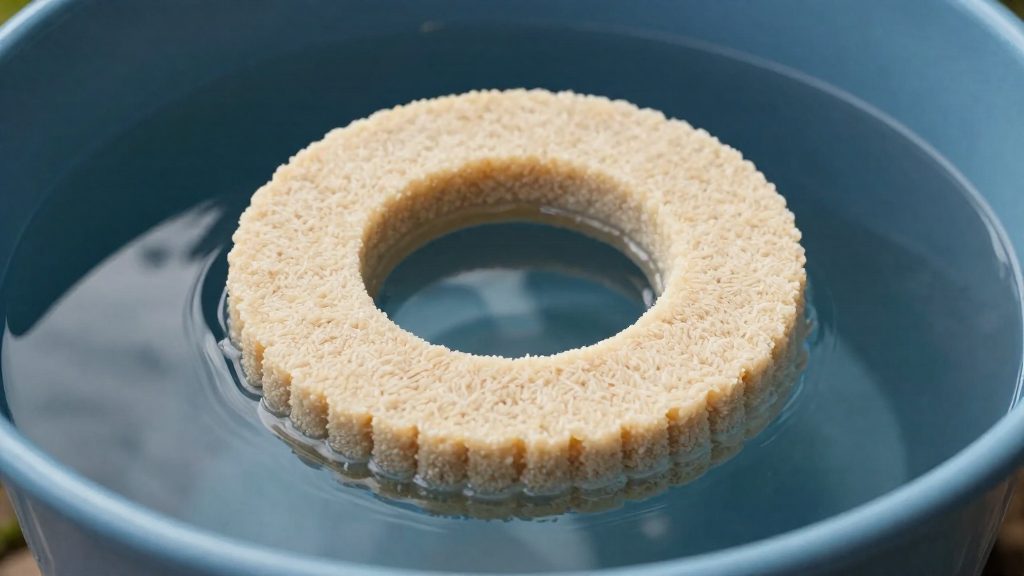
Mosquito Dunks can be used in a rain barrel when the stored water will not be used soon after a storm. Montgomery County, Maryland advises that if rain barrel water cannot be used within a week after a storm, you can add a larvicide such as Mosquito Dunks. The decision therefore depends on how long the water stays unused, not on whether the barrel is merely present. The county’s guidance treats the storm date as the starting point for this timing.
Do mosquito dunks work in rain barrels?
Acting on larvae in stored water
Mosquito Dunks are a larvicide, so they target mosquito larvae in standing water rather than adult mosquitoes. A rain barrel holds water for extended periods, which is the situation the county’s guidance addresses. The product is added to the water itself, so it only matters while the water remains in the barrel. Once the barrel is emptied or refilled, the water that was treated is gone.
When to add a larvicide
According to Montgomery County, Maryland government (2026), the trigger is the one-week window after a storm. Use this sequence:
- Record the date of the storm that filled the barrel.
- Plan to use or drain the water within seven days of that storm.
- If the water cannot be used in that window, add a larvicide such as Mosquito Dunks.
- Keep the barrel tightly closed and fit a debris screen, both of which the county also recommends.
The county also advises draining the barrel before winter, which removes stored water entirely for the cold season.
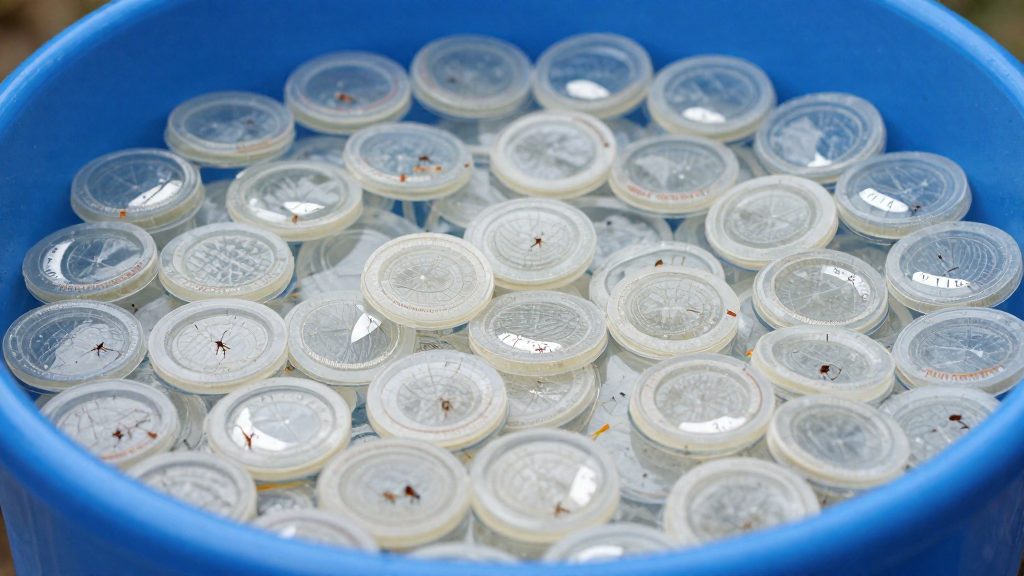
How Bti dunks kill mosquito larvae
Bti (Bacillus thuringiensis subsp. israelensis) is a soil bacterium whose toxic agent is a crystal protein it produces as it sporulates. The crystals act only after ingestion. When a larva swallows them, the alkaline conditions in its gut dissolve the crystals and activate the toxins, which damage the gut lining. The larva stops feeding and dies.
Because the toxin must be eaten, the effect depends on feeding. Mosquito larvae filter-feed on particles near the water surface and in the water column, so they take in the bacterial material released from the dunk as it breaks down in the water. Larvae that feed on it are affected; larvae that do not feed are not.
Pupae do not feed, so they are not killed by the toxin, and the larvicide has no effect on the winged stage. Adult mosquitoes are unaffected for the same reason: they do not ingest the water in the barrel. Adults feed on nectar, and females take blood, but neither requires drinking the water where the dunk sits.
Treatment therefore targets the larval stage only. Any larvae that hatch after the water has been changed or drained will need a new dose to be exposed to the toxin.
How many dunks does a rain barrel need?
The dunk count depends on the water surface area in the barrel, following the rate printed on the product label, not on the barrel’s rated capacity. Montgomery County, Maryland government (2026) advises adding a larvicide such as Mosquito Dunks when rain barrel water cannot be used within a week after a storm, so the dosing applies to water that stays in the barrel.
Calculate the count in four steps:
- Measure the water volume. Determine how many gallons are actually in the barrel. A barrel that is only partly filled needs a count based on its current level, not its full capacity.
- Read the label rate. Mosquito Dunks labels give a dosing rate based on the surface area of standing water, not its volume. Use the rate printed on the package you have, not a rate from memory or from another product.
- Multiply. Divide the water’s surface area (for a round barrel, π × radius × radius, measured at the current water level) by the surface area that one dunk covers according to the label. The result is the number of dunks. Follow the label’s instructions for partial units.
- Scale to other barrels. Apply the same formula to each barrel separately. A larger barrel holding more water needs more dunks, and a smaller one needs fewer. Barrels of different sizes are not dosed with a single common count.
Recalculate whenever the water level changes. Rain that adds water raises the count, and draining the barrel lowers it. Any dunk in the water should be placed as the label directs, and the barrel should stay tightly closed, as Montgomery County, Maryland government (2026) also recommends.
Is rain barrel water treated with dunks safe for gardens?
Whether treated rain barrel water suits garden use is set by the product label, so check its use and potable-water statements first. The county guidance cited here covers mosquito control, not the safety of treated water on plants, so rely on the label for that question. Timing and a closed lid are mosquito-control measures that apply in either case. Montgomery County, Maryland government (2026) advises that if rain barrel water cannot be used within a week after a storm, a larvicide such as Mosquito Dunks can be added. The same guidance sets the limit for how long the water stays in the barrel: use it or drain it within a week of a storm.
Limiting exposure to the barrel
Keeping the barrel closed is the most direct control over who can reach the water. Montgomery County (2026) recommends keeping the barrel tightly closed, which limits open access for children, pets and wildlife. Debris screens on the inlet keep leaves and other organic matter out, so the water stays cleaner and the lid stays on longer between openings.
- Fit the lid so it closes fully after every fill or pour.
- Place the barrel where small children and pets cannot easily climb onto it or tip it.
- Do not leave an open bucket or watering can of treated water standing outdoors.
Using treated water in the garden
Treated water should be used on a short schedule. Use the water within a week of a storm, or drain it, as Montgomery County (2026) advises. If water cannot be used within that window, the county advises adding a larvicide such as Mosquito Dunks, or draining the barrel. Mosquito Dunks are a larvicide added to standing water, so the practical rule is to apply them only when the water will not be used within the week.
Seasonal draining
Draining the barrel before winter prevents water from sitting in the barrel through the cold months, when it is less likely to be used. Montgomery County (2026) gives this as a standard step in its rain barrel guidance.
How often should you replace dunks?
Mosquito Dunks are a larvicide with a label-stated period of effectiveness, which is shortened if the water is refilled, diluted or drained. Montgomery County, Maryland government (2026) advises that if rain barrel water cannot be used within a week after a storm, a larvicide such as Mosquito Dunks can be added. Timing therefore follows each storm and the water that collects after it.
The label states how long a dunk stays active, so replace it on that schedule and also when you see it break down during routine checks:
- Inspection at each water check: Look at the dunk every time you open the barrel or check the water level.
- Visible breakdown: Replace the dunk once it no longer holds its original block shape, has crumbled, or has dissolved into the water.
- Storm periods: Check more often after storms, since each storm is when the county’s guidance applies and the water may be refilled and left standing.
- Reuse of old material: Do not keep adding fragments of a spent dunk. Remove remnants and start with an intact dunk.
Keep a simple log of the date you add each dunk and the dates you check it. A written record makes it easier to spot when a dunk breaks down faster than expected and to adjust your inspections accordingly.
Other ways to keep mosquitoes out of rain barrels
Physical barriers work without any chemical product. Montgomery County, Maryland government (2026) recommends three measures for rain barrels: a debris screen over the inlet, a tightly closed lid, and draining the barrel before winter.
Covering the inlet with a debris screen
Fit a screen or fine mesh over the opening where water enters from the downspout. Adult mosquitoes lay eggs on the water surface, so a cover over the inlet keeps them from reaching it. The same screen catches leaves and other debris before they fall into the water.
To keep the screen effective:
- Measure the inlet before buying mesh, so it covers the whole opening with no gap at the edges.
- Secure it with clamps, cable ties, or tape so heavy rain cannot shift it.
- Clear debris from the screen regularly, since a clogged screen slows the flow and can lift off under pressure.
Sealing the lid
Keep the lid closed whenever the barrel holds water, not only when it is full. Check the seam between the lid and the barrel for cracks or gaps, and replace a lid that no longer sits flush. Any overflow outlet should also be covered with mesh, because it is an easy point of entry.
Draining before winter and after storms
Empty the barrel before freezing weather arrives. Disconnect the downspout, open the spigot, and leave the barrel upside down or with the lid off so no water collects in the bottom. Montgomery County also advises using or draining collected water within a week of a storm, which limits the time standing water remains available to mosquitoes.
Mosquito Dunks or draining: which to choose
Montgomery County, Maryland (2026) names Mosquito Dunks as the larvicide to add to rain barrel water when it cannot be used within a week after a storm. The decision therefore depends on timing: how soon the stored water will actually be used. The product is one option within a sequence that starts with using or draining the water, not a replacement for it.
Deciding whether to add a larvicide
| Situation | Action |
|---|---|
| Stored water will be used within one week after a storm | No larvicide is needed under this guidance |
| Stored water cannot be used within one week after a storm | Add a larvicide such as Mosquito Dunks |
To apply the rule:
- Record the date of each storm that fills the barrel.
- Count seven days from that date.
- Use the water for watering or other household needs before day seven. If you cannot, add the larvicide.
- Keep the lid closed after treatment, so the water stays covered between uses.
Mosquito Dunks are the only larvicide this guidance names, so the choice in this section is between treating the water and emptying it. Using or draining the water within the same one-week window removes the need for any product. The county advises adding a larvicide when the water cannot be used in that time. Treatment is for the cases where the water must stay in the barrel longer than that window.
Check the label before you use them
Before you put Mosquito Dunks in a rain barrel, read the label on the package itself. The label sets the conditions of use, and it is the reference to check against any general advice. Montgomery County, Maryland government (2026) recommends adding a larvicide such as Mosquito Dunks when rain barrel water cannot be used within a week after a storm, so the label and the timing of your barrel use should be checked together.
Three parts of the label deserve a close read:
- EPA registration number: Find the registration number printed on the package and record it with your barrel notes. It identifies the product as registered with the U.S. Environmental Protection Agency.
- Potable water statements: Read any wording about drinking water. If the label restricts use in water intended for drinking, do not place the product in a barrel whose water is used that way.
- Storage and disposal instructions: Follow the storage conditions printed on the package. Dispose of unused product and empty packaging as the label directs, not with household waste by default.
Compare the label with the barrel’s use before each treatment. Confirm that the water is destined for garden irrigation rather than drinking, and confirm that the product is still within the storage conditions printed on the package.
Frequently asked questions
Can I put Mosquito Dunks in a rain barrel?
Yes, if the stored water cannot be used within a week after a storm. Montgomery County, Maryland government (2026) lists a larvicide such as Mosquito Dunks as an option for that situation, and the product only works while the treated water stays in the barrel.
How many Mosquito Dunks does my barrel need?
Count by surface area, not by gallons, because the label rate applies to the area of the water’s surface. Divide the surface area of the water at its current level (for a round barrel, pi × radius × radius) by the area one dunk covers according to the label, then follow the label’s instructions for partial units.
Can I use water treated with Mosquito Dunks on my garden?
Check the product label first, because its use and potable-water statements decide whether treated water can go on plants. The county guidance covers mosquito control, so treat its lid and timing advice as mosquito measures rather than as a garden-safety guide.