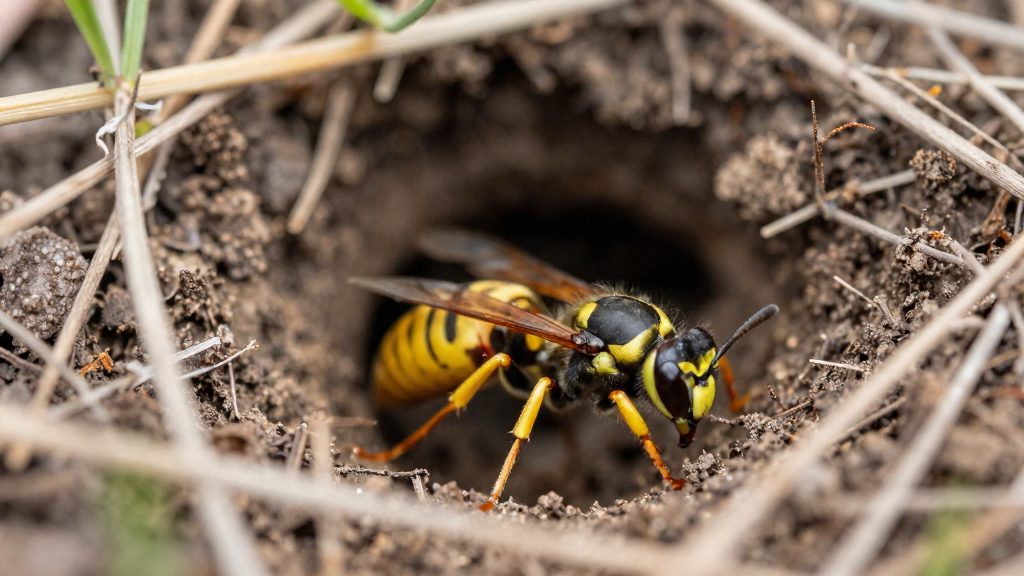
Yellow jacket nests in the ground can be dangerous, and the risk depends mostly on where the nest sits and how often people pass near it. Eastern yellowjackets nest in forest floors, rock walls, creek banks and lawns. A nest in a busy outdoor space carries far more exposure than one in an area people rarely enter.
Are yellow jacket nests in the ground dangerous?
How nest location sets the risk
The location of the nest determines how likely people are to meet it:
| Location | Risk assessment |
|---|---|
| Mowed lawn | Not suitable to leave alone |
| Near a building entrance | Not suitable to leave alone |
| Where people regularly gather or walk | Not suitable to leave alone |
| Inside a wall | Never plug the opening |
| Creek bank, forest floor or rock wall, away from people | Lower risk |
A nest in a lawn is the most exposed case, since mowing brings people into direct contact with the entrance.
Defensiveness when the entrance is disturbed
Activity at the entrance is what puts people in contact with a colony. Foot traffic, mowing and digging near the opening all raise the chance of stings. Yellowjackets can spray venom at the eyes, which means exposure to the face is a risk even without a sting.
Repeated stings near occupied outdoor areas
A nest close to a patio, play area or regular walking route produces repeated exposure, because the same people cross the nest location day after day. A nest in a high-traffic area or near children calls for the most caution of any location. Each repeated disturbance at a known nest keeps the colony active near those people, which is why the frequency of use of an outdoor space matters as much as the nest’s position.
How to identify an in-ground yellow jacket nest
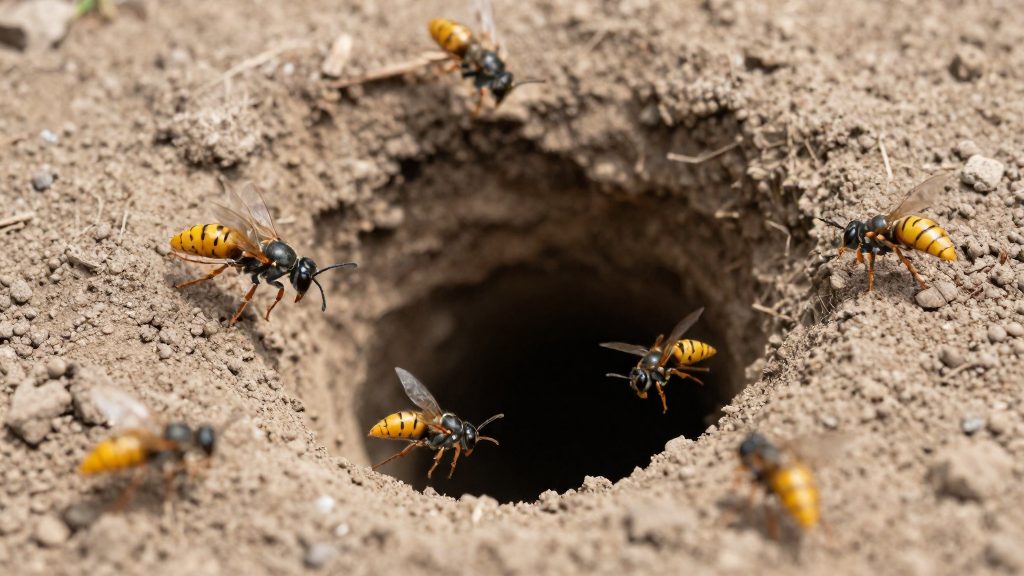
Confirm a ground nest by watching the insects before you treat anything. A steady stream of yellowjackets entering and leaving one small opening in the soil is the clearest sign of an active colony. Wasps scattered over a lawn or bare ground without a clear focal point are usually foraging, not flying to a nest beneath them.
Entrance activity should be checked during the day, when the colony is flying. Note whether traffic is concentrated at a single hole or spread across several openings. Observe for a sustained period, because a single hole with constant traffic is far more reliable than a brief sighting.
Daytime scouting is the next step. Stand 10 to 15 feet away from the opening, which is the distance the Penn State Extension recommends for watching the colony, and keep still. Watch where workers approach from and where they depart to. This avoids disturbing the colony while you collect the information needed for the flight path.
Tracing the flight path shows you where the nest sits. Follow the direction workers take as they leave the opening and note where they land or turn. Mark the line with a stake or flag so you can see it from several angles. The entrance may be several feet from the nest itself, so the flight path is what tells you where to direct the treatment.
| Observation | What it indicates |
|---|---|
| Steady traffic at one soil opening | Active nest entrance |
| Wasps scattered over open ground, no fixed hole | Foraging, not a confirmed nest |
| Flight path leading away from the opening | Direction of the nest body |
When should you leave a ground nest alone?
A ground nest found in late summer or fall often needs no treatment. Penn State Extension notes that these nests die off on their own soon after they are found. The timing follows the colony’s life cycle: new queens and males appear in August–September. Only fertilized queens overwinter, so the colony’s activity fades as the season ends. Checking the date is the first step. A nest discovered in late summer or fall is a candidate for waiting, while one discovered in spring or early summer, when the colony is still growing, is not.
Remote nests are the second case where leaving the colony alone makes sense. According to Penn State Extension, a ground nest can be left in place if it meets all of these conditions:
- It is not near a building entrance.
- It is not in a mowed lawn.
- People will not meet it in their normal use of the yard.
In practice, this means a nest in a wooded edge, a rock wall or a creek bank, well away from walkways, play areas, garden beds and any spot where a dog or cat roams. Yellowjackets are beneficial insects, so an isolated colony that poses no contact risk has little reason to be disturbed. If any condition fails, the nest moves into the treatment category, because a nest that is close to people or in a mowed area is much more likely to produce stings.
Best time of day and season to treat a ground nest
Treatment timing depends on two factors: the size of the colony and the daily activity of the workers.
Early season, while the colony is small
Overwintered queens start new nests in May or early June, which means a nest found in late spring is at the start of its growth. A young colony has fewer workers guarding the entrance than a mature one, so the early weeks of the season offer the lowest-risk window for treatment. Waiting through the summer lets the colony grow, and a larger nest is more dangerous to approach.
Night treatment, when activity is lowest
Daily timing matters as much as the season. Dust should be applied at night, when yellowjackets are less active. Use a red light or red filter so the insects can see you less easily, and be ready to walk calmly away if they fly at you.
Timing summary
| Factor | Timing to aim for |
|---|---|
| Season | Early season |
| Time of day | Night |
How do you remove a ground nest step by step?
Treatment works by getting product into the entrance opening, because the insects carry it back into the colony. Dust is the main method for a yellowjacket ground nest, according to Penn State Extension, with foam or a liquid drench as alternatives. The steps below apply to dust, with the drench variant noted where it differs.
-
Time the application for night. Work after dark.
-
Dust the opening generously. Apply a generous amount of dust directly into the nest entrance, not just onto the soil outside it. Work the dust into the opening so that the insects that enter pick it up.
-
Switch to a drench if dust is not suitable. Pour the liquid down the entrance and over the surrounding soil. Foam is a further alternative when a drench is impractical.
-
Withdraw calmly. Yellowjackets may fly at you during the work. Do not swat. Walk calmly away from the nest, which is the lower-risk response and the one to rehearse before you start.
-
Leave the nest to act. Do not reopen the entrance to check results during the same night. Return only after the insects have had time to be exposed to the product.
What gear do you need?
Yellowjackets defend the nest entrance, so the protective gear should leave no skin exposed and protect the face and eyes. Penn State Extension recommends long sleeves and long pants, closed shoes, chemical-resistant gloves, eye protection and a respirator when using dust.
- Clothing: Wear long sleeves, long pants and closed shoes so that no skin is bare from wrist to ankle.
- Gloves: Use chemical-resistant gloves with taped cuffs, sealing the glove to the sleeve so there is no gap at the wrist.
- Eyes: Wear eye protection at all times near the nest. Yellowjackets can spray venom at the eyes, so goggles or safety glasses are the minimum.
- Breathing: Put on a respirator whenever you apply dust into the opening. Dust is the main treatment method for ground nests, so the respirator is needed for most of the work.
- Lighting: A red light or a red light filter over your flashlight makes you harder for the insects to see. Use a red filter rather than a white beam when you approach the entrance.
Lay out all the gear before you approach the nest. Once insects are flying, adjusting a glove cuff or looking for a respirator strap leaves you exposed for longer than necessary. Check that each item fits before you start, because a loose glove or a respirator with a gap at the face defeats the purpose of the protection.
Methods to avoid: fire, gasoline and plugging
Three common shortcuts make treating a yellowjacket ground nest more dangerous. The accepted approaches are dust applied into the entrance, foam, or a liquid drench poured down the entrance and over the surrounding soil.
| Method | Hazard |
|---|---|
| Fire on the nest | Much more dangerous than the other methods |
| Gasoline poured into the nest | Not among the recommended treatments for a ground nest |
| Plugging the opening of a wall nest | Yellowjackets may chew through the sheetrock into the home |
Fire is the most serious of these mistakes. It is described as much more dangerous than dust, foam or a drench, so a ground nest should be treated with one of those products instead.
Gasoline is not a recommended treatment, and the approved options above make it unnecessary.
Plugging is the hazard that most often affects a home. Wall and attic nests should be handled by professionals, who can treat the colony without relying on an opening that the insects can enlarge.
When to call a pest professional
Professional removal is the safer option in three situations, and Penn State Extension names each of them as a reason to hire help for a ground nest of eastern yellowjackets. Treating a nest without these conditions is still possible, but these conditions change the risk enough to justify paying someone else to do the work.
The first is allergy to stings. Anyone with a known allergy to yellowjacket stings should not treat the nest personally, because treatment requires working at the entrance of an active colony. The allergy matters more than the size of the nest or how easy the treatment looks.
The second is a nest in a high-traffic area, such as a path, a patio, a play area or a lawn that is used every day. A nest in a spot where people pass repeatedly is more likely to be disturbed by accident, and treating it means keeping that area closed off while the work is done.
The third is a nest near children. Children cannot be relied on to keep away from the entrance during and after treatment, so a nest within their reach is a reason to call a professional even if no one in the household has an allergy.
Cost is the practical factor. Professional removal typically costs over $100, according to Penn State Extension. That figure should be weighed against the cost of protective equipment and dust for a do-it-yourself treatment, and against the value of avoiding stings. For a nest that meets none of the three conditions above, the expense may not be justified. For a nest that meets any of them, it usually is.
Frequently asked questions
Can I remove a ground yellow jacket nest myself?
You can dust a small, early-season nest that is away from people, applying a generous amount of insecticidal dust directly into the opening at night. Hire a professional instead if you are allergic to stings, or if the nest is in a high-traffic area or near children.
When is the best time to treat a ground nest?
Treat the nest early in the season, while the colony is still small. Nests found in late summer or fall often die off on their own, so they may not need treatment. Scout the flight path by day from 10–15 feet away before you act.
What protective gear do I need, and what should I avoid?
Wear long sleeves, long pants, closed shoes, chemical-resistant gloves with taped cuffs, eye protection, and a respirator when dusting. Never use fire on a nest, and if you are attacked, walk calmly away without swatting.