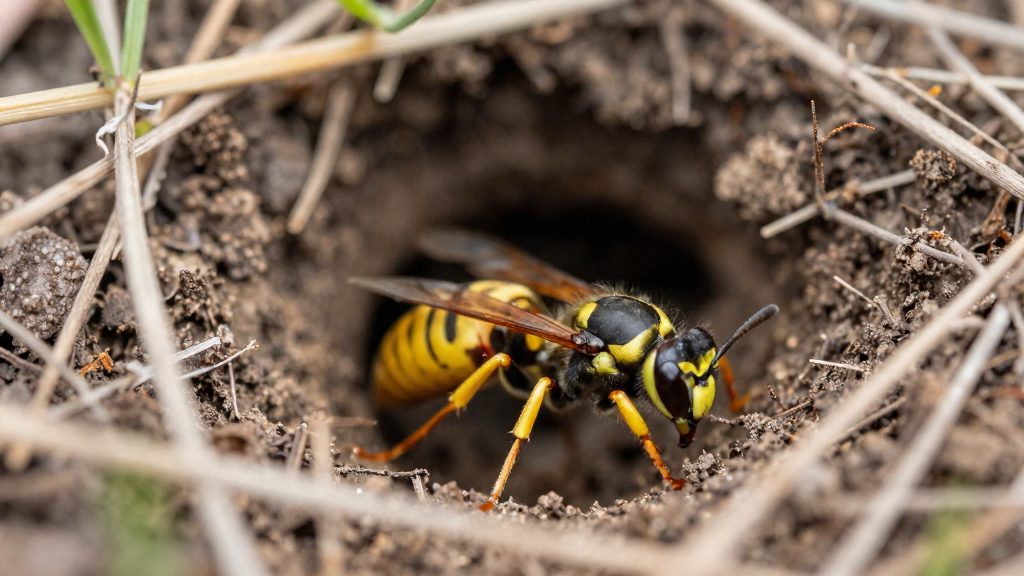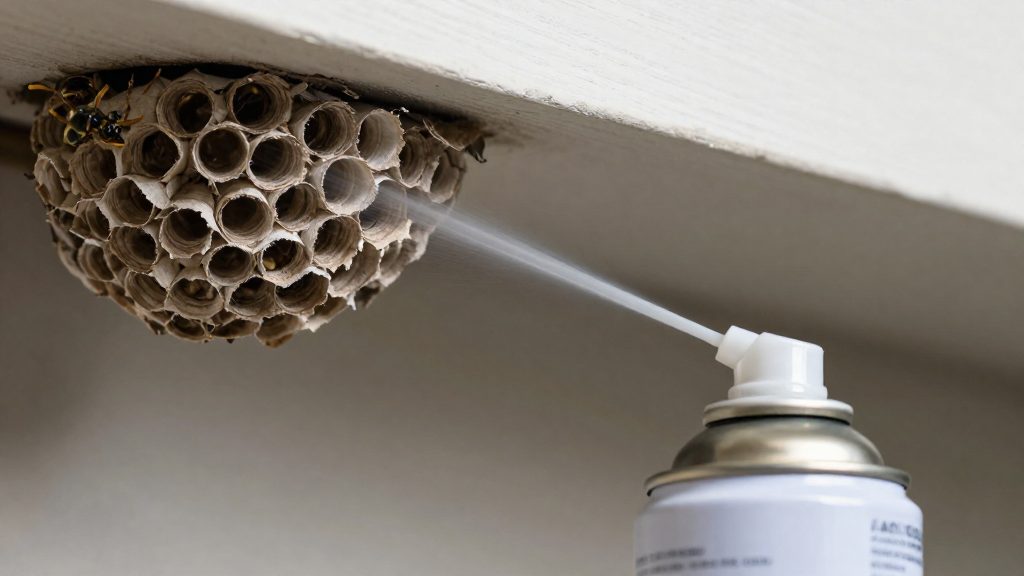
Most quality wasp and hornet sprays have an effective range of about 15 to 20 feet. That is the distance at which the stream stays dense enough to saturate a nest, and it is shorter than the farthest distance droplets can travel. For treating a nest, the effective range is the figure that matters. According to EngineerFix (2026), the band describes where the spray still does its job, not the limit of its throw.
How far does wasp spray reach?
Effective range
Within the 15-to-20-foot band, the stream delivers the coverage a treatment needs. Stand within this band when you spray a nest, and do not treat the distance as a fixed guarantee for every product or condition.
Why droplets travel farther
Droplets can fly beyond the effective range, but at those distances the stream no longer delivers a saturating dose. A visible spray cloud at the far edge of its throw does not mean the nest has been fully covered. Judge coverage by the density of the stream at the target, not by how far the mist reaches.
Applying the range
- Measure the distance to the nest before spraying, and keep the nozzle within about 15 to 20 feet of the entrance.
- Aim at the nest entrance, not at the surrounding wall or branches.
Advertised range vs. real-world distance
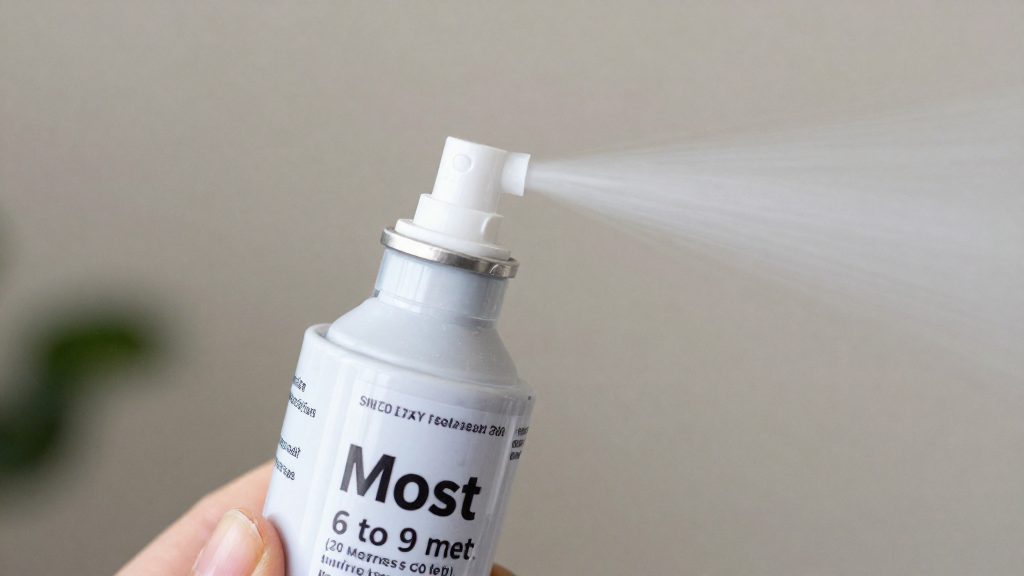
The label maximum is the longest distance a manufacturer quotes for a spray. Bob Vila (2026) lists advertised maximums of up to 22 feet for Raid Wasp & Hornet Killer, up to 27 feet for Spectracide and Hot Shot, and up to 20 feet for Ortho Home Defense foam. EngineerFix (2026) places the effective range of most quality wasp and hornet sprays at about 15 to 20 feet.
Set against that benchmark, the label maximums exceed the effective range by different amounts, except Ortho foam, which matches the upper limit:
| Product | Advertised maximum | Excess over the 20 ft benchmark |
|---|---|---|
| Raid Wasp & Hornet Killer | Up to 22 ft | 2 ft |
| Spectracide | Up to 27 ft | 7 ft |
| Hot Shot | Up to 27 ft | 7 ft |
| Ortho Home Defense foam | Up to 20 ft | 0 ft |
Spectracide and Hot Shot carry the largest gap. Their 27-foot maximum sits 7 feet beyond the top of the benchmark and 12 feet beyond its bottom, so a nest at that distance falls outside the 15-to-20-foot effective range. The Raid product exceeds the upper benchmark by 2 feet, and the Ortho foam label matches it exactly. Because the 15 to 20 foot figure is a general benchmark rather than a test result for each product, these gaps indicate relative headroom, not guaranteed performance.
What shortens the spray stream?
Two conditions reduce how far a wasp spray reaches: low can pressure and crosswind. Both shorten the distance at which the stream still carries enough product to saturate a nest entrance. When a stream falls well short of its expected distance, one of these two causes is usually responsible.
Low can pressure from age or repeated use
The propellant pushes liquid out of the nozzle, so the stream’s reach depends on the pressure inside the can. According to EngineerFix (2026), low can pressure from age or repeated use shortens the reach. A can that has been used many times can still spray, but with a weaker stream that stops short of its target.
To check a can before approaching a nest, test-spray it in an open area away from the nest. If the stream falls short of the distance you need, or sputters, replace the can instead of moving closer to the nest.
Crosswinds
Wind is the second factor. Crosswinds can cut the effective range sharply (EngineerFix, 2026). A breeze can push the stream off target well before the can’s rated distance is reached.
Before spraying, check the air at the nest. If the breeze crosses the line between you and the entrance, wait for calmer air. Bob Vila (2026) advises spraying at dusk or early morning, when most wasps are in the nest, but check the wind at the nest whatever the time of day.
Foam or jet spray: which reaches farther?
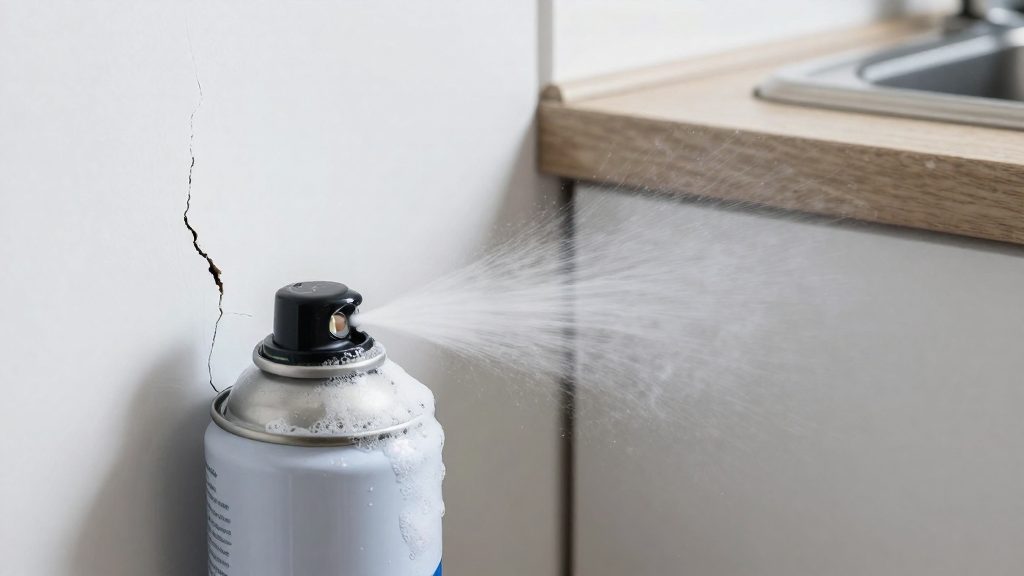
Tight liquid streams reach farther than foams. According to EngineerFix (2026), foams expand as they leave the nozzle, which shortens their distance but gives better coverage of the nest. A tight stream keeps its volume together, so it travels farther before breaking up.
The two sprays trade distance for coverage:
| Property | Tight liquid stream | Expanding foam |
|---|---|---|
| Reach | Farther | Shorter, because it expands on exit |
| Nest coverage | Narrower patch | Wider, spreads across the nest surface |
For the nest itself, foam is the better choice when it is within reach. Bob Vila (2026) advises soaking the whole nest, and foam’s expansion helps cover the entrance and the surrounding surfaces in one pass. A stream lands in a smaller area, so it suits a nest that is farther away or hard to reach, but it requires more careful aim to treat the full structure.
In practice, choose the spray by the situation:
- Stream: the nest is out of comfortable foam range and you can accept a smaller target area.
- Foam: the nest is close enough to reach and you want to cover the whole structure.
How far should you stand from a nest?
Your position relative to the nest matters as much as how far away you stand. Three positioning rules apply before you spray.
Never stand directly beneath the nest. According to Bob Vila (2026), this is the position to avoid when spraying. EngineerFix (2026) notes that insects may swarm briefly after contact, so the ground directly below the nest is where you would be most exposed to that short burst of activity. Stand to one side, with the nest in front of you and the entrance in view.
Stay upwind where possible. EngineerFix (2026) recommends staying upwind of the nest whenever you can. Standing on the side the breeze comes from means the air carries the spray and any disturbed wasps away from your face and body. To check wind direction, watch how a light object, such as a leaf or a strand of grass, moves before you take position.
Plan an exit route before spraying. Choose a path that leads away from the nest and confirm it is clear before you begin. Remove or step around obstacles such as garden furniture, hoses, ladders, or low branches, because you need to be able to leave at once without stopping to clear the way. Walk the route once with the spray can in hand. After treatment, move straight along that path rather than turning back toward the nest.
Safe steps for spraying a wasp nest
Put on gloves, glasses and a mask before you approach the nest, then follow this routine: timing, aiming, then the wait before removal.
- Choose the timing. Spray at dusk or early morning, when most wasps are inside the nest. Bob Vila (2026) gives this window as the best time to treat a nest.
- Aim at the entrance, then soak the nest. Start the stream at the nest entrance and keep spraying until the whole nest is wet, not just the opening. Use foam when the nest is within reach, or a tight stream when it is farther away, as described above.
- Keep your protective gear on throughout. Gloves, glasses and a mask, put on before you approached the nest, stay on until treatment is finished. Bob Vila (2026) recommends these items for this task.
- Wait about 24 hours before removal. Do not take down or handle the nest until roughly a day has passed after treatment, as Bob Vila (2026) advises.
When should you call a professional?
Some wasp nests should not be treated with a spray can. The deciding factors are where the nest is, who is exposed to stings, and whether the nest can be reached from a stable position.
Nests inside wall voids, attics or ceilings
A spray can only treat what it can reach. When a nest is built in wall voids, under a roof or above a ceiling, usually only the entrance is visible. Spray directed at that opening may not reach the nest itself, and wasps that survive can move into living spaces through gaps in the structure. A pest control professional can locate the nest and choose a treatment suited to enclosed spaces.
Known severe allergy or multiple prior stings
Anyone with a severe allergy to wasp venom, or a history of several stings, should not approach a nest, even to spray it. Allergic reactions can develop quickly after a single sting. Hire a professional and keep any prescribed emergency medication within reach while the nest is being dealt with. If anyone develops trouble breathing, swelling of the face or throat, dizziness or widespread hives after a sting, use prescribed epinephrine if available and call 911 immediately.
Nests too high to reach from a safe position
A nest that can only be sprayed from a ladder requires holding the can at arm’s length while balancing, which makes a quick retreat difficult if wasps swarm. Crosswinds can also push the spray off target at height, so the stream may miss the nest entirely. If you cannot maintain a stable position with clear footing and a free escape route, the nest should be handled by a professional with appropriate access equipment.
Frequently asked questions
How far should I stand from a wasp nest when spraying?
Stay within the effective range of about 15 to 20 feet from the entrance. Beyond that, the stream may not saturate the nest, even though the label maximums are higher, such as up to 27 feet for Spectracide and Hot Shot according to Bob Vila (2026).
Does foam reach as far as a liquid stream?
No. According to EngineerFix (2026), a tight stream reaches farther because foam expands on exit and gives up distance for better coverage. Beyond the effective range, even a stream may not saturate the nest.
Can wind or an old can shorten the spray’s reach?
Yes. EngineerFix (2026) notes that crosswinds can cut effective range sharply, and low can pressure from age or repeated use also shortens the reach. Check the wind at the nest before spraying, whatever the time of day.