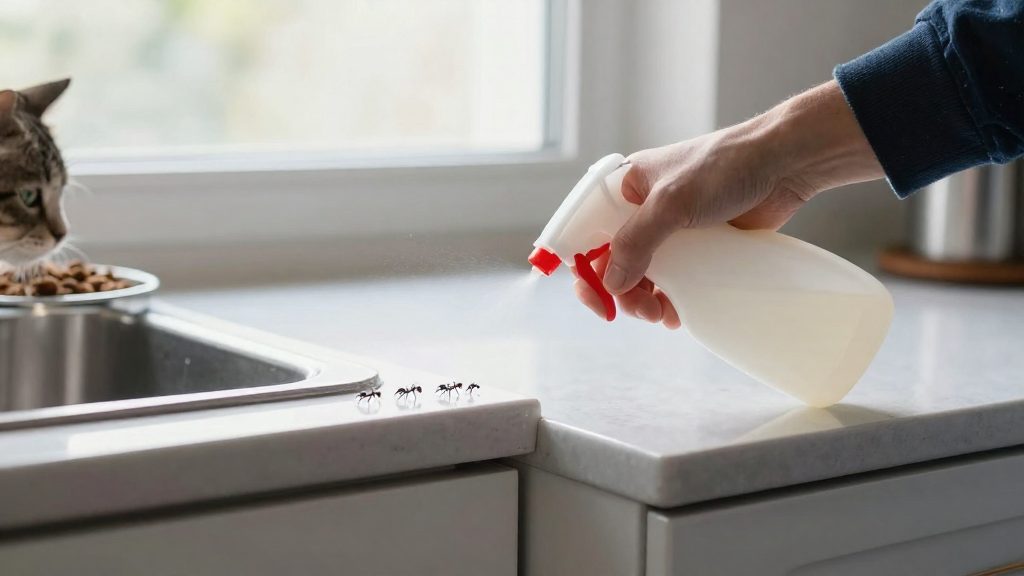
What Does Pet Safe Really Mean?
Pet safe is a conditional claim. It describes how a product performs when used as its label directs, not in every situation. The table below shows the wording and limits on two sprays.
| Product | Claim on pack | Conditions the manufacturer attaches |
|---|---|---|
| Raid Essentials Ant, Spider & Roach Killer 30 (SC Johnson) | Safe around people and pets | Only when used as directed |
| Zevo Multi-Insect Killer (Zevo) | Safe around people and pets | Only when used as directed; spray away from pets; avoid use near birds, fish, and exotic pets; do not spray pet beds, toys, cages, or bowls |
The claim does not cover every pet species or every exposure condition. Zevo’s species-specific limits show that a general “pet safe” statement can sit alongside restrictions for particular animals.
Which document governs use
The product label governs use. Front-panel wording is marketing, and the directions and precautions on the label set the rules.
Choosing an Ant Spray for Your Kitchen
Check that the label names kitchen cabinets as an application site. According to Mississippi State University Extension Service (2026), a kitchen insecticide must be labeled for the specific application site, and permission for indoor use alone does not establish suitability for kitchen cabinets. Read the application-site section of the label rather than relying on the front-panel claim.
Some labels also restrict surfaces where food is kept. Cabinets that hold food may therefore fall outside the approved use for that product. Before spraying any kitchen surface, remove or cover food and keep spray droplets and mist away from utensils and food preparation surfaces, as recommended by Mississippi State University Extension Service (2026).
Match the Kill Mechanism to the Ants You See
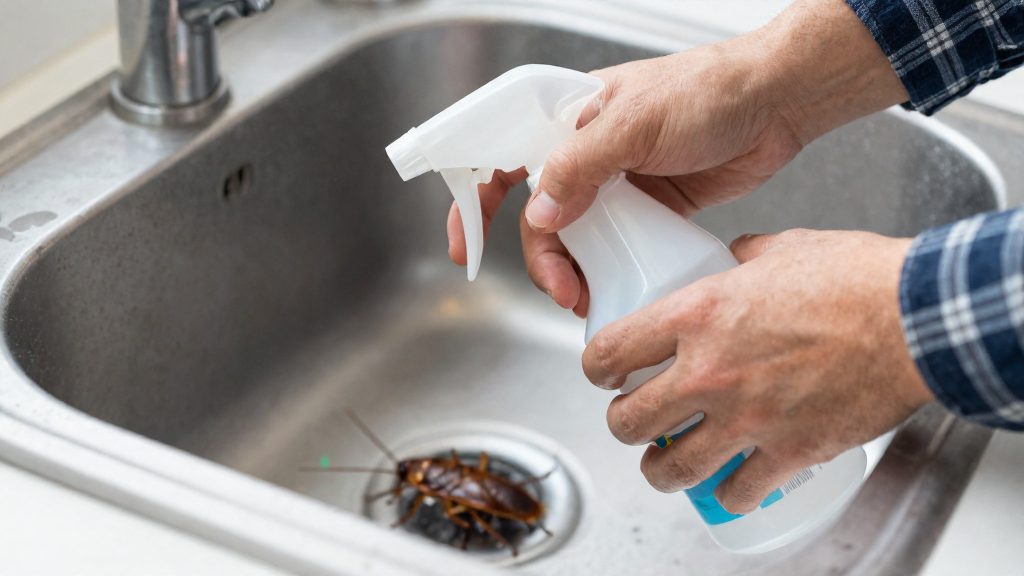
Raid Essentials Ant, Spider & Roach Killer 30 and Zevo Multi-Insect Killer are direct-contact sprays. Other products may have different label-approved uses and residual effects. Raid Essentials Ant, Spider & Roach Killer 30 requires direct contact with insects to kill them, according to SC Johnson. Ants that are out of reach or inside wall voids and cabinet gaps are not affected by a surface spray.
Ant baits work differently. According to the University of California Statewide Integrated Pest Management Program (UC IPM), workers carry a slow-acting insecticide back to the nest, where it can kill other colony members, including queens. UC IPM advises against using insecticide sprays while baiting, because a spray can kill the foragers before they return to the nest.
Understand the Non-Preventive Limit
Zevo states that its insect sprays are not preventive treatments; do not assume the same limitation applies to every insecticide spray. Zevo states that its insect sprays are not preventive treatments, so new ants can enter treated areas after the spray dries. Prevention depends on removing the reasons ants come inside.
Can You Spray Kitchen Countertops?
Usually not. The precautions for Raid Essentials Ant, Spider & Roach Killer 30 prohibit applying it to surfaces where food is stored, prepared, or eaten (SC Johnson). Check the label of any kitchen aerosol before use, and treat food-prep areas as off-limits unless the label names them.
If the label permits use near food, follow these steps:
- Remove or cover food on and around the work surface before spraying. Mississippi State University Extension Service (2026) advises this step specifically for kitchens.
- Shield utensils and prep surfaces from mist. Store cutting boards, dishes, and tools in closed cabinets or cover them. Spray droplets can contaminate them.
- Wipe up residue after application. Zevo states that its insect sprays should always be wiped up after use. For Raid Essentials, the manufacturer directs users to wipe surfaces if they are damp (SC Johnson).
- If mist reaches a utensil or cutting board, stop using it for food until it has been cleaned according to the product’s instructions. If cleanup instructions are unclear, contact the manufacturer before reuse.
Using Sprays Around Pets
Keep pets out of treated areas for the period stated on the product label. The U.S. Environmental Protection Agency (2026) advises this for all pesticides. Reentry times differ between products, so check the label of the exact spray before letting pets back into the kitchen.
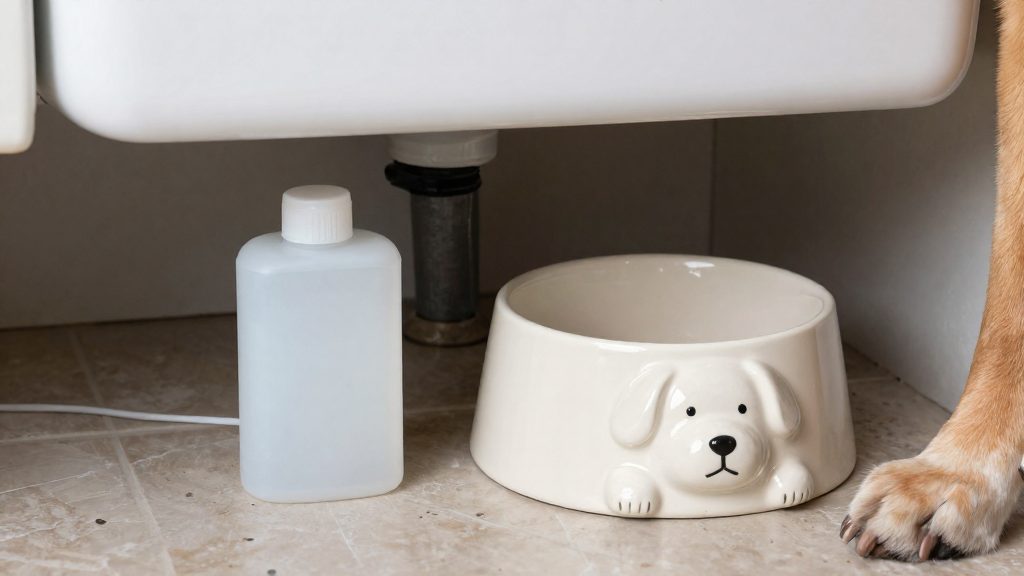
Never spray a pet directly, and keep spray away from food and water bowls. The EPA (2026) says pesticides should not be sprayed or stored near pet food or water dishes. Both products below are marketed as safe around pets only when used as directed.
| Product | Manufacturer instruction for pets |
|---|---|
| Raid Essentials Ant, Spider & Roach Killer 30 (SC Johnson) | Do not spray pets directly. |
| Zevo Multi-Insect Killer (Zevo) | Spray away from pets. Avoid use near birds, fish and exotic pets. |
Move birds, fish tanks and exotic pet enclosures to another room before spraying. Zevo specifically advises against use near these animals.
When Ant Baits Work Better
Baits suit colonies better than contact sprays because they reach the nest, not just the ants on the surface. Foraging workers carry slow-acting insecticide back to the colony, where it can kill other members, including queens, according to the University of California Statewide Integrated Pest Management Program (UC IPM). A contact spray only affects the insects it touches. Raid Essentials Ant, Spider & Roach Killer 30 requires direct contact with insects to kill them.
| Factor | Contact spray | Ant bait |
|---|---|---|
| Who is affected | Insects hit directly by the spray | Foragers and the wider colony |
| Kill mechanism | Direct contact | Workers carry the product back to the nest |
| Pet rule | Spray away from pets; never spray pets directly | Pets must never access bait stations or bait products |
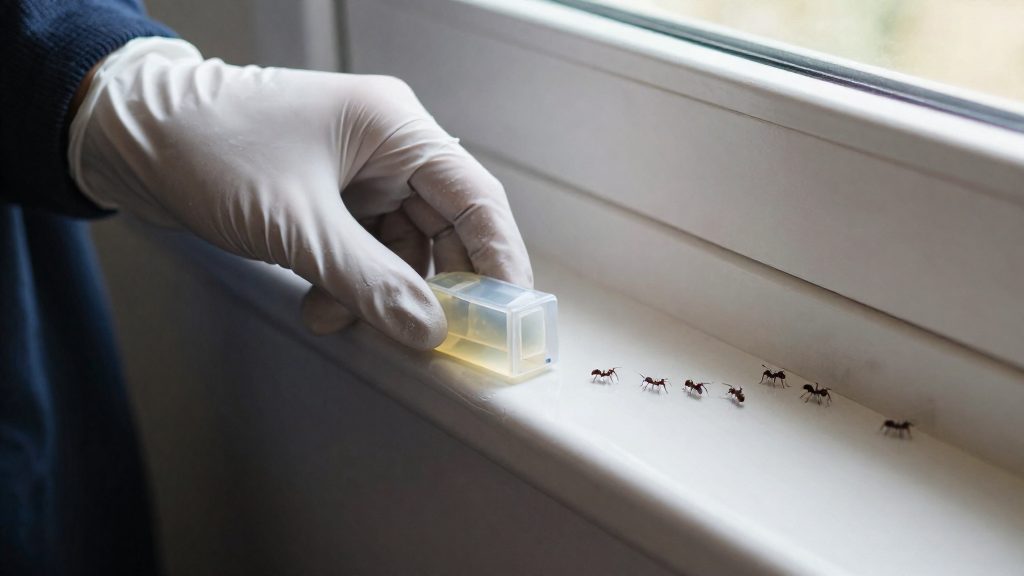
Placing bait along trails
- Put bait stations on active foraging trails, where ants are visibly moving, rather than at random spots.
- Check the label for replacement timing.
Removing Ant Trails Without Insecticide
Wiping a trail is the most direct non-chemical step. According to the University of California Statewide Integrated Pest Management Program (UC IPM), wiping ant trails with soapy water removes their scent trail and can be as effective as insecticide spray for temporarily removing indoor foraging ants. Because the scent trail is what guides workers back to the food source, a clean path interrupts the recruitment signal that brings new ants in.
Cleaning Trails With Detergent Water
Mix a mild dish detergent into warm water and apply it with a damp cloth or paper towel along the full length of the trail, including edges, cracks, and the spots where ants enter a wall or appliance. Rinse the cloth often so the trail is not smeared into a wider area. Work from the nearest food source outward, so that you do not push ants back into areas you have not yet cleaned.
Repeating Until No Ants Return
Clean visible trails with soapy water and repeat if ants return, while addressing food sources and entry points. Wipe the same path repeatedly over several days, and continue until no ants reappear along it. Returning ants do not prove that the original scent trail remains. Check for food, water and entry points as well as cleaning visible trails.
Non-Insecticide Cleaners and Their Limits
Soapy water is a cleaning step, not a lasting barrier. The UC IPM guidance indicates that the effect is temporary, so it should be combined with removing the food source that attracted the ants.
Keeping Ants Out of Your Kitchen
Ant entry into a kitchen is usually a matter of access, not of attraction alone. Closing the openings ants use, removing the food they follow, and cleaning their trails reduces how often they reach food areas. The methods below are sealing, storage and daily sanitation. Use these prevention measures alongside the directions on any pesticide label.
Seal Entry Points
Ants enter through small gaps, so inspect the places where utilities and structures meet the wall:
- Gaps around pipes under sinks and behind appliances
- Gaps around electrical outlets and switch plates
- Window frames and door thresholds
Fill these openings with a sealant suited to the surface, then check them again after cleaning, since a reopened gap restores the route. University of California Statewide Integrated Pest Management Program (UC IPM) lists sealing entry points among the measures that make a home less attractive to ants.
Store Sugary Foods in Airtight Containers
Food preferences vary by ant species and season; sweets, proteins and fats can all attract foraging ants. Keep sugar, honey, syrups, cereals and dried fruit in sealed containers rather than in their original paper or thin plastic packaging. UC IPM recommends storing food in sealed containers as part of the same prevention approach.
Wipe Up Crumbs and Spills Daily
Crumbs and sticky spills left overnight give ants a steady food source. Wipe counters, the tops of stoves and the areas beneath toasters at the end of each day. Fixing leaking faucets removes another water source that ants use, and UC IPM lists both practices among its prevention measures.