Essential oil sprays may deter some insects for a short time, but the evidence does not show that they repel common household pests reliably indoors. Most research on these products measures whether pests die, not whether they avoid a treated area. Treat any repellent claim as unproven unless the product label names the specific pest and the claim is backed by a test.
Do essential oil sprays really repel pests indoors?
Repellent, insecticide and knockdown effects compared
These three effects are often confused on product labels, but they are measured differently:
| Effect | What it means | What you would observe indoors |
|---|---|---|
| Repellent | Pests avoid a treated surface or area without being killed | Fewer insects settle on the treated spot; no body count |
| Insecticide (lethal) | Pests die after contact or ingestion | Dead insects found during the treatment period |
| Knockdown | Pests are quickly immobilised, which may not mean death | Insects stop moving or fall, and some may recover |
A spray can produce a knockdown effect without a lethal one, and a lethal effect says nothing about repellency. Lethal results for essential oils are weak: in the bed bug trial cited below, none of the essential oils worked as a control.
Typical spray formats sold to consumers
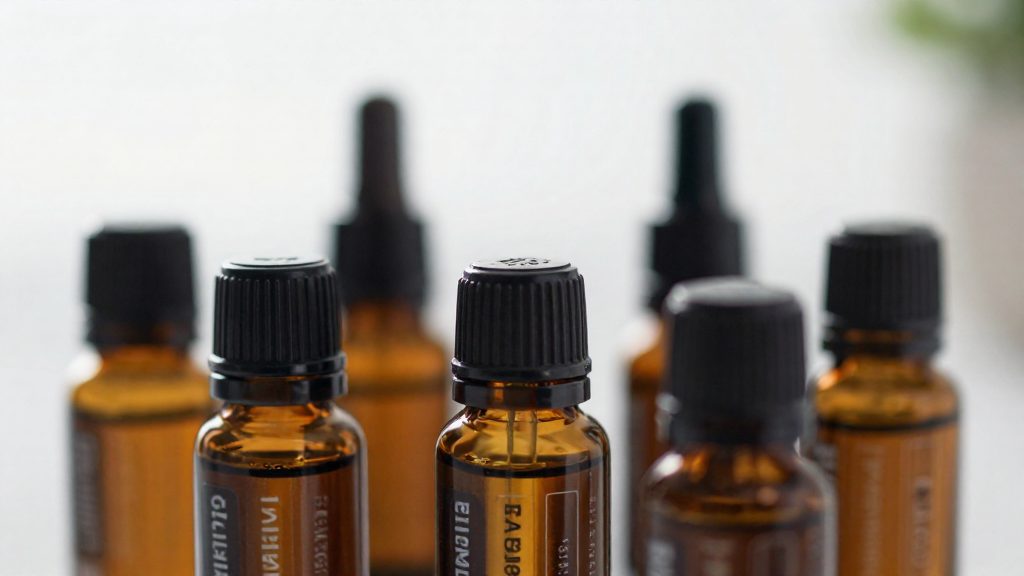
Retail essential oil sprays usually come in two forms: ready-to-use trigger bottles and concentrates that must be diluted in water before use. Labels commonly name oils such as peppermint, eucalyptus or lemongrass as the active ingredient. Dilution instructions on concentrates matter, because the product is only as consistent as the mix made from it.
Overall verdict on repellent claims for common pests
This review contains no trial testing repellency of essential oil sprays against ants, cockroaches, spiders or mosquitoes, so such claims remain unproven.
Sprays are most useful as a supplement to other measures. Removing food and water sources, and using labelled traps or products, are standard measures for limiting infestations and do not depend on an unproven scent barrier.

What the EPA says about essential oil pesticides
Under U.S. federal law, an essential oil spray sold with pest-control claims is generally treated as a pesticide, and its legal position depends on whether it qualifies for the minimum-risk exemption under FIFRA section 25(b). According to the U.S. Environmental Protection Agency (2026), minimum-risk pesticides are exempt from federal EPA registration because the agency considers they pose little to no risk to human health or the environment. The exemption is conditional, not a general permission, and the product label remains the main constraint on what the spray can claim.
The six conditions
A product must meet six conditions to qualify as a minimum-risk pesticide. A spray that fails any one of them falls outside the exemption and must go through standard federal registration. Manufacturers therefore need to confirm eligibility before they market a product under this exemption.
State registration still applies
The federal exemption does not remove state registration requirements, because states may require their own registration. An essential oil spray exempt from EPA registration may still need to be registered in each state where it is sold. Federal exemption alone does not establish that a product can be sold everywhere in the United States.
Prohibited and permitted claims
Labels on minimum-risk products may not carry false or misleading claims. EPA treats blanket claims as a specific risk: a label stating a product “kills all insects” is flagged as potentially misleading. The agency may accept a list of the specific insects the product kills.
| Label wording | EPA position |
|---|---|
| “Kills all insects” | Flagged as potentially misleading |
| A list of the specific insects killed | May be accepted |
| Controls ticks or mosquitoes | Permitted |
| Links a pest to a specific disease | Prohibited |
| Sterilizes, disinfects or kills germs | Prohibited |
Reading the label itself, rather than relying on the product name or general marketing, shows which of these categories a given spray falls into.
What lab studies show on bed bugs
A laboratory trial by Rutgers University and the USDA, published in the Journal of Economic Entomology, was reported by Entomology Today (Entomological Society of America, 2017-12-06). The researchers tested 18 essential oils, three silicone oils and one paraffin oil. Only the silicone and paraffin oils were effective enough, and none of the essential oils worked as a control.
Essential oil results varied widely. In the study’s test conditions, spearmint oil killed only 5% of bed bugs. Blood orange oil was the strongest essential oil in the trial, and the study compared products using LD50, the dose that kills 50% of a test population. The best silicone oil needed a smaller dose to reach that threshold:
| Product tested | Best performer | LD50 per bed bug |
|---|---|---|
| Essential oil | Blood orange oil | 0.184 mg |
| Silicone oil | Best silicone oil in the trial | 0.038 mg |
A lower LD50 means less active substance is needed to kill half the insects, so the silicone oil was the more potent of the two in this test.
Purdue University (2021-04-19) reported that plant essential oils can be lethal to bed bugs, particularly when combined with synthetic insecticides. That lethality is linked to combinations, and because none of the essential oils worked as a control in the Rutgers/USDA trial, neither study establishes that an essential oil spray works on its own.
Why lab results rarely match real homes
Petri-dish and contact trials measure whether a substance kills insects under fixed conditions, and those conditions rarely exist in an occupied home. A trial applies a known amount to a test surface, places insects on it, and records mortality after a set exposure period. A room differs on each of these points, so a strong result in a trial is a starting point for evaluation, not a forecast of what happens in a bedroom.
| Factor | Typical trial | Occupied home |
|---|---|---|
| Dose | Measured amount applied to a defined surface | Uneven coverage; the spray reaches some surfaces and misses others |
| Exposure time | Fixed and controlled | Variable; insects may move out of the treated area |
| Residue age | Tested on fresh deposits | Residue weathers, gets wiped, or is covered by dust and fabric |
| Insect access | Insects are confined to the treated surface | Insects retreat into cracks, seams and furniture |
| Insect population | Uniform laboratory colony | Field population that may include less sensitive individuals |
Hiding places limit contact
Many household pests avoid open surfaces. Bed bugs shelter in mattress seams, furniture joints and clutter, so a spray applied to visible areas may never reach the insects. A contact product only works when an insect walks across the residue, and in a cluttered room that contact is unpredictable.
Lab colonies differ from field populations
Laboratory insects are reared under controlled conditions, while insects in a home may come from populations that have already been exposed to other treatments. Repeated use of the same active ingredient can select for individuals that tolerate it, a process called resistance. A product that performed well on a lab colony can therefore underperform on a population with a treatment history.
Are essential oil sprays safe indoors?
Essential oil sprays are applied in occupied rooms, so their health profile matters as much as their pest-control claims. The main concerns are respiratory irritation from airborne terpenes, toxicity to pets, and repeated exposure for children and household surfaces.
Respiratory irritation from indoor use
Essential oils release volatile compounds into the air. In a closed room with little airflow, frequent spraying may irritate the eyes, nose and airways. People with asthma or other respiratory conditions are more likely to react and should avoid these sprays or ask a clinician before using them. Anyone who develops wheezing, chest tightness or difficulty breathing after exposure should leave the room for fresh air and seek medical care, and should call 911 if breathing difficulty is severe. Avoid spraying toward people, and do not spray in bedrooms or nurseries where people spend long periods.
Pet toxicity risk for cats and dogs
Many essential oils are poorly tolerated by cats and dogs, which process terpenes and phenols differently from people. Cats are generally more vulnerable. Animals can absorb residues by licking treated surfaces or grooming fur after contact. Keep pets out of the room during and after treatment, and wipe floors, bowls and bedding. If a pet may have licked, swallowed or touched the spray, contact a veterinarian or a pet poison helpline right away, without waiting for symptoms such as drooling, vomiting, tremors, lethargy or trouble breathing.
Safe use: ventilation, patch tests and storage
- Ventilate: Open windows or run extraction during and after spraying, and keep people and pets out of the room until the air has cleared.
- Patch test: Spray a small, hidden area of fabric or painted surface and check for staining or discoloration before treating a whole room.
- Dilute: Follow the dilution stated on the product label. Never apply undiluted oil to skin, fabric or pet bedding.
- Store: Keep oils in original, labelled, sealed bottles, away from heat and out of reach of children and pets.
- Separate: Do not spray near food-preparation surfaces or pet feeding areas.
Which pests have evidence, and which have none?
Bed bugs are the only pest group with trial data in this review.
For the other common household pests, the picture is weaker:
- Ants: No efficacy result is established here, so any repellent claim for ants is unverified.
- Mosquitoes: Labels may say a product controls mosquitoes, but may not link them to specific diseases (U.S. EPA, 2026). That is a labelling rule, not evidence of repellency.
- Rodents and cockroaches: No cited study tests either group. Essential oil sprays should not be relied on to deter mice, rats or cockroaches, because no cited evidence supports doing so.
- Spiders, wasps and moths: No cited trial covers these groups, so any claim for them is unproven. Treat any claim for them as unproven.
What works better: prevention and proven treatments
Physical measures and registered products give more reliable control than home-made sprays.
Heat treatment
Heat treatment, used mainly against bed bugs, raises the temperature of a room or of infested items to a level intended to kill all life stages of the pest, and it is normally done by professionals. Professional operators place temperature sensors in hard-to-reach spots such as furniture joints, mattress seams and wall voids, because the coolest point sets the effective temperature. The room must hold the target temperature for the full required duration, so ask the provider for both figures in writing before treatment. Items that cannot withstand heat, such as electronics or some plastics, must be removed or treated separately.
Sealing entry points
Rodents and other pests enter through small openings in the building envelope. Inspect the outside walls, foundation, and the areas around pipes, cables, vents and door thresholds. Fill gaps with coarse steel wool and cover it with a durable sealant or metal patch, since rodents can chew through soft materials. Check door sweeps and window screens, and repeat the inspection every season, since new gaps can open as materials shift.
Registered insecticides
Federally registered pesticides carry an EPA registration number on the label. Confirm that number before buying, and confirm that the label covers the room type where you plan to use it. The label is the legal instruction for use, so follow its dilution rate, application method, and any re-entry instructions exactly.
When should you call a professional?
Call a professional when sightings continue after several complete treatment cycles, when nests or burrows sit inside the structure, or when the activity is in wall voids, ceilings, or under floors that surface sprays cannot reach. Essential oil sprays are a poor substitute in these cases.
Persistent sightings after repeated treatment
Keep a dated log of each sighting, noting the location, the pest, and its life stage. Compare counts week to week after each treatment. If live insects or rodents still appear after several full cycles, and the counts are not falling, stop applying DIY products and request an inspection. Continued spraying at this stage delays the diagnosis without reducing the infestation.
Structural nests and burrows
Some infestations cannot be reached from the room surface:
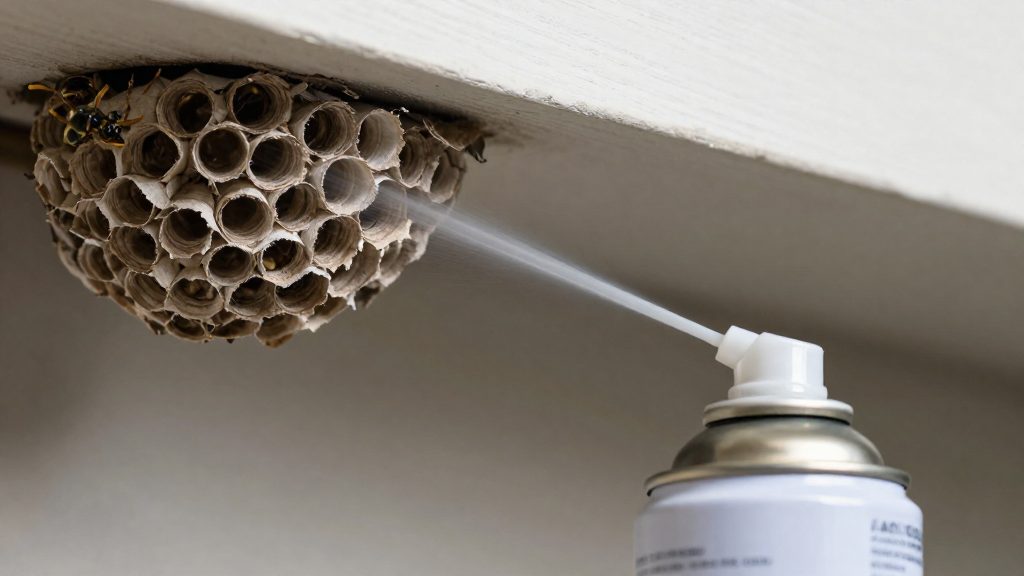
- Wasp nests in wall cavities, soffits, or eaves. Do not attempt to open or remove a large nest yourself.
- Rodent burrows at the foundation or under slabs, which indicate an established colony rather than a passing visit.
- Gnaw marks and droppings inside wall voids or ceilings, which point to activity you cannot treat with a spray.
Access to these sites usually requires the professional to treat voids directly and to seal entry points, work that goes beyond what a household spray covers.
What to verify before hiring
Before accepting service, confirm the following in writing:
- State licence: Ask for the pesticide applicator licence held by the technician.
- Inspection report: Request a written report listing the species found, the locations, and the evidence observed, such as droppings, nests, or burrows.
- Written guarantee: The written guarantee should name the pest, the treated areas, the coverage period, and the action taken if activity returns.
- Re-inspection: Confirm whether a follow-up visit is included to check the results.
Frequently asked questions
How can I tell whether a spray’s pest claim has any evidence behind it?
Check whether the label names the specific insects the product controls. EPA treats blanket claims such as “kills all insects” as potentially misleading on minimum-risk products, and it may accept a list of named insects instead. Labels may say a product controls ticks or mosquitoes, but they may not link pests to diseases or claim to disinfect or kill germs.
Is an essential oil spray sold for pest control legally a pesticide?
Under U.S. federal law, a spray sold with pest-control claims is generally treated as a pesticide. It can avoid EPA registration under the minimum-risk exemption in FIFRA section 25(b), but only if it meets six conditions. Even then, states may require their own registration, so check your state’s rules before buying.
If I choose the strongest essential oil, will it reliably kill bed bugs?
No. In the Rutgers/USDA bed bug trial, blood orange oil was the strongest essential oil, but none of the essential oils worked as a control, and only the silicone and paraffin oils were effective enough. The best silicone oil reached the LD50 (the dose that kills 50% of a test population) at 0.038 mg per bed bug, against 0.184 mg for blood orange oil. Purdue reported that plant essential oils can be lethal to bed bugs, mainly when combined with synthetic insecticides, but that finding concerns killing, not repelling.