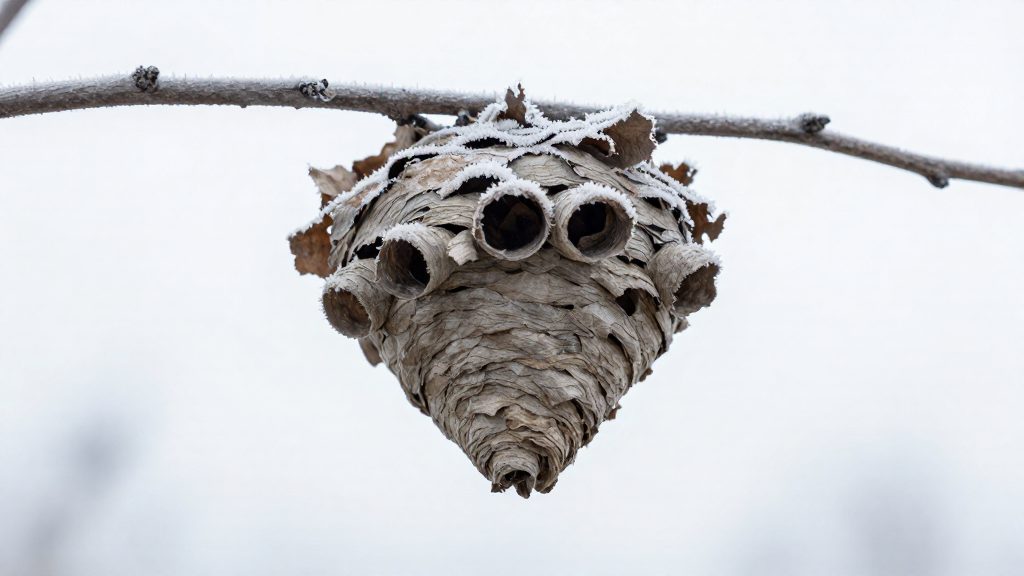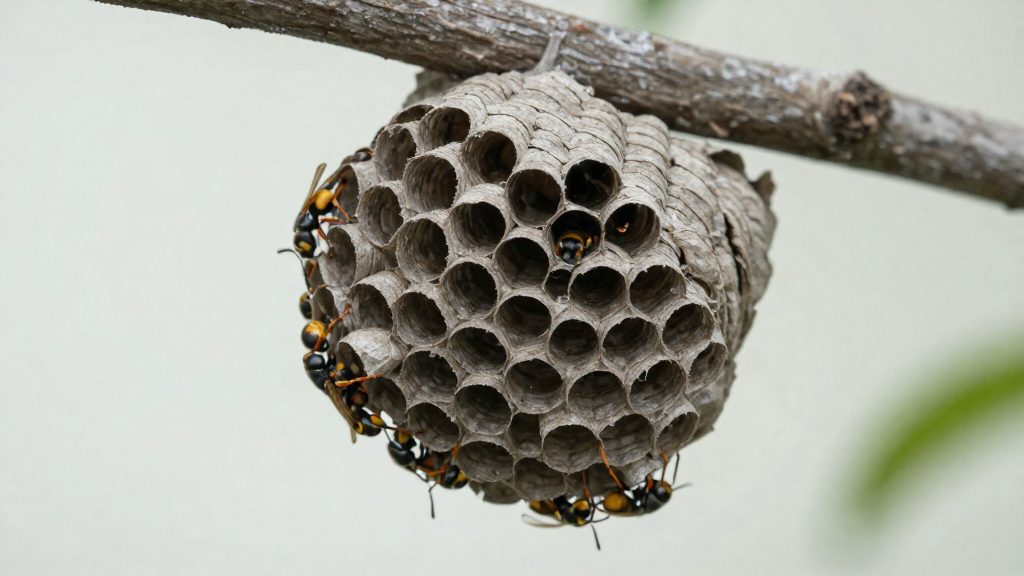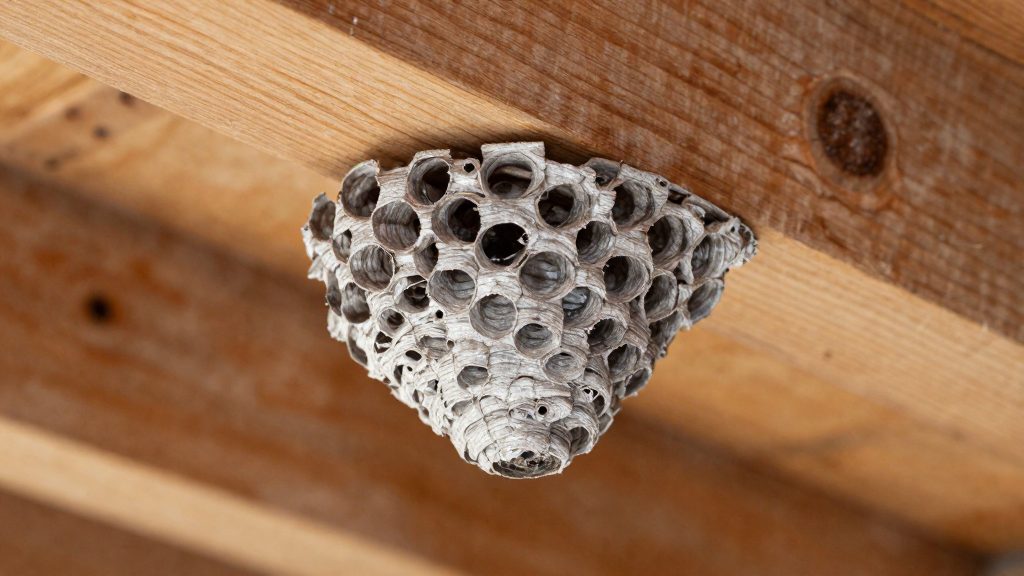
Yes, in limited cases. A nest that is exposed in open attic space and reachable by ladder can be handled by a homeowner if it is inactive. An active nest, or one hidden in a wall, along a foundation, or in an attic void, should go to a pest control company.
Can you remove a wasp nest in the attic yourself?
Exposed nests in open attic space
Check whether the nest is active before touching it. Disturbing a nest can trigger a swarm, and wasps can sting repeatedly.
Do not attempt removal of a nest that shows signs of activity. Removal is a reasonable task only when the nest is clearly inactive and the attic space is open enough to work without moving through insulation or tight framing.
Disposing of an inactive nest
If you remove the nest, seal it in a bag before discarding it, which is the method professional technicians use when they remove a nest (Orkin Canada, 2026).
Work in the attic only in clear weather with a stable ladder, and keep the removal area free of people and pets. Wear protective clothing before you approach the nest.
How to tell if the nest is active
A nest is occupied when its wasps are still alive, so the first check is the season. According to the City of Calgary (2026), wasps do not reuse old nests, and a nest found in winter or spring has no live wasps. In summer and autumn, the signs below show whether a live colony is still present.
Signs of a live colony
- Wasps flying in and out: Insects moving to and from the attic opening show the nest is occupied.
- Buzzing from inside: Audible buzzing from within the attic indicates wasps are still inside the nest.
- Concealed entrances: Nests in house attics are hard to reach, so the entrance is often the only visible sign of activity.
Watch the entrance for a while before drawing a conclusion, and note the time of day. Wasps are less active at dusk and after dark (City of Calgary, 2026), so a quiet entrance at those times is weaker evidence than a quiet entrance in daylight.
Reading the season and the site
A previously used site can hold a new nest, even though the old nest itself is not reused. Treat any attic nest as possibly active until you have checked the entrance and listened for sounds, and do not assume it is empty because the season has changed.
Key points to record:
- Season: Winter or spring suggests no live wasps; summer or autumn requires active checks.
- Entrance activity: Any wasps flying in or out indicate an occupied nest.
- Sound: Buzzing from inside the attic confirms wasps are present.
When to call a professional
A visible nest that is reachable from the ground is a job a homeowner can handle, but a concealed wasp nest is not. Nests built inside walls, along foundations or in attic voids are hard to reach, and the City of Calgary recommends calling a pest control company for them (City of Calgary, 2026).
| Nest location | Why it needs a professional |
|---|---|
| Inside a wall | Access is hidden, so the full nest cannot be seen or reached safely |
| Along a foundation | The nest is hard to reach and may sit in a concealed space |
| In an attic void | The nest is out of reach and may be difficult to access without opening the structure |
Why DIY removal carries more risk
The risks rise when the nest is inside a structure you cannot see into. A household with a known allergy should use a professional for any nest that is not easily reached (City of Calgary, 2026).
Recurring nests
Wasps may nest in walls, eaves, attics or underground (Orkin Canada, 2026). If a nest has returned to a concealed location after a previous removal, that pattern is a reason to bring in a pest control company rather than repeat the same approach.
What does a professional treatment involve?
A professional treatment starts with an inspection, not a spray. The technician first identifies the species and locates the nests, and the product is then chosen according to where each nest sits. According to Orkin Canada (2026), this sequence matches the treatment to the nest itself, so no product is applied before the nest has been found.
Inspection and species identification
The inspection answers two questions: which species is present, and where each nest is located. Both answers determine the method, so an exposed nest and a nest inside a void are not handled with the same product.
Matching the product to the nest location
| Nest location | Treatment | Application point |
|---|---|---|
| Exposed | Contact or foam aerosol | On the nest |
| Inside a void | Residual dust | At the entrance |
Timing and colony removal
Treatment is usually carried out in the early morning or late afternoon, when most wasps are inside the nest. Once the queen is gone, the colony gradually collapses. The technician may then bag the nest and remove it.
Safety gear and the best time of day
Protective clothing and timing are the two main controls you have when removing a wasp nest yourself. Neither removes the risk.
Protective clothing
Wear layers of protective clothing that cover the whole body. Any exposed skin is a place a wasp can reach, so aim for full coverage: long sleeves, long trousers, closed footwear, and head and face protection. Check that the layers meet at the wrists, waist and collar, with no gaps where a wasp could crawl in. Put the gear on before you approach the nest, not once the wasps are already flying.
Working at dusk or after dark
If the nest is confirmed inactive, plan the work for dusk or after dark, when wasps are less active than in full daylight. This does not make the job safe: never check for activity at those hours, because a quiet entrance at that time proves little.
Attic nests are harder to handle than exposed ones because they are concealed nests that are hard to reach. If you can see the nest but cannot reach it without working in a confined space, treat that as a sign to stop.

What not to do (fire, water, blocking the entrance)
Three improvised actions make attic wasp removal more dangerous: burning the nest, flooding it, and sealing its entrance. Disturbing the nest without a plan carries the same risk.
Burning or flooding the nest
The City of Calgary advises against burning or flooding a wasp nest because doing so provokes aggression in the colony. A nest under attack responds by defending itself, so the person working near it faces more wasps, not fewer. In an attic, where the nest is often in a confined space close to living areas, that escalation is harder to contain.
Blocking the entrance and sealing wasps inside
According to Orkin Canada (2026), the colony gradually collapses once the queen is gone, and only then can the technician bag the nest and remove it. Sealing the opening keeps the colony alive inside the structure, and the wasps have no clear route out, which raises the likelihood of defensive stinging when the opening is later disturbed.
Disturbing a nest can trigger a swarm
A swarm means many wasps leave the nest at once instead of a few, which multiplies the number of stings a person can receive in a short period. Because attic nests are often concealed behind insulation, joists or wall cavities, reaching them usually requires opening up the structure.
How do you stop wasps coming back?
Wasps often rebuild in the same spots year after year if nothing is done to prevent it, according to Orkin Canada (2026). Prevention therefore works on two fronts: closing entry points so that a colony cannot re-enter the same space, and seasonal inspection of the locations where nests have appeared before.
Leaving inactive nests in place
For some species, leaving an inactive nest in place can discourage new nesting, according to Orkin Canada (2026). The species matters here, so identify it before deciding.
Sealing entry points at eaves and attic vents
Wasps can nest in eaves and attics, so these are the areas to check for openings. Inspect the eaves and attic vents for gaps and holes, and close them with a durable material such as sealant or fine mesh. Mesh is preferable over vents that need to keep airflow, because it blocks entry while allowing air through.
Seal an opening only after the colony is confirmed gone. Sealing an entrance while wasps are still inside traps them in the structure, where they may later emerge in the living space.
Seasonal monitoring
Check the same spots at the start of each season and after any removal. Watch for wasps repeatedly entering or leaving the same opening, which indicates that a new nest is being built. Record where nests were found, so that the next inspection starts with the locations most likely to be reused.
Allergic reactions: what to do after a sting?
Orkin Canada (2026) notes that stings can trigger anaphylaxis in some cases, so the response should be judged by the person’s symptoms, not only by the size of the local reaction.
Local reactions: pain, swelling and itching
Pain, swelling and itching at the sting site are the expected local effects. Keep the person still, and check the site over the following period. If the swelling spreads well beyond the sting, or the itching spreads across the body, treat this as a warning sign and seek medical advice.
Anaphylaxis: when to call emergency services
Wasp stings can be dangerous and possibly fatal for people who are allergic to the venom (City of Calgary, 2026). Call emergency services immediately if the person shows signs of a severe reaction, such as:
- Difficulty breathing or wheezing
- Swelling of the face, lips, tongue or throat
- Dizziness, fainting or confusion
- Hives spreading over much of the body
Do not wait to see whether symptoms improve. Speed matters more than the cause of the reaction.
Repeated stings
Wasps can sting repeatedly (City of Calgary, 2026), so a person who has been stung should move calmly away from the area. Swatting at wasps or leaving them undisturbed in a nearby space can provoke further stings. Anyone who has already had a severe reaction to a sting should carry prescribed emergency medication and be checked by a doctor before any further exposure.
Frequently asked questions
Can I check the attic for wasp activity after dark?
No. Wasps are less active at dusk and after dark, so a quiet entrance at those hours says little about whether the nest is occupied. Judge activity by watching the entrance during daylight, and plan removal for dusk or after dark only once the nest is confirmed inactive.
Is an old nest from last season still a risk?
Wasps do not reuse old nests, so an empty nest from a previous season contains no live wasps, according to the City of Calgary (2026). The re-nesting risk remains, however, because wasps often rebuild in the same spots year after year if nothing is done to prevent it.
Should someone allergic to wasp venom remove an attic nest?
No. Wasp stings can be dangerous and possibly fatal for people allergic to the venom, and wasps can sting repeatedly. A pest control company is the safer option for anyone with a known allergy.