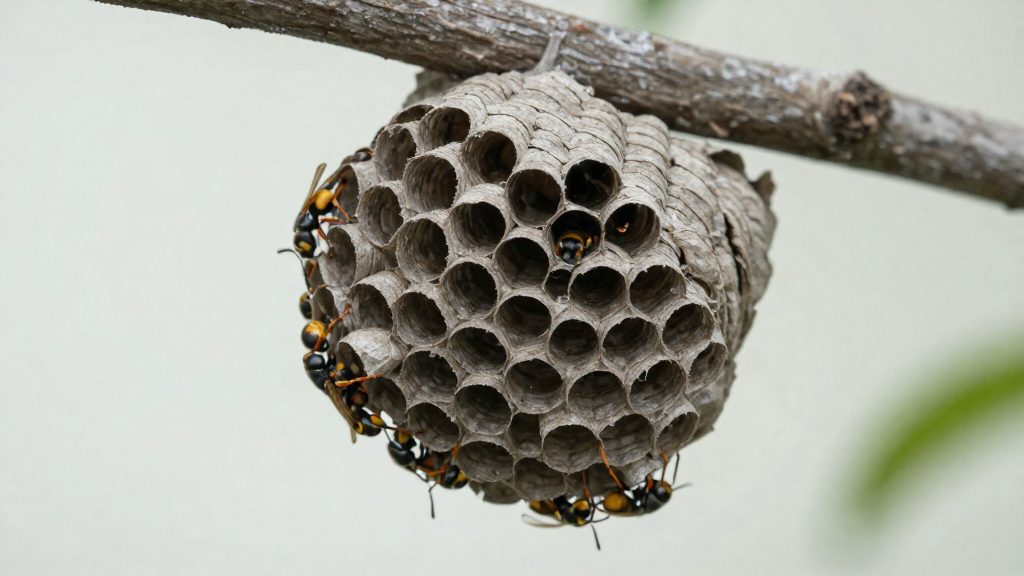
Hornet or wasp nest: how do you tell?
Hornets measure 12 to 30 mm, and you can locate a hornet nest mainly by watching where the insects come and go. According to Terminix Canada (Rentokil, 2026), hornet nests are usually out of sight, so the nest itself is hard to spot. Start by locating the entry point, then confirm the species before choosing any removal method.
Check the insect’s size
Estimate the insect’s size from a safe distance, for example with a photo taken with zoom. A range of 12 to 30 mm is only a rough guide, because it overlaps with the size of several wasps. If in doubt, ask a pest professional to confirm the species.
Look for likely nest sites
- Wall voids: check for activity at cracks and entry points in exterior walls.
- Tree cavities: look for steady insect traffic at holes in trunks or branches.
- Underground: watch for insects entering and leaving a hole in the soil.
Watching a single entry point for a few minutes shows whether one nest or several are active.
Identify the species
Canada has several hornet species, including European, Western and Bald-faced hornets. Knowing which species is present matters because the species affects how the colony behaves and how the nest is approached.
Time the check to the season
In Canada, bees, wasps and hornets are typically active from April through September, and activity drops in the fall. Sightings outside this window are less likely to indicate an active colony.
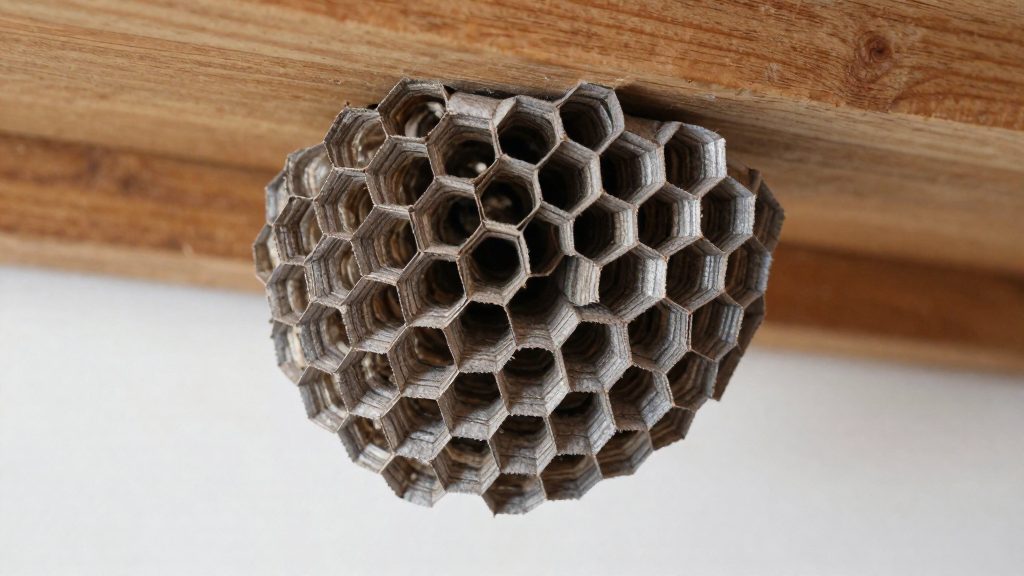
Is it safe to remove a hornets nest yourself?
Removing a hornets nest yourself is considered dangerous. Hornets and wasps become aggressive when their nest is disturbed, and a DIY removal can trigger a defensive swarm, in which many insects sting at once, according to Terminix Canada (Rentokil) (2026). The risk comes from disturbing the colony, not from the nest alone, so any work that vibrates, opens or sprays the structure should be treated as a direct trigger.
Defensive swarms are the main hazard. A colony that feels threatened releases many stings in a short period, and the danger rises with the number of insects that reach the person. People frequently work close to the entrance before they realise the colony is there. Ladders placed against the structure, sudden movements and noise near the entrance can all provoke an attack.
Multiple stings can require hospital care. Anyone who has been stung several times, or who shows signs of a severe allergic reaction such as difficulty breathing, swelling of the face, lips or throat, dizziness, widespread hives or fainting, should call 911 immediately rather than wait to see whether symptoms settle. Anyone caught in the open during an attack should move away from the nest at once and not try to finish the job first.
Given these risks, a DIY attempt is only appropriate when the nest is clearly small and accessible (for example a small paper wasp nest under an eave), and when you have already planned an exit route. For hornet nests, and for nests in walls, roofs, trees or underground, the safer course is to keep your distance and contact a professional.
When is the best time to remove a nest?
The season in which you approach a nest matters as much as the method you use.
Early season: remove small nests first
A small nest is the easiest to deal with. According to PestHQ (Canadian pest control specialist) (2026), small paper wasp nests can be knocked down with a broom, and nests under eaves should be knocked down while they are still small. Waiting until a nest grows gives the colony more time to expand, so checking eaves and other sheltered spots early in the season is the practical priority.
Mid to late season: the risk stays high
By mid to late season the colony has had time to grow, so a large nest should be left to a professional. The large-nest methods in the step-by-step below are the ones PestHQ describes, but they carry a high risk of a defensive swarm. They are not recommended for hornet nests or for nests in walls, roofs, trees or underground.
Fall decline and late-fall waiting
If the wasps are not an immediate danger, you can wait until late fall, after they have died, according to PestHQ (Canadian pest control specialist) (2026). Waiting avoids disturbing a live colony. Before handling the nest, confirm that no insects are coming or going. Only wait if no immediate danger is present, such as a nest near a door, a play area or a living space where people are regularly exposed to wasps.
How to remove a nest step by step
For the DIY steps below, work at night, when wasps are less active. Do not shine a flashlight directly on the nest, because light near the entrance can provoke the colony. Use only enough light to see your path, and keep it pointed away from the nest.
Step 1: Dress fully before you approach. Wear a bee suit or protective clothing, long gloves and a mesh veil. Cover all exposed skin, and make sure the veil closes at the collar so the face is protected before you reach the nest.
Step 2: Approach slowly and quietly. Move in from the side of the nest rather than walking directly at the entrance. Sudden movement and vibration can disturb the colony, so keep your motions deliberate.
Step 3: Enclose the nest. For a large nest, slide a plastic garbage bag over it and seal the bag shut. Keeping the nest fully enclosed traps the wasps inside. Otherwise, spray an aerosol at the nest opening from 10 to 12 feet (about 3 to 3.5 m) away using a pole holder; several applications may be needed. Because large nests are risky, consider hiring a professional instead.
Step 4: Freeze the sealed bag for 48 hours. Keep the bagged nest frozen for 48 hours. This is the freezing method PestHQ describes for large nests.
Step 5: Destroy the nest and confirm the colony is gone. Freezing alone does not finish the job. The colony is eliminated only when the queen is killed and the nest is destroyed, so dispose of the bagged nest once it is fully frozen and check the site afterward for remaining activity.
Source: PestHQ (Canadian pest control specialist), 2026.
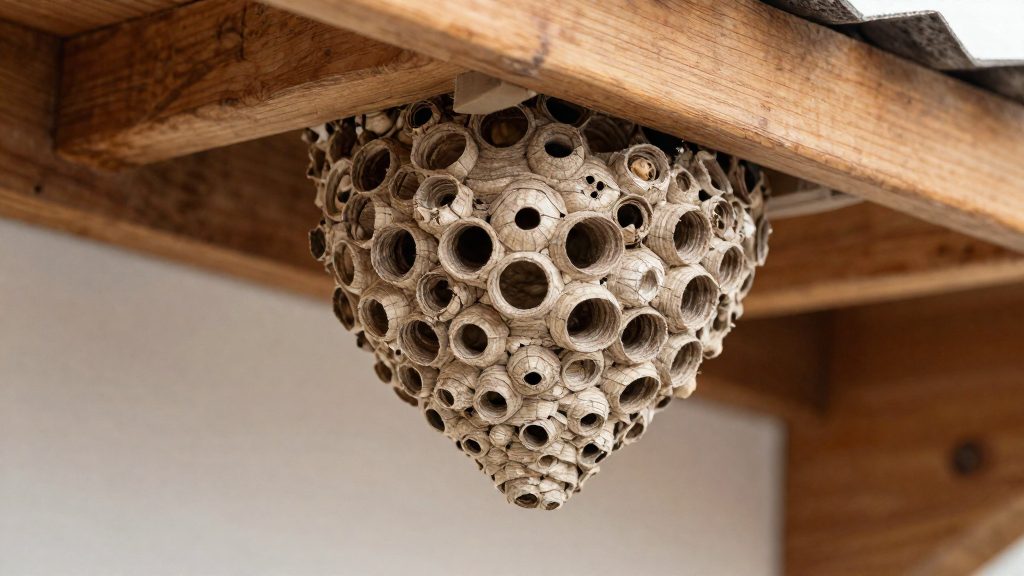
When should you call a professional?
Hire a pest control company when the nest is hidden, out of reach, or built inside a structure, since these sites are difficult to assess without the right equipment.
Because the nest’s position and the species are not always visible from outside, a technician confirms both before choosing a treatment.
What the treatment involves
A professional treatment follows three stages:
| Stage | What happens |
|---|---|
| Inspection | The technician locates the nest before any product is applied. |
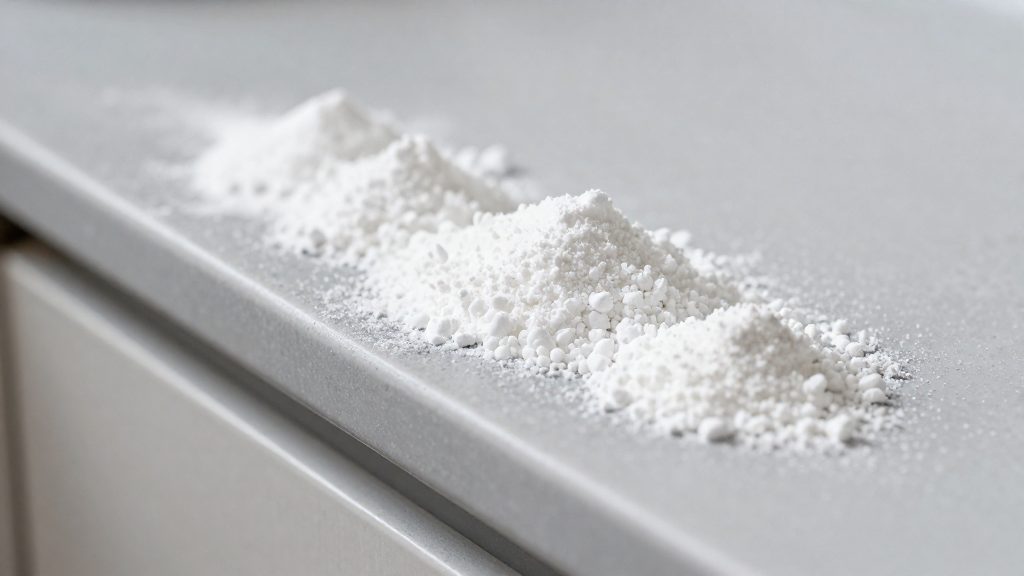
| Treatment | Insecticidal dusts and aerosols are used for aerial nests. Insecticides are used for underground nests. |
| Follow-up monitoring | Checks after treatment are carried out to prevent the nest from returning. |
Timing also affects the decision. Ask the technician to confirm that the nest is still active before treatment begins.
Preventing a new nest
Preventing a new nest means blocking the sites where hornets and wasps can build and removing what draws them close to the house. According to Terminix Canada (Rentokil) (2026), the main prevention steps are sealing cracks and entry points, keeping garbage and food waste sealed, cleaning up spills, trimming vegetation near the house and removing old inactive nests.
Seal cracks and entry points
Walk the exterior of the building and check gaps around window frames, vents, eaves, soffits and utility penetrations. Seal every crack and opening that leads into a wall cavity. Recheck these points before the season starts.
Keep garbage and food waste sealed
Store garbage in containers with tight-fitting lids and keep food waste in sealed bags until collection. Move bins away from doors and windows where possible. Clean up spills promptly, including food scraps, sugary residue and drink spills on patios, decks and outdoor tables.
Trim vegetation near the house
Cut back shrubs, branches and tall plants that touch or grow against walls, eaves and the roofline. Keeping vegetation trimmed away from the house reduces the sheltered spots where nests can be built.
Remove old inactive nests
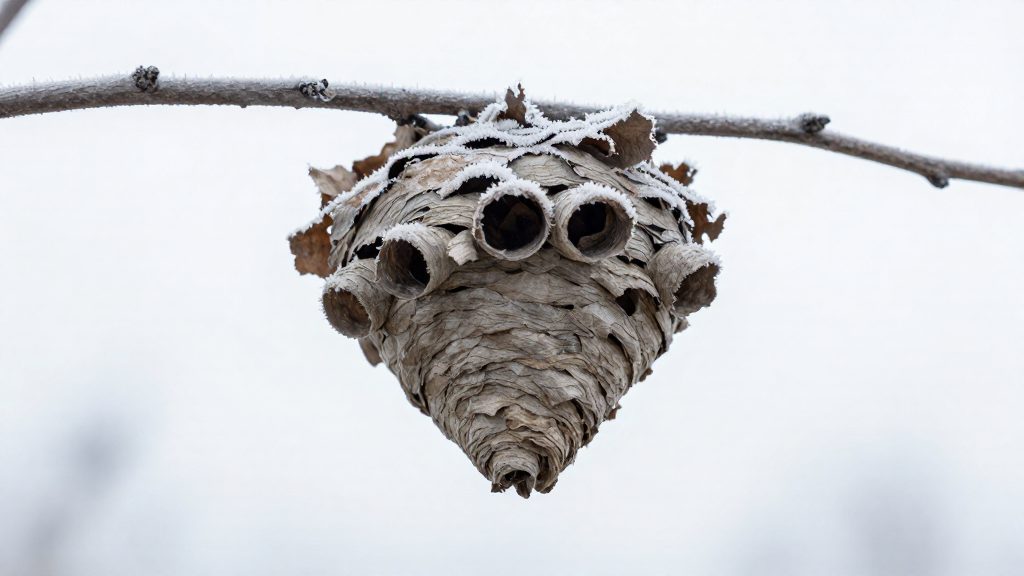
Old nests from previous seasons can be cleared once they are inactive. Remove them from eaves, sheds, trees and other sheltered spots so that the structure is not reused.
How do you choose a suitable product from the label?
Choose a hornet or wasp product by reading its label, not by brand name. In Canada, a pesticide label should show a registration number, and the product should name the target insect and match where the nest is. Because the nest location determines the product form, identify the location before buying.
Checking the label
- Registration number: confirm that a registration number is printed on the product. Without it, you cannot verify that the product is registered for use in Canada.
- Target pest: the label should name hornets, wasps or both. A product listed only for ants, cockroaches or other pests does not cover these insects.
- Use site: the label should cover the location where the nest is found, whether aerial, in a cavity or underground.
Matching the product to the nest location
| Nest location | Product form |
|---|---|
| Aerial nest | Insecticidal dusts and aerosols |
| Underground nest | Insecticides |
Nests in wall voids or tree cavities are not assigned a product form in this guide, so check the label’s listed nest types before buying. Check labels before the season begins, so the product is on hand when nests are still small.
Frequently asked questions
Can a beginner remove a hornet nest without help?
Usually not. Hornets defend their nest aggressively, so hornet nests and nests in walls, roofs or underground should go to a pest professional. Only a small paper wasp nest under an eave, knocked down with a broom while it is still small, is a reasonable DIY task.
Does one spray or one bag stop the colony?
Not necessarily. Several applications may be needed, and the colony is only eliminated when the queen is killed and the nest is destroyed.
Why can a nest come back after treatment?
A new colony can move into the same site if entry points stay open or old nests are left in place. Sealing cracks, keeping garbage sealed and removing inactive nests reduces that risk, and professional treatment includes follow-up monitoring to catch a return early.