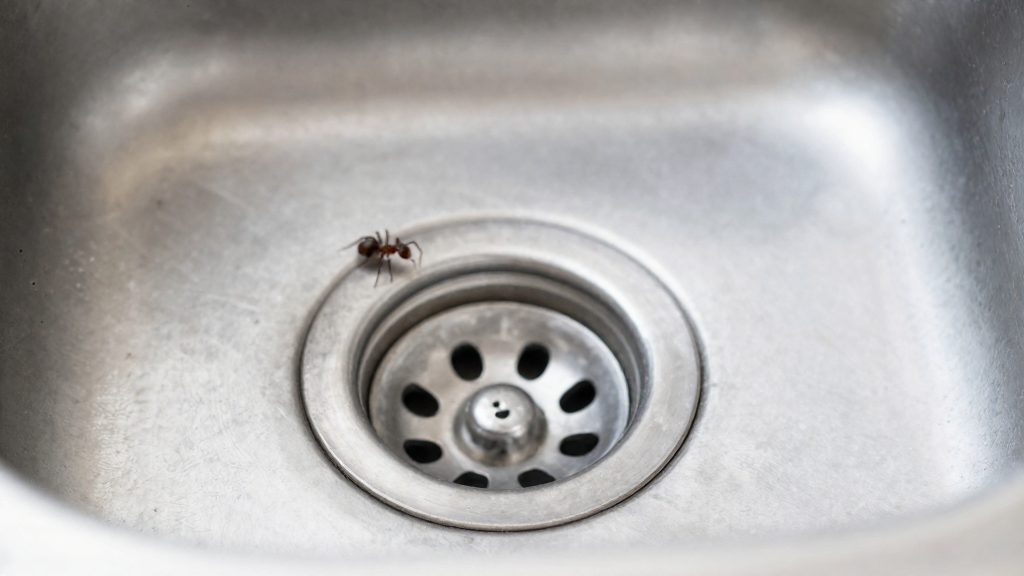
Ants come up a kitchen sink drain because they are foraging for food or water. According to Today’s Homeowner (2026), ants around a kitchen sink are usually looking for one of these two things. The most common causes are moisture from leaky pipes, failing caulk or standing water, and food residue in the drain or around the garbage disposal. The drain is the route they use to reach these resources.
Why are ants coming up my kitchen sink drain?
Ants forage for food and water, and a sink area often supplies both, which makes the drain a repeat entry point.
| Attractant | Typical source at a sink |
|---|---|
| Water | Leaky pipes, failing caulk, standing water |
| Food | Sugar and grease residue in the drain or around the garbage disposal |
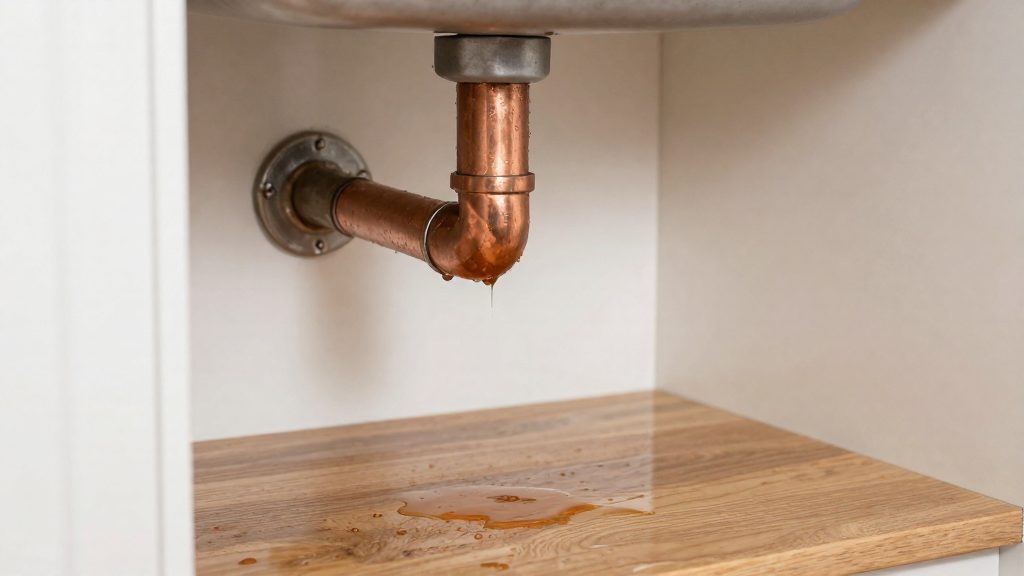
Water is the most persistent draw. Moisture from a slow leak or pooled water under the sink can keep foragers returning even when no food is present.
Food residue is the second draw. Sugar and grease left in the drain or around the disposal attract foraging worker ants, which collect the material and carry it back to the colony. In a New Jersey case documented by Cowleys Pest Control (2026), a technician found heavy pavement ant activity at a sink drain, under a catch-all pan caked with grease and food debris. The grease-laden pan had become a sustained foraging site.
Ants also follow trail pheromones. A worker that finds a food or water source lays a chemical trail on the way back to its nest, and other workers follow it to the same spot. A few foragers can therefore lead a steady stream to one drain. Wiping a trail with vinegar or soapy water can disrupt the chemical marking that guides others to the sink, but ants may lay a new trail if the food or water source remains.
Are the ants living in the drain?
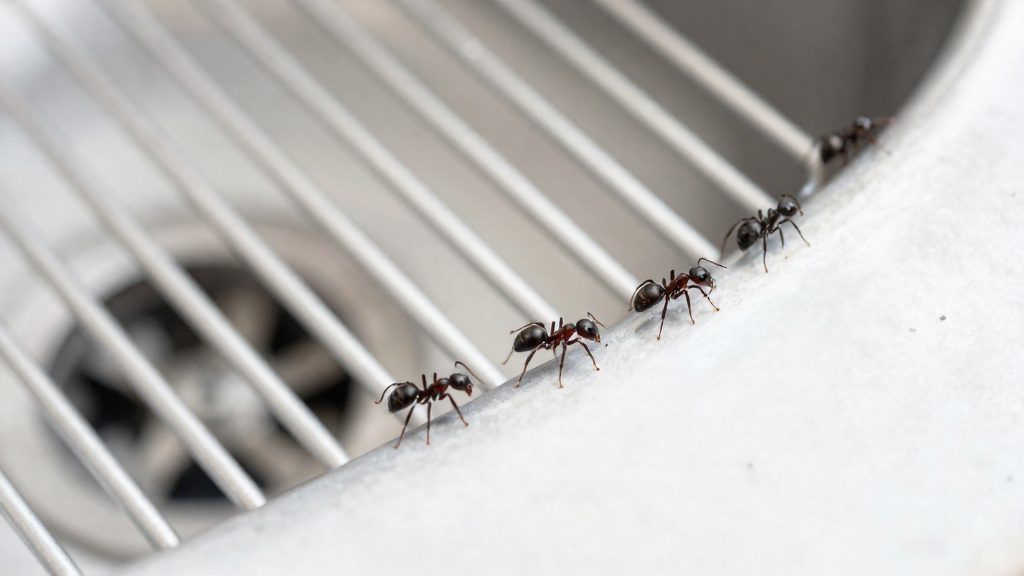
Ants seen at a kitchen sink are usually foraging, not nesting in the drain itself. The nest is often elsewhere, and the sink is simply the nearest source of food or water. According to Today’s Homeowner (2026), pharaoh ants often nest in wall and plumbing voids. A colony in these hidden spaces can send workers to a sink across a long, unseen route.
Foraging trail or nest? A foraging trail is a steady line of ants moving between a food or water source and a point of entry. The ants keep to one route and carry food or water back. A nest shows up as a concentration of ants in one spot, with activity that does not fade when food is removed. Bulwark Pest Control (2026) notes that colonies settle where moisture is easy to reach: near leaky fixtures under kitchen or bathroom sinks, in laundry rooms, and inside water pipes within walls.
Tracing the trail to the nest:
- Follow the line from the sink back toward the wall, cabinet, or pipe run it leads to.
- Mark the point where ants enter the wall, floor, or cabinet base.
- Open the cabinet under the sink and inspect the pipe joints and the wall behind the plumbing.
- Check whether the ants cluster around the trap or the drain outlet.
The drain can still host activity even when the colony is elsewhere, with the drain serving only as a food source.
Which ants show up at kitchen sinks?
Today’s Homeowner (2026) names four species in this setting: odorous house ants (sugar ants), pharaoh ants, carpenter ants and Argentine ants. Each one is drawn by a different resource.
| Species | What draws it to the sink | Typical sign |
|---|---|---|
| Odorous house ant (sugar ant) | Sugary food residue in drains and around the garbage disposal | Trails leading to the drain or disposal |
| Carpenter ant | Damp or moisture-damaged wood | Activity near wood that stays wet |
| Pharaoh ant | Food or water sources; often nests in wall and plumbing voids | Trails from walls or plumbing toward the sink |
| Argentine ant | Food or water sources near the sink | Trails along the sink area |
Odorous house ants, also called sugar ants, are drawn to sweet spills and residue, so the drain and disposal are good places to check. Carpenter ants depart from that pattern: they favor wood that stays damp or has been damaged by moisture, which means a leak under the cabinet can matter more to them than food debris does.
Food residue is not limited to sugar. Greasy buildup alone can attract ants to the sink.
A sink with both leaks and residue can attract several species at once, so identify the attraction before choosing a treatment.
How to clean the drain and remove food and grease
Grease and food debris in the drain and trap give ants a food source that keeps them returning. Once leaks and standing water are fixed, clearing that debris is the next step.
Wiping ant trails
Start by wiping the trails ants follow along the sink edge, the drain opening and the adjacent counter or cabinet floor. Today’s Homeowner (2026) recommends wiping ant trails with vinegar or soapy water. Wipe each trail completely, then dry the surface so no residue is left in the path.
Clearing grease and food debris
Work through the drain in this order:
- Remove the catch-all pan, strainer or stopper, and empty any standing residue into a bag before disposal.
- Scrape caked grease and food particles from the pan, the strainer and the visible drain opening.
- Wipe the drain walls and the underside of the sink rim with hot soapy water, then rinse.
- Clear food debris that has collected in the trap, the curved section beneath the sink, with a brush or a flexible drain tool.
Wipe the pan and strainer dry before reinstalling them, so moisture does not return to the area.
Sanitizing and unclogging the drain
Once the drain is clear, unclog any remaining buildup and sanitize the drain and pan. Cowleys Pest Control (2026) lists unclogging and sanitizing as part of the drain fix, applied after the debris has been removed. Use a sanitizing cleaner according to its label, then flush with clean water.
Moisture and leaks to fix
Removing moisture sources is the first step, because a steady water supply keeps a nest close to the sink.
Tightening fittings and repairing pipes and hoses
Check each connection under the sink, including the supply lines, the trap joints and the connections to the garbage disposal. Tighten any loose fitting by hand, then with a wrench if needed. Run the water and check for drips. A joint that keeps dampening the cabinet floor needs repair or replacement, not just wiping. Repairing leaking pipes or hoses removes the moisture ants depend on, according to Bulwark Pest Control (2026).
Replacing failing caulk and drying standing water
Caulk around the sink rim and the backsplash can crack and let water reach the cabinet. Cut out the damaged bead, let the surface dry completely, then apply a fresh bead. Wipe up water in the basin, on the countertop edge and on the cabinet floor as soon as it appears.
Moisture near under-sink fixtures and laundry rooms
Inspect the area around the washing machine connections and the drain standpipe for damp spots, and dry any puddles on the floor.
Damp pipe runs hidden inside walls are worth checking even when the cabinet looks dry. A moisture meter or a visual check of the wall behind the cabinet can reveal hidden leaks before ants appear at the drain.
What are the best baits for sink ants?
Bait stations and liquid or gel baits are the two bait formats used against sink ants. They differ mainly in format, in how they are placed, and in how quickly they clear a colony. According to Today’s Homeowner (2026), bait stations are the step to use when ants persist after moisture is fixed and food sources are removed, and they can eliminate a colony in about a week.
Bait stations
Bait stations are sealed units that hold the bait inside, so the bait stays protected and ants reach it through the station. Place them directly along the trail the ants use between the sink base or drain and their entry point, rather than in open areas. Judge them by whether ant activity drops within about a week, the timeframe Today’s Homeowner (2026) gives for eliminating a colony.
Liquid and gel baits
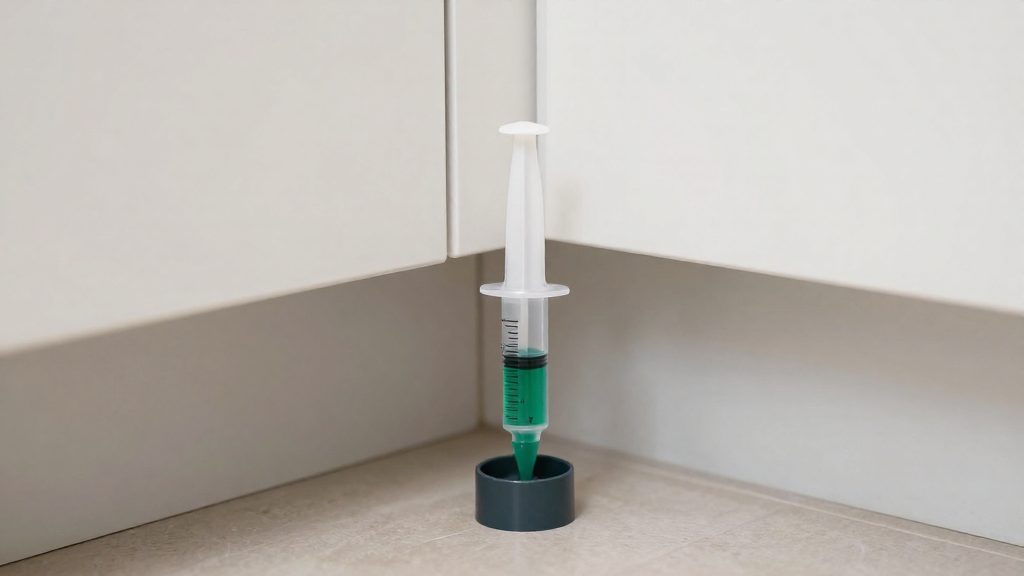
Liquid and gel baits are another option when a trail is easy to reach. The one-week timeframe cited by Today’s Homeowner (2026) applies to bait stations. Liquid and gel baits are sold in several brands, so compare the active ingredient and the label directions before buying. Liquid products are placed as ready-to-use reservoirs, while gel is applied in small dabs on surfaces near the trail. The main difference between products in this category is the active ingredient, so read the label before buying. Choosing by format alone is not enough, because two products in the same format can work differently.
Choosing and timing
Start with the format that matches where the trail runs. Keep baits away from the sink’s water and food residue, since those compete with the bait. If activity has not dropped after about a week, or if infestations keep returning, Today’s Homeowner (2026) advises calling a professional.
How to seal entry points and stop ants coming back
Ants reach a kitchen sink through gaps between the sink, the cabinet, the countertop and the pipes behind them. Sealing these openings and repairing leaks removes both the access route and the water.
Sealing cracks around the sink base and counters
Inspect the joint where the countertop meets the backsplash and the rim of the sink. Failing caulk in these seams lets moisture reach the cabinet and gives ants a route in. Remove the old caulk, and apply a new bead of caulk that fills the full depth of the crack. Check the cabinet back and bottom panels where they meet the wall and seal those gaps the same way.
Caulking gaps around pipes and utility penetrations
Water supply lines, drain pipes and electrical or gas lines pass through the cabinet floor and the wall. Each opening around them is a utility penetration and a possible entry point. Fix any drip first, then fill the gap around the pipe with sealant. Then fill the gap around the pipe with sealant. The wall opening behind the sink matters as much as the visible one under it.
Routine inspection to catch reopened gaps
Check the seals and the under-sink area on a fixed schedule and after any plumbing work. Look for dark staining or soft wood in the cabinet base, since carpenter ants favor damp or moisture-damaged wood, according to Today’s Homeowner (2026). Reopened gaps usually appear first as cracked caulk at the same joints, so re-seal those spots as soon as they show.
| Location | Warning sign | Action |
|---|---|---|
| Countertop-to-backsplash joint | Cracked or peeling caulk | Remove and re-seal |
| Pipe penetrations under the sink | Drips, damp wood, ant trails | Repair the fitting, then seal the gap |
| Wall behind the sink | Gap or stain at a pipe entry | Seal the gap and check for leaks |
When should you call a pest control professional?
Call a professional when ants around the kitchen sink are serious or recurring, meaning they keep returning after moisture has been fixed. According to Today’s Homeowner (2026), this is the threshold for professional treatment.
What a technician does on site
The Cowleys Pest Control case (2026) shows the typical sequence:
- Cleared the debris, then unclogged and sanitized the drain.
- Applied a light liquid treatment to cracks and baseboards.
- Treated the exterior perimeter.
- Advised regular cleaning.
Why the exterior perimeter is treated
Ants carry treatment back to their colony, so interior work alone may not reach the source of the trail. For this reason, the technician treats the outside perimeter together with the cracks and baseboards inside the kitchen. The interior application was a light liquid treatment to cracks and baseboards.
Frequently asked questions
Should I call a professional for ants at my sink?
Start with the home fixes: remove the moisture and clear the food residue. Today’s Homeowner (2026) recommends calling a professional for serious or recurring infestations.
Are the ants living inside my sink drain?
Not necessarily. Pharaoh ants often nest in wall and plumbing voids, and carpenter ants favor damp or moisture-damaged wood, so the nest may sit in the wall or cabinet structure rather than in the drain itself.
What should I do first if the ants keep coming back?
Work in order: fix leaks and tighten fittings, remove food sources, then wipe the trails with vinegar or soapy water. If ants persist, set out bait stations, which Today’s Homeowner (2026) says can eliminate a colony in about a week.