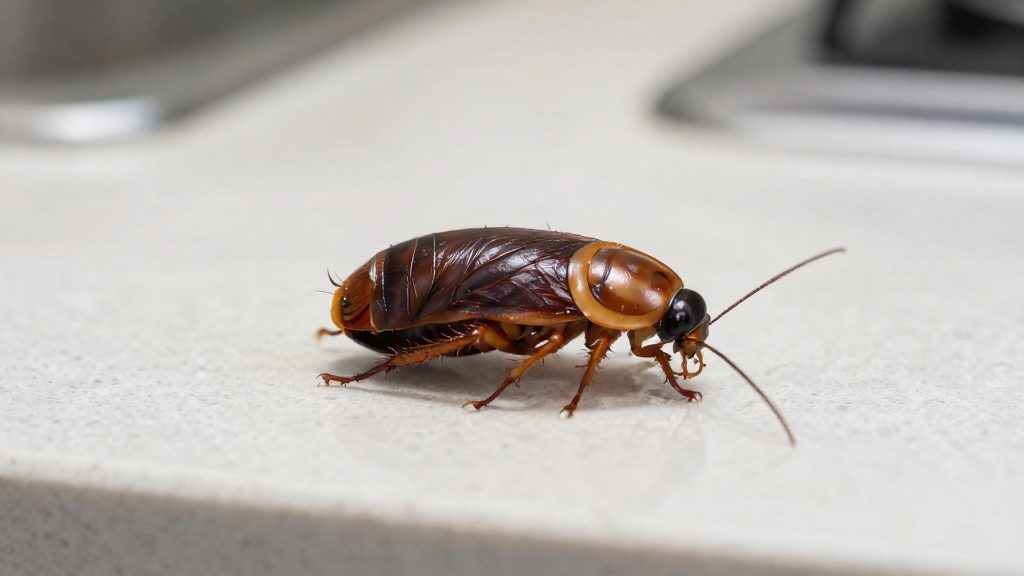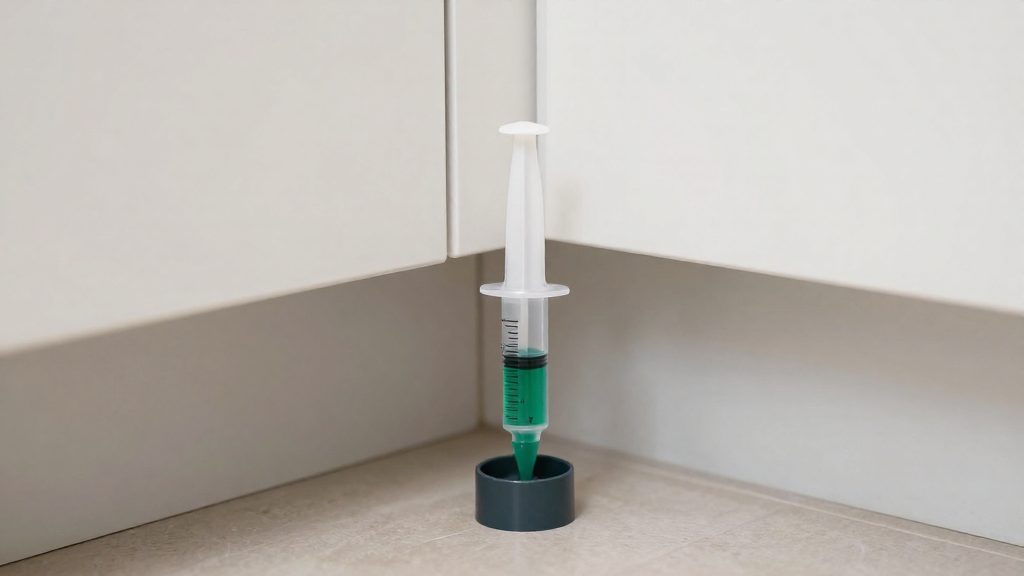
Gel bait is placed where German cockroaches already travel, hide and feed, so placement should target suspected harbourages. The kill therefore does not depend only on each cockroach eating a lethal dose. The mechanism relies on contact and transfer within the colony, so placement should target the spots where cockroaches already gather and feed.
Why gel bait works on German cockroaches
Gel bait spreads through the colony in two ways: direct ingestion and secondary transfer. Gel bait is most effective when it is placed close to the harbourages where cockroaches rest between feeding.
Gel formulation and palatability
The gel’s soft, food-like texture is what makes it attractive to feeding cockroaches. Because the bait is consumed and carried rather than simply encountered, the formulation needs to be palatable enough to draw feeding, and it must remain at the placement point long enough for cockroaches to find it.
Handling and moving the bait
Placing gel on small squares of greaseproof paper, known as bait tacos, keeps surfaces cleaner, and the bait can be moved when a surface needs cleaning. According to Professional Pest Manager, this lets you keep the bait in active feeding areas without leaving residue on surfaces that are cleaned often.
For a practical baiting routine:
- Inspect the area with a flashlight before placing any bait.
- Use sticky-trap catches to judge how much gel to apply and to track results over time.
- At follow-up visits, remove old deposits and re-inspect before deciding where to add new bait.
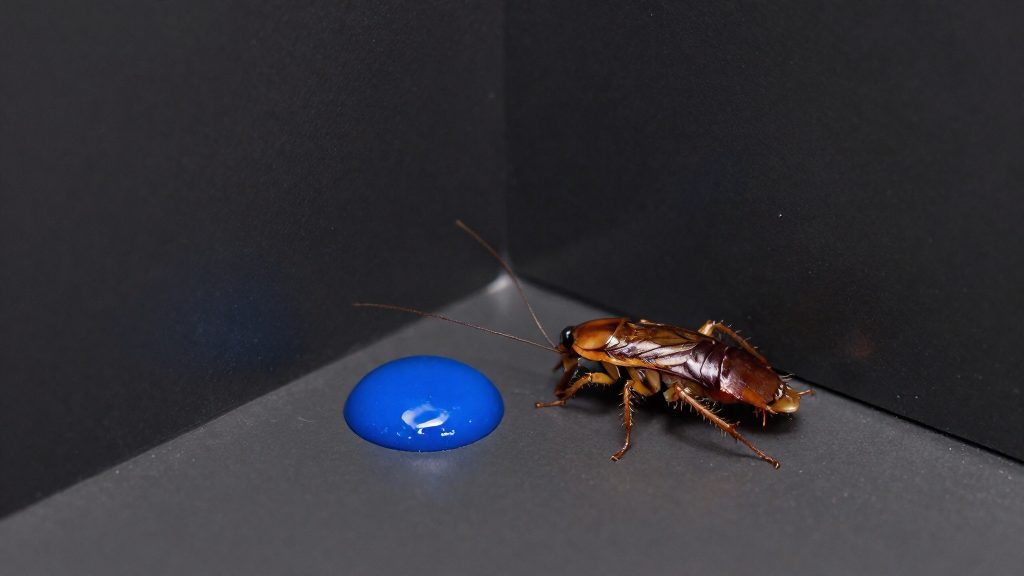
Where should you place roach gel bait?
Gel bait works best where German cockroaches already travel and hide. Placement therefore centres on harbourages, not open floor. According to Professional Pest Manager (trade guidance), gel should go near suspected harbourages in the typical sites below.
| Area | Where to apply gel |
|---|---|
| Cracks and crevices | Along the length of the crack or crevice |
| Cupboard door hinges | At the hinge line where the door meets the frame |
| Electrical junction boxes and plug sockets | Only in nearby gaps and not on or inside live fittings; follow the label and call a professional if unsure |
| Food storage areas with cardboard boxes | On shelves and surfaces beneath and beside the boxes |
| Dishwashers | In and around the unit |
| Under-sink areas | Inside the cabinet, around the pipework |
| Plumbing penetrations | Around pipes where they pass through walls, floors or cabinets |
| Cooking appliances and extraction fans | Around the appliance and fan housing, prioritising spots with grease buildup |
Work through each zone in a fixed order so none is skipped. Cupboards and kitchen appliances often hold several of these sites at once, so check them together. Apply the same small-dot or short-line format at each harbourage, and adjust the amount to the sticky-trap catches.
Keep gel away from areas where it can be disturbed or contaminated by food preparation; if a surface needs cleaning, a bait taco lets you move the bait. Near plug sockets and junction boxes, keep gel out of live electrical parts. Place it only in a nearby gap, follow the label, and use a professional if unsure.
How much gel bait should you apply?
Apply German cockroach gel bait as small dots or a short line near suspected harbourages, following the product label, according to Professional Pest Manager. The quantity is not a fixed amount per room. It is judged from sticky-trap catches, so the same small-dot pattern is repeated at each harbourage and the amount is adjusted to what the traps show.
Scaling to the infestation
- Sticky-trap catches set the amount. Where traps catch more cockroaches, apply more gel at the harbourages in that area. Where catches are low, keep the deposits to the basic small-dot pattern.
- Use the same dot or line format at every harbourage. Keep the dot or line format the same at each harbourage; the label and the trap catches set how much to add.
- Apply gel to all suspected harbourages in the infested area, not only to the spot where you see the most activity.
Applying more during a clear-out
- During a clear-out, apply more gel rather than less. For a clear-out, the trade guidance is that it is better to apply more than less, within the product label.
- Use bait tacos to keep surfaces cleaner: place the gel on small squares of greaseproof paper. The bait can be lifted and moved when a surface needs cleaning, without wiping away the gel itself.
⚠️ Avoid: Do not depart from the product label. Follow the label for how to apply the gel, and use sticky-trap catches to judge the amount.
Inspect and monitor before baiting
A torch inspection shows where German cockroaches are active before any gel goes down. Professional Pest Manager advises inspecting with a torch first, then using sticky traps to locate and size the population and to track results over time. Working this way puts bait where the insects are rather than where the kitchen looks likely to harbour them.
Torch inspection
Work the room with the main lights off and the torch held at a low angle, so the beam catches movement along edges and gaps. Check the typical harbourage points: cracks and crevices, in and around dishwashers, under sinks and around plumbing penetrations, around cooking appliances and extraction fans, cupboard door hinges, electrical junction boxes and plug sockets, and food storage areas with cardboard boxes. Note live insects and any signs of activity at each point, and record where grease has built up, since the trade guidance singles out appliances and extraction fans in that condition.
Sticky traps
Place sticky traps at the same points you inspected, so the catches can be compared directly with what the torch showed. Trap catches reveal which areas hold the most insects, which indicates the size of the population in each zone. Catch counts also inform how much gel to apply: the trade guidance recommends using them to judge the amount, and for a full clear-out, applying more is preferable to applying less.
Tracking results over time
Count the catches at each visit and compare them with the previous check, location by location. A falling count at a point shows that the treatment is working there. A count that does not fall should be re-inspected before anything else is added to that area.
Why isn’t my gel bait working?
When gel bait appears to fail, the cause is usually how it was placed or followed up, not the product itself. Three errors account for most failures: old deposits left in place, bait positioned away from where cockroaches are active, and no record of what the bait is catching.
Old deposits left in place
At a follow-up visit, do not add fresh gel on top of existing old deposits. Adding product this way hides whether the earlier placements worked. Remove the old deposits, re-inspect the treated area, and only then decide where new bait should go, according to MyPMP (trade publication).
Bait placed away from activity zones
Gel should go near suspected harbourages, not spread at random across a room. Professional Pest Manager advises applying it as small dots or a line near these areas, following the label. Typical placement sites include:
- Cracks and crevices
- In and around dishwashers
- Under sinks and around plumbing penetrations
- Around cooking appliances and extraction fans, especially where grease has built up
- Cupboard door hinges
- Electrical junction boxes and plug sockets
- Food storage areas with cardboard boxes
If bait sits in these zones but the cockroaches are using a different route, the bait will not be found. When a surface needs cleaning, gel placed on small squares of greaseproof paper (“bait tacos”) can be lifted and repositioned without losing the bait.
Unmonitored results
Placement errors go unnoticed when nothing is tracked. Professional Pest Manager recommends sticky-trap catches to judge how much gel to apply and to track results over time. If catches stay flat between visits, review the current placement before adding more bait. For a clear-out, the same guidance favours applying more gel rather than less.
Common gel bait placement mistakes
The most common error is smearing gel directly onto a surface that will later need cleaning. Gel spread across an open worktop, a hob surround or the body of a cooking appliance ends up mixed into the cleaning routine, so the bait is either wiped off or disturbed, and the surface stays sticky. The trade guidance is to apply gel as small dots or a line near suspected harbourages, following the label, rather than covering a surface. Sites where grease has built up, such as around cooking appliances and extraction fans, are listed as typical placement sites, but they are also the areas most likely to need degreasing, so gel placed there directly becomes a cleaning problem.
A second error is placing gel in areas that need frequent wet cleaning. Under sinks, in and around dishwashers, and around plumbing penetrations are typical placement sites, yet they are also washed and wiped often. Gel left there is repeatedly wetted and wiped away, which makes it harder to tell whether bait is being taken or simply removed.
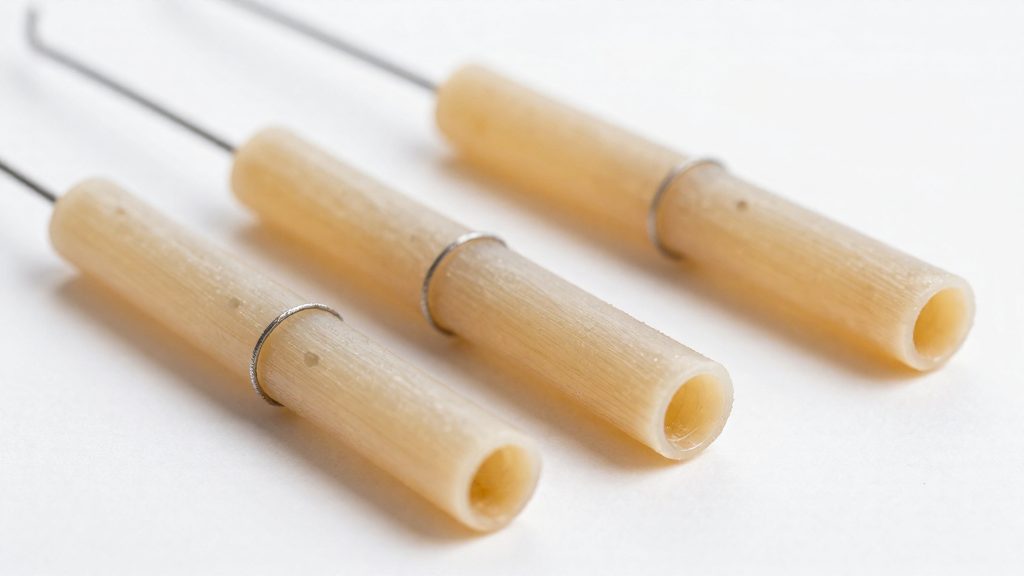
Bait tacos solve both problems. Professional Pest Manager (2025) describes placing gel on small squares of greaseproof paper, which keeps surfaces cleaner because the bait can be lifted and moved when a surface needs cleaning. The workflow is:
- Apply the gel to a greaseproof square, not to the surface itself.
- Position the taco at a typical site, such as a crack, crevice or hinge area near a suspected harbourage.
- When the surface needs cleaning, lift the taco, clean the area, and set the taco back in place, or move it to a new spot if the placement needs changing.
Using frequent wet cleaning areas as a deciding factor, rather than the bait’s location alone, keeps the treatment and the cleaning routine from working against each other. Tacos are the cleaning-safe option wherever the surface around the bait will be wiped, degreased or rinsed.
Is gel bait safe around kids and pets?
Safety around children and pets depends mainly on where the gel is placed and on following the product label. Professional Pest Manager recommends applying gel as small dots or a line near suspected harbourages, following the label, and it lists the usual placement sites: cracks and crevices, in and around dishwashers, under sinks, around plumbing penetrations, behind cooking appliances, at cupboard door hinges, inside electrical junction boxes and plug sockets, and in food storage areas with cardboard boxes. Some of these sites, such as under-sink cabinets, hinges and low gaps, can still be reached by children and pets, so follow the label and place gel where they cannot reach it.
Keeping bait out of reach of children
- Place gel only in the sites listed above, not on open counters, floors or shelves at child height.
- Inspect with a torch first so you apply gel to a specific crack or harbourage rather than spreading it across a wide area.
- Check the product label before use for precautions and first-aid instructions, and keep the product stored where children cannot reach it. If a child or pet swallows gel bait, call Poison Control at 1-800-222-1222 or a veterinarian right away.
Controlling pet access
Pets are more likely to walk over floors and investigate low gaps than to reach fixtures. Apply gel where a pet cannot step on it or lick it, and avoid placing it at floor level along pet walkways or near food and water bowls.
Using bait tacos to limit surface contact
Placing gel on small squares of greaseproof paper, known as “bait tacos”, keeps the gel off surfaces and lets you move it when a surface needs cleaning. Use this method in any area a child or pet can access, and keep the paper squares in the sites listed above.
When to call a pro
Gel baiting depends on monitoring. If sticky-trap catches do not fall after repeated bait rounds, the infestation has likely outgrown what placement alone can fix. Use the trap counts you recorded at the start as your baseline. A trend that stays flat or rises across several rounds is the signal to escalate, not the number of days elapsed.
Before a professional visit, do not add new gel onto old deposits. According to MyPMP (trade publication), the correct sequence is to remove old deposits, re-inspect, and only then decide where new bait goes. Doing this first gives the operator a clearer picture of where the population is concentrated.
Professional follow-up should be part of the service, not a single visit. Ask the operator how return visits are scheduled and what they check at each one: whether old deposits were removed, whether sticky traps were re-read, and whether bait placement was adjusted to the catches. A visit that only adds bait without reviewing trap results should prompt questions.
Choosing a licensed operator means confirming that the company holds the pest-control licence required in your state and checking it with your state’s licensing authority, not relying only on the company’s own statement. Ask for an inspection with a torch before any quote is given. Ask how they will monitor results. Operators who can explain their placement sites, such as cracks and crevices, behind and under dishwashers and sinks, cupboard door hinges, electrical junction boxes and plug sockets, and who describe a trap-tracking method, can justify their plan.
Frequently asked questions
How much gel should I apply at each spot?
Apply small dots or a line near suspected harbourages, following the product label. Use sticky-trap catches to judge the amount, and during a clear-out, apply more gel rather than less.
Is it safe to put gel bait near plug sockets and junction boxes?
Electrical junction boxes and plug sockets are listed among typical placement sites, so they are a valid spot where cockroaches travel. Follow the label’s directions for any electrical fitting, and keep the placement limited to the small dots or line described for other sites.
How can I tell whether the gel is working?
Place sticky traps before treatment and keep checking them, because the trend in catches over time is the clearest sign of progress. A single inspection shows only the cockroaches present on that day.