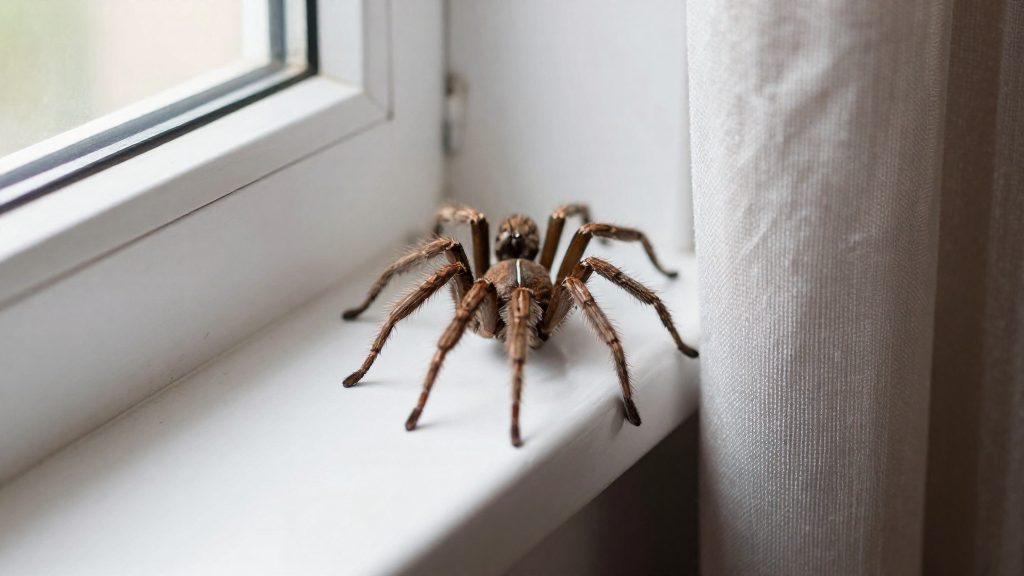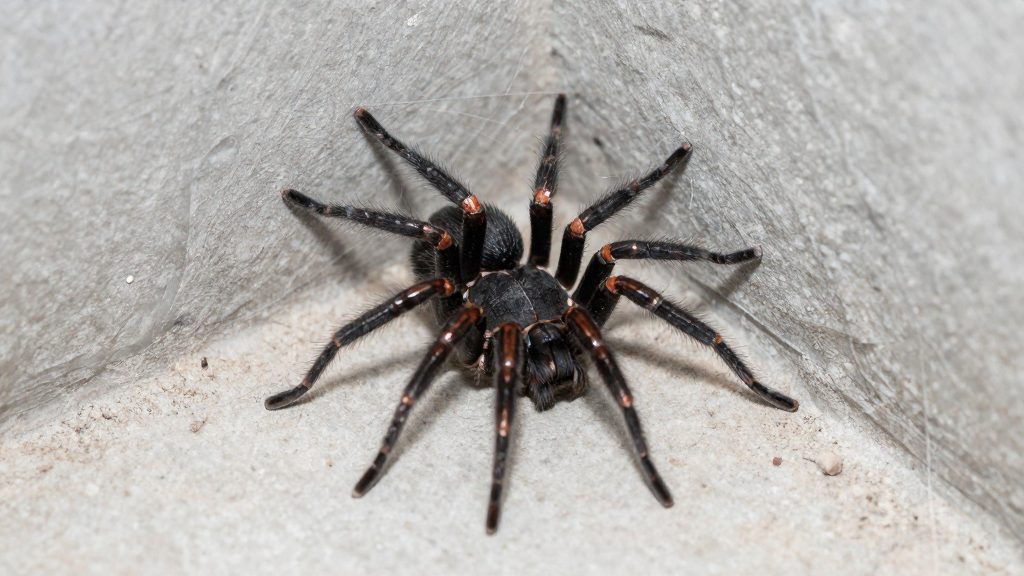
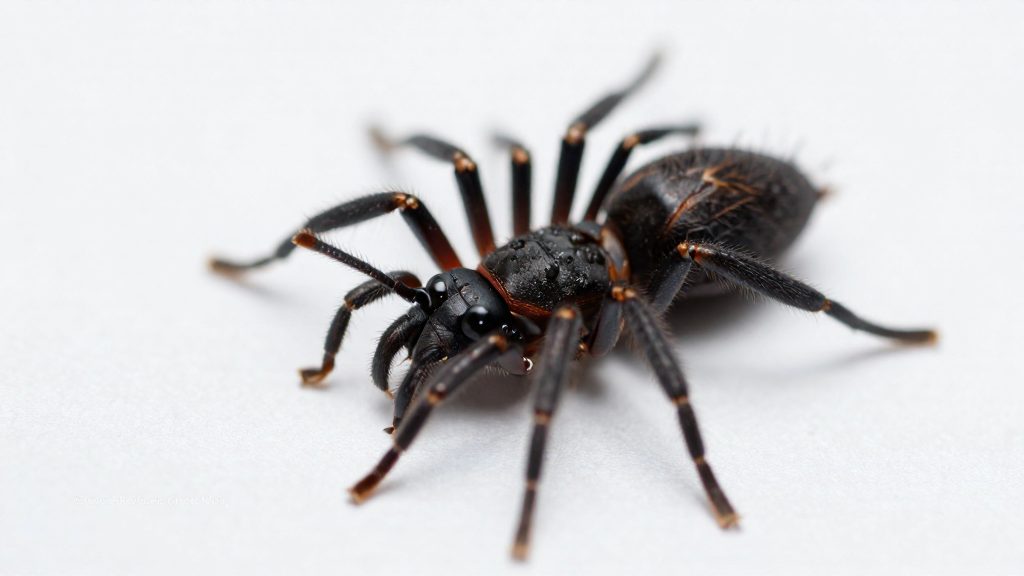
Black widows have a glossy black body with a red hourglass marking, which is usually on the underside of the abdomen. Confirm the marking before acting, because colour alone does not settle the identification.
How do I know it’s a black widow?
Body colour and the hourglass marking
The adult black widow has a shiny black body with a smooth, glossy surface. Mississippi State University Extension (2020) describes the red hourglass as its defining feature, often on the underside. Look at the spider from a safe distance, using a flashlight, and do not pick it up or try to turn it over.
Where to look in a garage
According to Mississippi State University Extension (2020), black widows nest in dark, protected spots near the ground. These include:
- Lumber and trash piles
- Hollow concrete blocks
- Overturned flowerpots
- Water meter housings
Irregular webs in dark corners
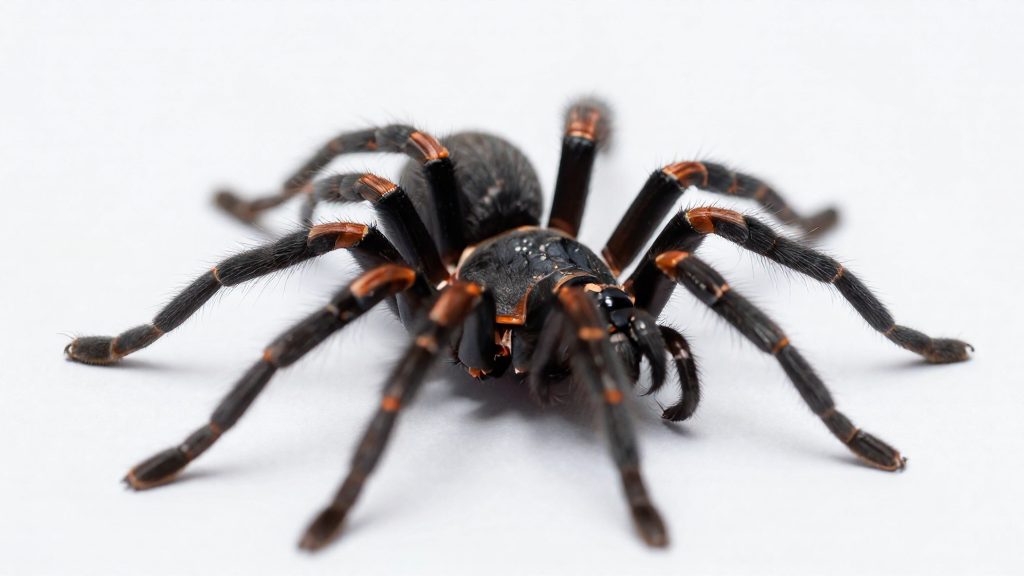
Irregular, tangled webs in dark, undisturbed corners are the sign to check first. Inspect the floor edges, the underside of shelves and the space behind stored items. Keep your hands out of any web.
Why do black widows nest in garages?
Black widows are outdoor spiders that favor dark, undisturbed sites near the ground. The Alabama Cooperative Extension System (2019) notes that they usually live outdoors in such spots, and Mississippi State University Extension (2020) describes their nests as dark, protected places close to the ground. Garages, sheds and cellars are often the closest match to those conditions.
Outdoor nesting sites
Outdoors, black widows nest in places that combine darkness, shelter and little disturbance:
- Woodpiles
- Debris
These sites share two features: they sit low to the ground, and they are rarely moved. Items stored in a garage or shed, such as stacked lumber or bags of trash, offer the same features.
Cold weather and drought drive indoor migration
When conditions outdoors become harsh, black widows may move indoors. Cold weather and drought can push them out of their outdoor sites and into garages, sheds, barns, cellars, crawl spaces and utility boxes, according to the Alabama Cooperative Extension System (2019). These structures stay dark and sheltered, so they keep the same conditions the spiders already prefer.
Inspecting likely shelters
Because black widows favor these locations, inspect the same kinds of spots indoors that they use outdoors. Check stored lumber, trash piles, utility boxes and cellar corners first. These are the areas where a black widow is most likely to have taken shelter during cold or dry periods.
Is it safe to remove a black widow yourself?
Do not remove black widows with your bare hands, because the bite risk depends largely on how you handle them. According to the Alabama Cooperative Extension System (2019), only females bite, and only when they are pressed against skin. Keeping your hands and body away from the spider lowers the risk, but it does not remove it.
Black widows hide in dark, undisturbed spots, so the risky moment is usually reaching blind into debris. Mississippi State University Extension (2020) notes that most bites happen when someone reaches into a web or crushes a spider against their body. Two habits help reduce the risk:
- Wear gloves whenever you clear debris, stacked boxes, or stored items.
- Use long-handled tools, such as a broom, tongs, or a stick, to lift and move material, so your hands and body stay outside the web area.
Move items slowly and look before you lift. Lift one object at a time with a long-handled tool rather than pulling out a full pile at once.
Stop the removal and reassess when the risk rises:
- Spiders are numerous. Many spiders in one spot mean more chances of accidental contact.
- Spiders are hidden in places you cannot see into, such as utility boxes.
Once you stop, shift to exclusion.
Vacuuming webs and egg sacs
Sanitation means inspecting for breeding areas first, then vacuuming up spiders, webs and egg sacs.
Inspecting breeding areas before vacuuming
Inspect every nesting site before starting the vacuum, so you know where the webs and egg sacs are.
Vacuuming webs and egg sacs
Vacuum the spiders, webs and egg sacs you find at each site, keeping your hands away from the webs.
Sealing and disposing of the bag
Keep the vacuum motor running while you seal the bag. Once sealed, dispose of the bag outside rather than in an indoor bin.
Do insecticides work on black widows?
Rarely, and not as a first step. Insecticides are not very useful against black widows, so the best approach is removing nesting sites. The Alabama Cooperative Extension System (2019) names integrated pest management as the best approach, with nonchemical methods as the primary control technique. Chemical products are a targeted addition for serious infestations, not a routine garage treatment.
Nonchemical methods come first
In a garage, inspect and clear every nesting site.
When a labeled spider product is justified
Use a product labeled for spiders only when the infestation is serious. Where a labeled product is used, apply it to these targets:
| Target | Permitted application |
|---|---|
| Corners and web sites | Spot treatment with a pyrethroid or other labeled product |
| Crawl spaces | Dusting |
Spot treatment limits the product to the places where black widows rest and build webs, rather than treating the whole garage.
Product limits and professional help
Read the label before buying or applying any product, and follow it exactly. Some products are restricted to licensed professionals, so you cannot legally apply them yourself. For infestations, consider hiring a professional.
Clearing clutter and sealing entry points
Exclusion is the nonchemical part of control. Exclusion has three parts: removing the debris where spiders hide, sealing gaps in the structure, and fitting screens on the vents.
Removing debris, woodpiles and stored boxes
Start by clearing the dark, undisturbed material where black widows shelter. The main targets are woodpiles and debris, along with stored boxes. Inspect the undersides and back panels of stored boxes before you handle them, and keep them off the floor once cleared.
Sealing windowsills, door thresholds and pipe gaps
Walk the garage perimeter at ground level and at windowsill height. Seal every crack and gap you find at windowsills, door thresholds and pipe entries. Each opening you leave unsealed can be a route into the garage.
Screening attic and foundation vents
Fit tight screens on attic and foundation vents to block entry. Check the screens regularly for gaps, since a loose or damaged screen admits the same spiders as an open vent.
When should I call a professional?
A licensed pest control operator should take over when a black widow problem outgrows household methods. The Alabama Cooperative Extension System (2019) advises considering a professional for infestations. Three situations signal when to do so.
Infestations too large for DIY sanitation and exclusion
Sanitation means inspecting for breeding areas and vacuuming up spiders, webs and egg sacs. When spiders are spread across a garage and linked spaces such as a shed, barn, cellar or crawl space, and you cannot inspect and clear every hiding place, the job has outgrown a homeowner’s routine. Some products are also restricted to licensed professionals, so a large infestation may require an operator to apply them.
Infestations that return after sanitation and exclusion
Recurrence usually means a nesting site remains untouched. Mississippi State University Extension (2020) notes that insecticides are not very useful against them, and that removing nesting sites is the best approach. If spiders reappear after you have cleared debris, sealed gaps and removed egg sacs, check each nesting site. If you cannot identify or reach the site, an operator should assess the property.
Returns after a dry or cold spell may reflect new spiders moving in from outdoors, so check both the nesting sites and the entry points.
Finding egg sacs inside living spaces
Egg sacs are part of the breeding cycle that sanitation targets, so finding them inside a living area means breeding is happening nearby. Inspect the surrounding space for nesting sites, then check whether exclusion work has closed the entry points. If the breeding site cannot be found or cleared, or egg sacs keep appearing, call a licensed operator rather than repeating the same steps.
What should I do after a bite?
Treat a black widow bite as a medical concern, not just a wound. Wash the site with mild soap and water, apply antibiotic ointment, and hold a cool compress on the bite. Contact a doctor or your local poison control center promptly after any bite, and seek emergency care right away if pain is severe or spreading, if you develop muscle cramps or trouble breathing, or if the person bitten is a young child. The first-aid guidance also includes checking your tetanus status. Wash the site with mild soap and water, apply antibiotic ointment, and hold a cool compress on the bite to ease local discomfort. The first-aid guidance also includes checking your tetanus status. According to the Alabama Cooperative Extension System (2019), these steps cover the standard first response to a bite.
First-aid steps
- Wash the bite with mild soap and water.
- Apply antibiotic ointment to the bite.
- Place a cool compress over the area.
- Check your tetanus status.
Symptom timeline
Pain is the main symptom to track, and it follows a predictable pattern:
| Time after bite | What to expect |
|---|---|
| 1 to 3 hours | Pain peaks |
| 12 to 24 hours | Pain usually fades |
Keep the cool compress in use during the peak window, since that is when pain is most intense. Pain usually fades within 12 to 24 hours, but if pain is severe, spreading or worsening, or if muscle cramps, trouble breathing or other symptoms appear, seek emergency care right away.
Who faces the greatest risk
Children under 30 lb (about 13.6 kg) face the greatest risk from a black widow bite. Deaths are rare, according to the Alabama Cooperative Extension System (2019). Because of the higher risk for small children, contact a doctor or poison control right away for any bite on a child, and follow the first-aid steps while you arrange care.
Frequently asked questions
Should I hire a professional to remove black widows from my garage?
The Alabama Cooperative Extension System (2019) advises considering a professional for infestations, because some products that work against spiders are restricted to licensed applicators. Hiring one is most worth it when you find webs in several corners or spiders keep returning after you have cleared the nesting sites.
Will a spray insecticide get rid of black widows in my garage?
Usually not on its own. Mississippi State University Extension (2020) notes that insecticides are not very useful against black widows, so removing their nesting sites comes first. Where a serious infestation justifies chemical control, a spider-labeled pyrethroid can be spot-treated on corners and web sites, and crawl spaces can be dusted.
What should I do if I find an egg sac while cleaning?
Vacuum the egg sac up along with any spiders and webs nearby. Keep the vacuum motor running while you seal the bag, then dispose of the bag outside the garage.