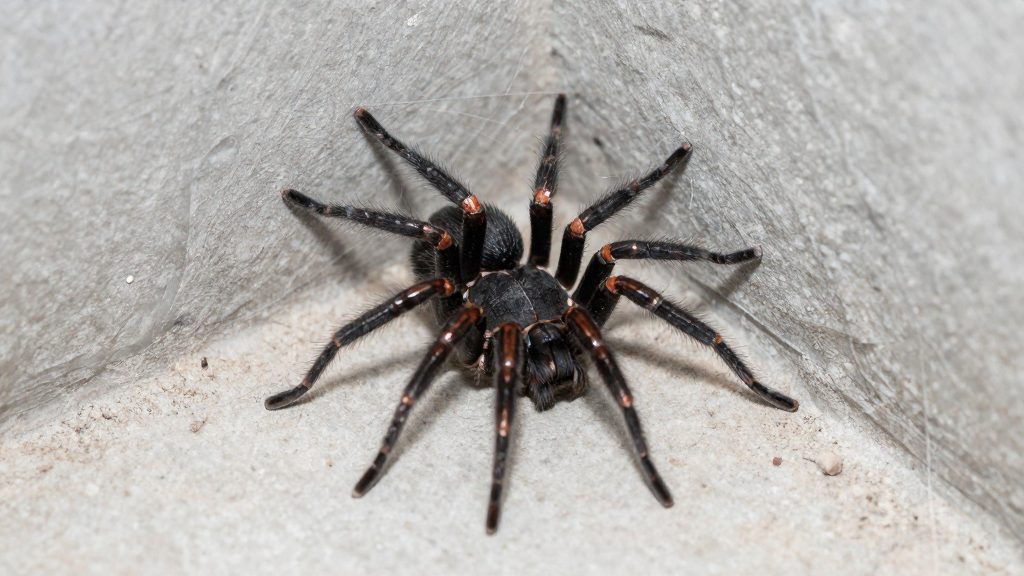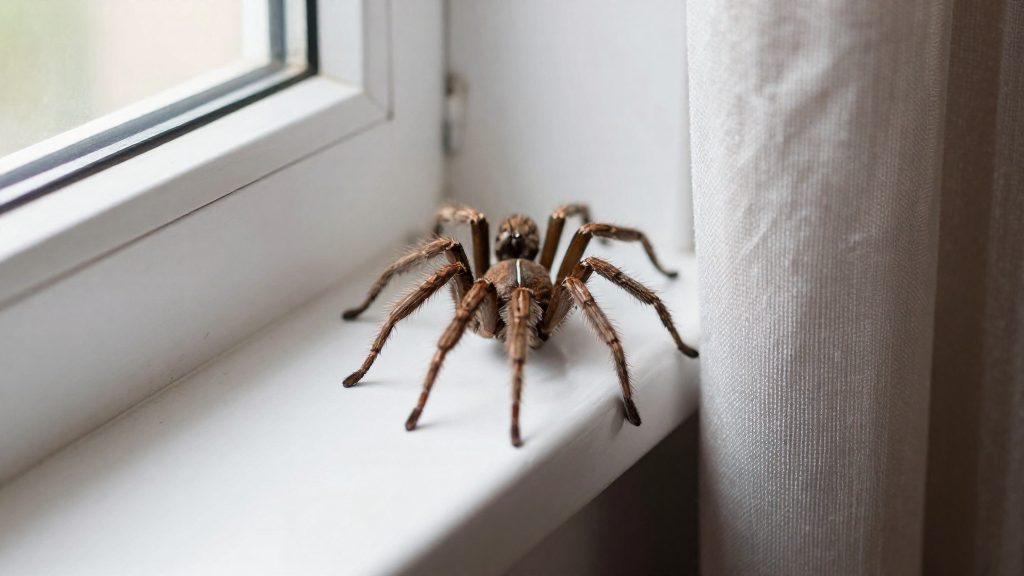
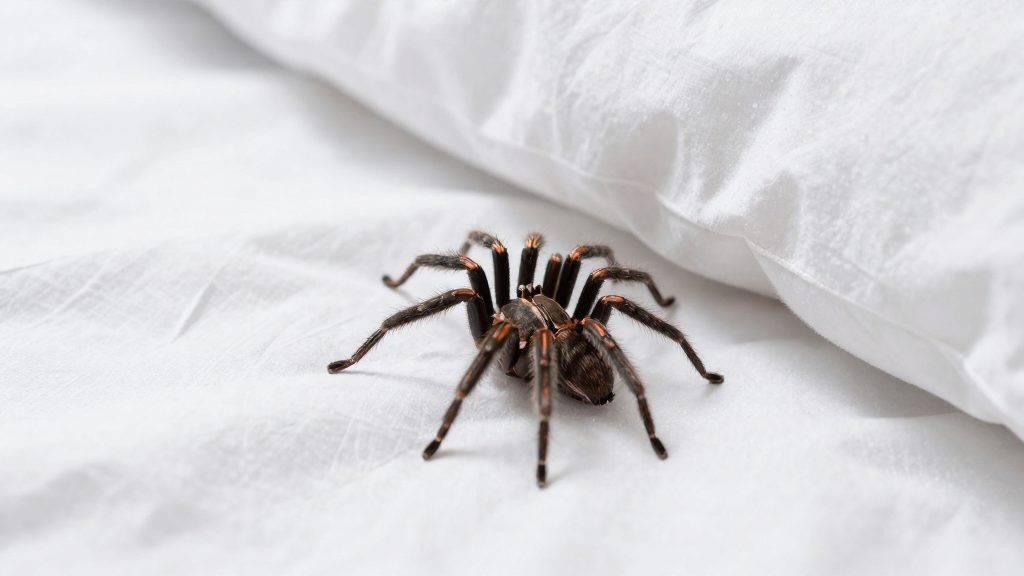
Spiders end up in bedrooms mainly because they follow prey and look for shelter. They are predators, so any room where insects are present becomes a hunting ground, and they settle where food is reliably found. According to UC IPM (University of California, 2026), spiders and the insects they feed on both enter homes, so the two problems are closely linked.
Why do spiders end up in the bedroom?
Indoor prey draws spiders in
Spiders hunt insects, not people, so a bedroom with flying or crawling insects inside it is worth their time. A spider that finds prey indoors tends to stay near it rather than move on. Because spiders feed on insects, a bedroom with a steady supply of insects may be more attractive to them than one without.
Seasonal movement and shelter
Spiders also move indoors in search of shelter. Spiders may also move indoors in search of shelter, and quiet, undisturbed spaces that are rarely cleaned or moved can suit them.
Nocturnal hunting
Spiders are often noticed by chance
Spiders can go unnoticed in a quiet bedroom, so they are often spotted only by chance.
Methods for controlling spiders in and around the home, with their reported effectiveness.
| Method | Details | Source |
|---|---|---|
| Vacuuming spiders, webs and egg sacs | Effective from corners, windows and storage areas; spiders’ soft bodies usually don’t survive the trip through the hose | UC IPM, University of California (2026) |
| Crushing or vacuuming spiders | Easier and much less toxic than insecticides | UC IPM, University of California (2026) |
| Insecticide sprays | Do not provide long-term spider control | UC IPM, University of California (2026) |
| Sealing cracks, gaps around windows and doors, and fitting good screens | Keeps out spiders and the insects they eat | UC IPM, University of California (2026) |
| Sticky traps | Non-insecticidal indoor removal; place where children and pets can’t reach them | UC IPM, University of California (2026) |
| Bedroom spider-proofing | Vacuum under the bed and behind furniture, wipe surfaces weekly, remove webs, push furniture against walls, use night lights in closets | Hawx Pest Control (2026) |
| Limiting outdoor lighting | Outdoor lights attract the insects spiders feed on; motion-activated floodlights reduce this | Hawx Pest Control (2026) |
| Essential oils (lavender, tea tree) | Mixed results as spider repellents | Hawx Pest Control (2026) |
| Professional exterior treatment | Described as the most effective way to repel spiders | Hawx Pest Control (2026) |
Seal the entry points
Spiders reach a bedroom through the same openings they use to get to the insects they feed on. According to UC IPM (University of California, 2026), sealing cracks in the foundation and gaps around windows and doors, and using good screens, keeps out both spiders and their prey. Start at the building’s perimeter, then move to the window and door openings that lead into the bedroom.
Cracks in the foundation
Walk the outside of the house at ground level and check where the foundation meets the wall and where the wall meets the soil. Mark each crack you find, then seal it with a masonry or exterior-grade sealant so that no opening remains. Recheck the same spots after heavy rain or seasonal ground movement, since new cracks can open and let spiders in.
Gaps around windows and doors
Inspect the joint between each window or door frame and the surrounding wall, as well as the gap under exterior doors. Look for light showing through the frame when you stand inside the bedroom at night. Seal any visible gap with a flexible caulk, and fit a door sweep or threshold seal where the gap sits at the base of the door. Do this for the bedroom window first, since it is the opening closest to where you sleep.
Good screens
Fit screens on every window that opens, including the bedroom window, and check them regularly for tears, holes and gaps at the frame edges. Keep screens firmly fixed in their tracks, because a loose screen leaves a path open even when the mesh itself is intact. Repair or replace a damaged screen promptly, and do not leave a window open without one.
Declutter and clean to remove hiding spots
According to UC IPM (University of California, 2026), vacuuming spiders, webs and egg sacs from corners, windows and storage areas is an effective control technique, because spiders’ soft bodies usually don’t survive the trip through the hose. Vacuuming is also easier and much less toxic than insecticide sprays. Removing webs and egg sacs during cleaning also cuts down the number of hiding spots a spider can use in the bedroom.
Corners, windows and storage areas
Use the crevice tool to clean the junctions between walls and ceilings, window frames and tracks, and the corners of the room, where webs and egg sacs are found. Then clean the storage areas: the inside of closets, the spaces under sinks, and stored boxes and bags. Open the boxes and check their corners and seams before putting them back.
Under the bed and behind furniture
Vacuum under the bed and behind the headboard, dressers and nightstands, as Hawx Pest Control (2026) recommends. Lift the bed skirt or remove it before cleaning, so the vacuum reaches the full area under the frame.
Pushing furniture against walls
Push furniture flush against the walls to remove hiding spots. Moving a dresser or bed frame away from the wall exposes the gap behind it, and pushing it back closes that space. Check the area behind the furniture after each move, since the webs and egg sacs there are removed with the vacuum.
Regular maintenance
Keep the bedroom clear by weekly wiping of surfaces and removing any new webs, as recommended by Hawx Pest Control (2026). Vacuum the areas listed above at the same time so that egg sacs do not build up between cleanings.
Do essential oils really repel spiders?
Lavender and tea tree are the essential oils most often suggested as spider repellents. According to Hawx Pest Control (2026), both give mixed results, so neither can be relied on as a control method. Whether a spray changes spider activity in a given room is hard to predict in advance.
The mixed results reflect inconsistent evidence rather than a clear pattern of success or failure. An oil that appears to reduce sightings in one bedroom may have no visible effect in another, because every home has different entry points and different levels of insect activity for spiders to feed on. Expectations should be set accordingly before any treatment begins.
Practical approach for a bedroom:
- Use oils as a supplement only. Apply lavender or tea tree spray alongside physical measures, never in place of them. Where spiders have already built webs, an oil spray should not be the only step taken.
- Test one room first. Compare spider sightings in the treated bedroom with an untreated room before extending the approach to the rest of the home.
- Judge results by observation. Record sightings and webs over a set period. If the counts do not change, stop relying on the oil and move to methods with documented effects.
Are sticky traps and sprays worth using?
Insecticide sprays are a poor choice for spider control. According to UC IPM, University of California (2026), they do not give long-term control. A treated corner may look clear for a short time, but the result does not last. Spraying also places insecticide on surfaces that people and pets touch, so the cost in exposure is high for a benefit that fades.
Sticky traps are the non-insecticidal alternative in the same guidance. UC IPM, University of California (2026) identifies them as a non-insecticidal way to remove spiders indoors. Because they capture spiders without an insecticide, they are a non-insecticidal option for removing spiders indoors.
Placement is the main safety rule. Put sticky traps where children and pets cannot reach them, and check their position before leaving them in place. The adhesive surface can catch or stick to anything that touches it, so a trap within a child’s or pet’s reach creates a hazard that a trap out of reach does not.
Sticky traps are a targeted tool for removing spiders that are already indoors. UC IPM says that vacuuming or crushing spiders is easier and much less toxic than insecticides, and it lists sticky traps as a non-insecticidal way to remove spiders indoors.
Cut back outdoor lights and nearby prey
Outdoor lighting is a direct way to draw prey, and spiders follow their prey. According to Hawx Pest Control (2026), outdoor lighting attracts the insects spiders feed on, so a constantly lit entrance or patio can keep a steady food supply near the walls. Reducing that light may mean fewer insects, and so fewer spiders, near the building.
Switch to motion-activated floodlights
Hawx Pest Control (2026) recommends limiting outdoor lighting, with motion-activated floodlights as one option. A motion-activated unit lights the area only when someone is present, so it does not stay on through the night.
- Identify always-on fixtures. Walk the perimeter after dark and list every light that stays on continuously.
- Replace the busiest ones first. Start with the fixtures near doors and windows, since these are the points where spiders are most likely to move indoors.
- Set the sensor range. Aim the sensor at the path you actually use so that it does not trigger from passing traffic or for areas you do not need lit.
- Check the timer. Confirm the unit turns off after it has detected movement, rather than running for a long fixed period.
When should you call a pest professional?
A bedroom that keeps getting visited despite consistent indoor work may call for a different approach. According to Hawx Pest Control (2026), a professional exterior treatment is the most effective way to repel spiders, so it is the logical next step once the indoor routine no longer keeps the room clear.
Persistent activity after the indoor work is a useful signal. If spiders or new webs still appear after you have vacuumed corners and storage areas, removed webs and cleared hiding spots, spiders may be arriving from outside, so check the entry points. Before booking a service, check whether those entry routes are still open.
Call a professional when both of the following are true:
- The bedroom has been vacuumed under the bed and behind furniture, and surfaces have been wiped on a regular schedule.
- Spiders or webs still return to the room after this routine has been kept up consistently.
When these conditions are met, a professional exterior treatment addresses the source of the activity, which home measures alone cannot reach. Ask the provider which areas of the exterior they plan to treat and whether the work covers the foundation perimeter where the bedroom’s outside walls meet the ground.
Frequently asked questions
Do essential oils such as lavender or tea tree keep spiders out of a bedroom?
Results are mixed. According to Hawx Pest Control (2026), these oils do not reliably repel spiders, and a professional exterior treatment is described as the most effective way to repel them.
Is an insecticide spray a good option for a bedroom?
UC IPM (University of California, 2026) states that insecticide sprays do not provide long-term spider control. Crushing or vacuuming a spider is easier and much less toxic.
Do outdoor lights make spiders more likely to come indoors?
Outdoor lighting attracts the insects that spiders feed on. Hawx Pest Control (2026) suggests limiting it, for example with motion-activated floodlights.