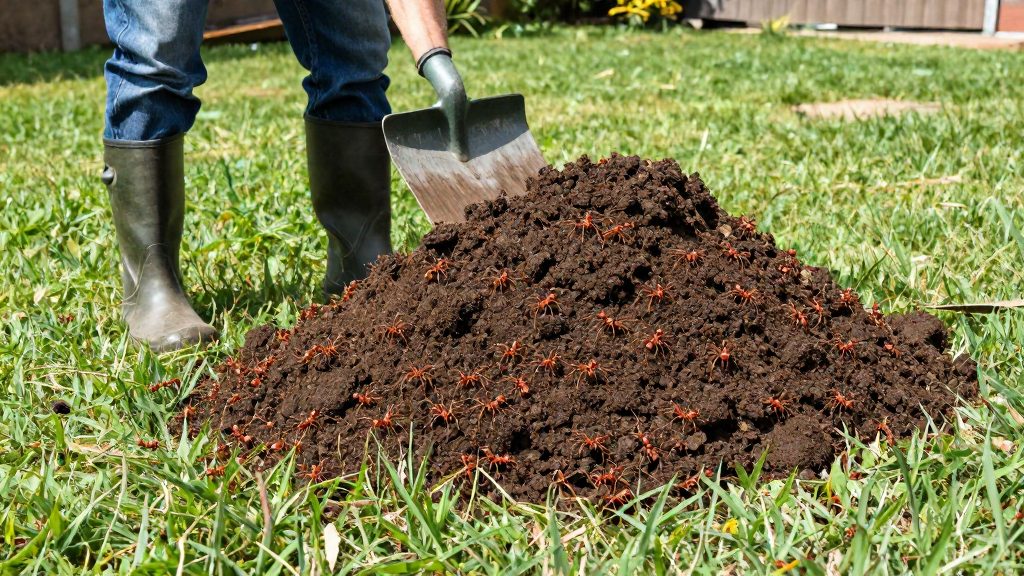
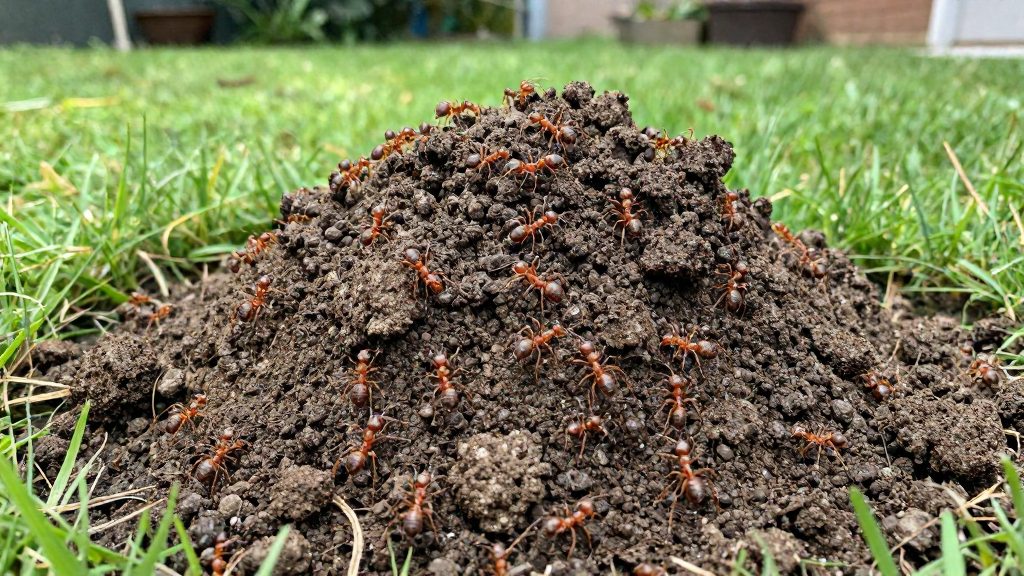
A mound built by imported fire ants usually has no central entrance hole. Workers enter and leave through underground tunnels that open at the surface without a single visible door, so a missing central opening is the first structural clue to check. Confirming the nest type before treatment matters because the appropriate method depends on whether the colony is an imported fire ant colony.
Is This a Fire Ant Mound?
Checking for a Central Entrance Hole
Inspect the top and sides of the mound for a single opening. If one clear central hole is present, the nest is less likely to be an imported fire ant mound and should be checked against the other features below before you apply any product.
Reading the Underground Tunnel Pattern
Because the entrances sit below the surface, you will usually not see ants repeatedly going in and out of a hole. Foraging workers normally use underground tunnels that open at the soil surface away from the mound, so watching the mound itself may reveal little traffic. Activity that appears without a central hole fits the tunnel-based entry pattern of imported fire ants.
Telling Fire Ant Mounds from Other Ant Nests
Use the central-hole check and the tunnel pattern together rather than relying on either alone. A nest with a central opening and visible traffic through it does not match the imported fire ant structure described above. When the features are unclear, contact your local extension service, such as the Texas A&M AgriLife Extension Service or the University of Florida IFAS Extension, for identification before choosing a treatment.
Choose Spot Treatment or Yard Baiting
Yard size and mound count decide whether to use individual treatment or broadcast bait. Texas A&M AgriLife Extension Service identifies individual mound treatment as suited to small areas with few mounds, and to situations where preserving native ants is a priority.
| Situation | Suggested approach |
|---|---|
| Small area with few mounds | Individual mound treatment |
| Native ant preservation is a priority | Individual mound treatment |
| Larger infestation with several active mounds | Two-Step Method |
Two-Step Method for Larger Infestations
The Two-Step Method combines broadcast fire ant bait with individual treatment of troublesome active mounds, according to Texas A&M AgriLife Extension Service. Mississippi State University Extension Service advises waiting several days after broadcasting bait before applying contact treatments to individual mounds, so workers have time to carry bait into the colony.
Individual Treatment for Limited Infestations
Before treating a mound, leave it undisturbed. Mississippi State University Extension Service warns that disturbing mounds can cause workers to move queens deeper underground or establish satellite mounds, which complicates control.
Apply Fire Ant Bait Correctly
Bait works only when foraging workers pick it up and carry it into the colony, so product type, timing and placement all matter.
Choose granular bait, not contact granules
Granular baits and granular contact insecticides work differently. Workers collect bait as food, while contact granules are not attractive food.
| Product type | Worker response |
|---|---|
| Granular bait | Collected as food and carried back into the colony |
| Granular contact insecticide | Not attractive as food, so not collected for transport |
According to Mississippi State University Extension Service, this difference is why bait, not a contact product, is the tool for delivering a toxicant inside the nest.
Time applications to active foraging
Texas A&M AgriLife Extension Service recommends applying bait when ants are actively foraging. Seasonal timing varies by region and active ingredient.
Place the label amount around the mound
For individual mound treatment, spread the amount specified on the label around the mound, not directly on top of it. Mississippi State University Extension Service gives this placement guidance.
Treat Troublesome Mounds Without Disturbing Them
For an active mound causing problems in a small area, a liquid drench is the faster option. Mississippi State University Extension Service reports that liquid insecticide drenches generally control individual problem mounds faster than bait treatments.
Avoid probing, flattening, or digging into the mound before applying the drench.
Does Boiling Water Kill Fire Ants?
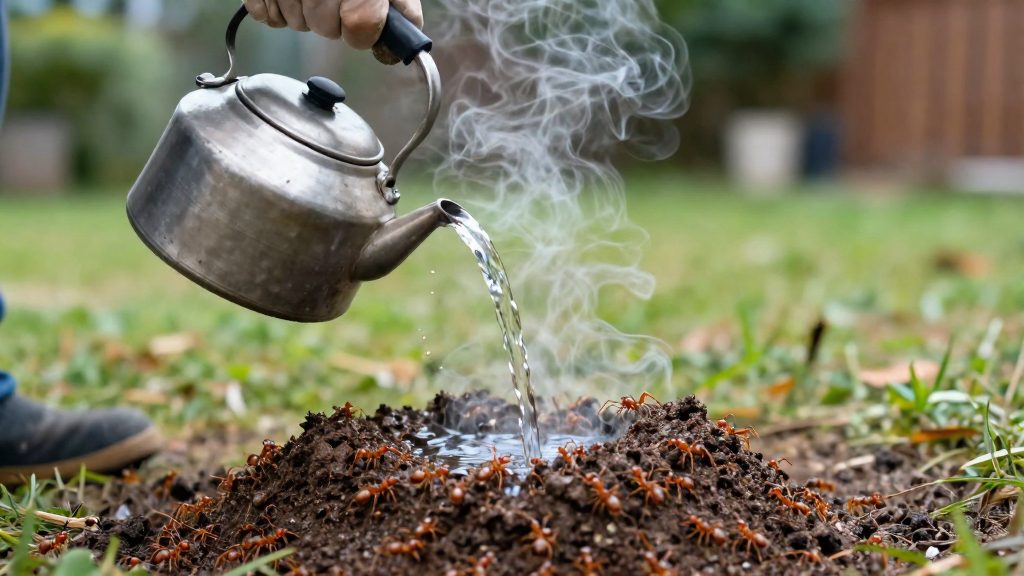
Hot water kills fire ant workers it touches, but it is an unreliable way to eliminate a colony. According to UF/IFAS Extension, scalding-water treatments eliminate colonies at a rate of 20%–60%, so a large share of treated mounds survive.
Why Surface Contact Is Limited
Water poured on the mound has no single opening to flow into. Its effect concentrates on the mound surface and on the tunnels it soaks into directly, and it does not reliably reach the rest of the nest.
Queens Sheltered Deeper
Hot water may fail to reach and kill every queen; queen location varies with conditions within the nest. A colony that relocates its queen can survive the treatment even when most of the mound’s workers die.
Avoid Ineffective and Dangerous Home Remedies
Improvised remedies usually fail because they do not reach the queen. According to University of Florida IFAS Extension, eliminating a fire ant colony requires killing its queen, or all queens in a multiple-queen colony. A remedy that kills only the surface workers leaves the queen and the colony intact.
Ineffective home remedies (University of Florida IFAS Extension):
- Grits
- Club soda
- Mixing ants from different mounds
Scalding water is unreliable and hazardous. UF/IFAS reports a 20%–60% colony elimination rate for scalding-water treatments and warns that hot water can burn the user and injure nearby plants.
Hazardous mixtures. UF/IFAS classes the following as dangerous or environmentally harmful when used on mounds:
- Gasoline
- Bleach
- Ammonia
- Battery acid
- Other cleaning products
Monitor Your Yard for Returning Colonies
Treatment does not give permanent protection. According to University of Florida IFAS Extension, fire ants can reinfest a yard after control measures stop, so monitoring has to continue after the first application.
Scanning Treated Areas for New Mounds
- Walk the treated area on a regular schedule and check for new mounds, including small ones near the original nest.
- Look for mounds with no single opening.
- Record any satellite mounds and check them for activity, without assuming that each represents an independent colony; follow the product label when deciding where to treat.
Retreating Colonies That Return
- Treat a returning mound as a new target.
Recording Dates and Mound Locations
- Log each treatment date, the mound’s location, the product used and the application rate.
- Mark mound positions on a simple sketch of the yard so you can tell a retreat on a known colony from a new one.
- Set follow-up dates for each product. No single timeline applies across regions, products and seasons.