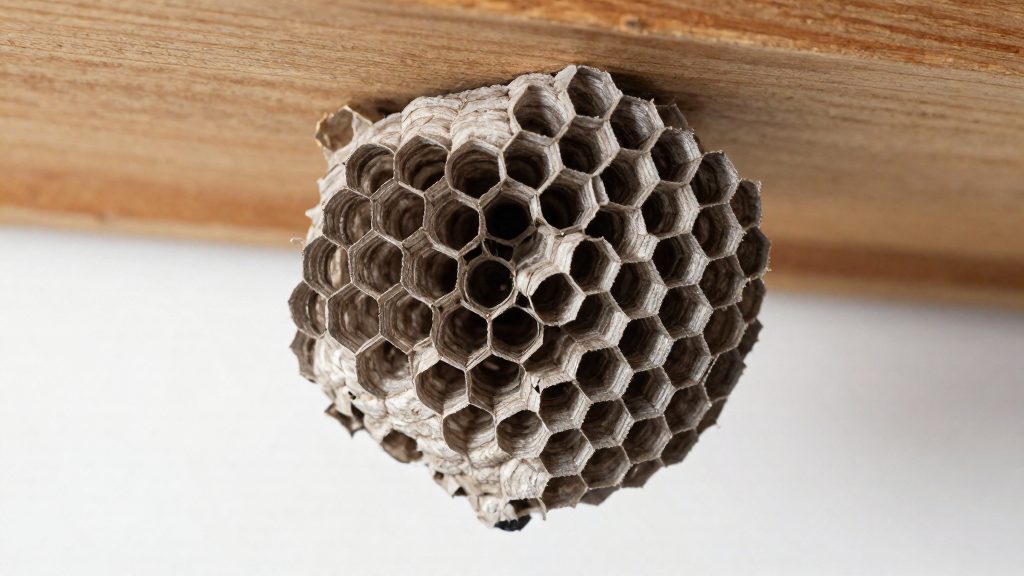
Paper wasp nest under eaves can be identified by where they are sited and how they are shaped. A nest is most likely to appear at a roof overhang, soffit, or other concealed gap. An exposed nest looks like an upside-down umbrella with its open cells visible from below, which is the clearest visual marker for confirming a paper wasp nest without disturbing it.
How to identify a paper wasp nest under eaves
Check the nesting site
Paper wasps use sheltered sites. According to Penn State Extension (2026), nests are built under and within eaves, in attics and wall voids. Start the inspection at the roof edge by looking along the underside of each eave and at the junction between the eave and the soffit. A nest inside an attic or wall void is hidden from outside view, so the shape test below applies only to exposed nests.
Look at the shape from below
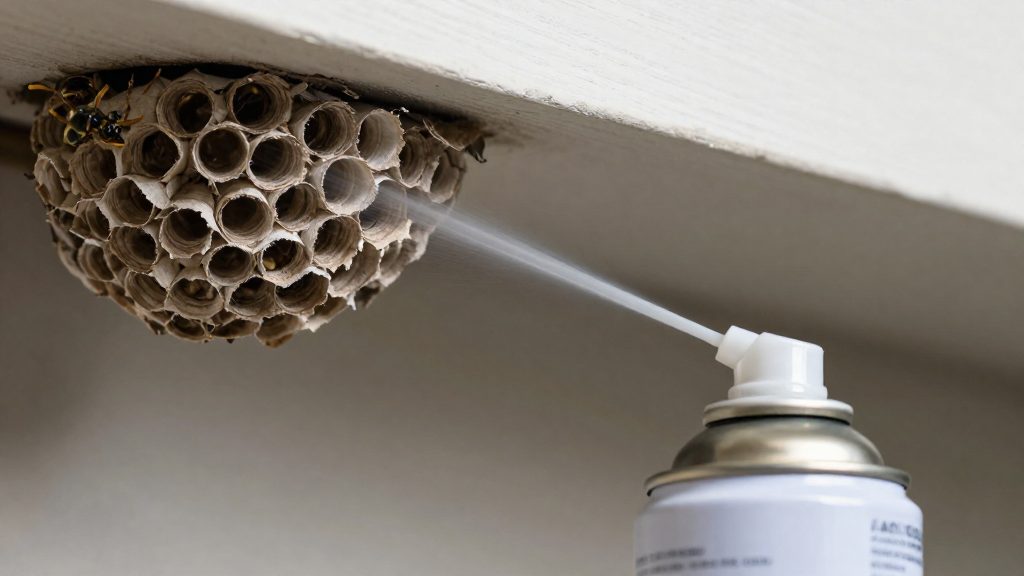
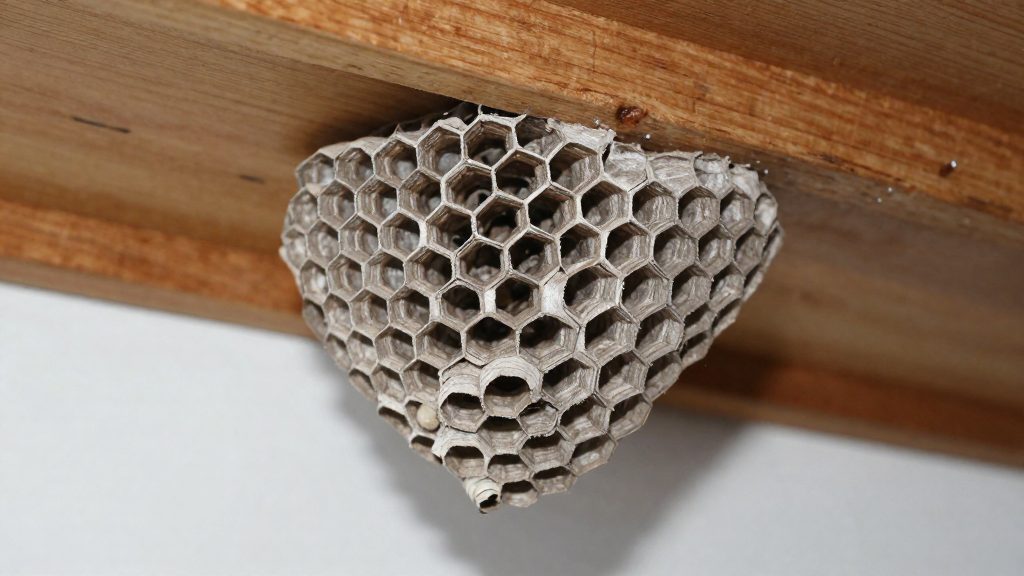
An exposed paper wasp nest resembles an upside-down umbrella. Its open cells face downward, so they are visible only from below. Stand directly beneath the eave and look up at the underside of the nest. Open cells on a downward-facing, umbrella-shaped structure under an eave are the feature that points to a paper wasp nest.
Should you remove the nest or leave it?
Paper wasps seldom sting unless their nest is disturbed, so the decision rests mainly on disturbance risk: how likely people, children or pets are to come close to the nest. According to Colorado State University Extension, these wasps also prey on caterpillars and sawfly larvae, so a nest in a low-traffic area can be left in place.
Judge the location by how often people pass it:
| Location | Activity | Suggested decision |
|---|---|---|
| Above or beside a door or entry | High | Remove |
| Over a patio table, bench, swing or play area | High | Remove |
| Near a pet’s feeding or resting area | High | Remove |
| Under an eave on a rarely used wall or side of the house | Low | Leave in place |
A nest in a high-traffic spot should be removed, since any routine contact can disturb it. Avoid brushing, striking or leaning a ladder against a nest that has workers while it is occupied.
When leaving the nest is reasonable
Leaving the nest is reasonable when all of the following apply:
- The nest sits in a low-traffic spot that no one needs to pass or work near.
- No seating, play equipment or pet area is within reach of the nest.
- Nobody in the household needs to access that part of the building.
Paper wasp colonies are annual. According to Colorado State University Extension, nests are abandoned by late fall and are then generally safe to remove. A nest in a low-traffic spot can therefore stay until it is abandoned, which avoids disturbing the colony for no practical gain.
When is the best time to treat a nest?
The colony’s stage and the time of day both determine whether a treatment works. Once workers have emerged, the timing and approach change.
Single-queen nests early in the season
A single-queen nest is still small and has no workers. At this stage, the nest is easiest to remove, before workers emerge. Checking eaves and sheltered spots early in the season gives the best chance of dealing with the nest before the colony grows.
Nests with several workers: treat at night
When a nest has several workers, treat it in the evening or at night, when the workers and the queen are all on the nest, so the treatment reaches the whole colony. Colorado State University Extension recommends an evening treatment with a wasp and hornet insecticide for active nests, followed by removing and destroying the nest.
How do you remove a paper wasp nest safely?
Removing an exposed paper wasp nest comes down to two methods: spraying from a distance with a labeled wasp and hornet spray, or knocking the nest down by hand. The stage of the colony determines which method applies. Preparing before you approach matters as much as the treatment itself.
Prepare before approaching
- Protective clothing: cover all exposed skin with long sleeves, long trousers, gloves and eye protection before going near the nest.
- Escape route: clear a path to a door or open area before you start, so you can leave the nest’s immediate area quickly without tripping over ladders or hoses.
Spray method
For nests with several workers, use a wasp and hornet spray labeled to project insecticide up to about 20 feet, according to Penn State Extension (2026-01-19). Aim the spray at the nest from outside that range, then move away along your escape route once the nest is treated.
Knocking down by hand
Hand knockdown applies only to a nest started early in the season by a single queen, before workers emerge. At that stage, the exposed nest can be knocked down and the queen killed. Do not attempt this on a nest that already has workers; use the spray method instead. (The earlier advice not to touch a nest applies to inspection and to nests with workers.)
Clean up after removal
Hose down the area to remove colony odors, as recommended by Colorado State University Extension.
What if the nest is inside the soffit or wall void?
When a nest sits inside a soffit, eave or wall void, the comb is out of reach, so treatment goes to the entrance. According to Penn State Extension (2026), you apply a labeled insecticidal dust into the void openings. “Labeled” means the product’s label names the stinging insect you are targeting and the sites where it may be used, so read the label before opening the container.
Locate the openings first. Watch which gaps under the eave, in the soffit or along the wall board the wasps use to come and go. Those are the points to dust.
Choose the applicator. Penn State Extension lists three options: a bulb, a plunger or a pump duster. Any of the three can deliver the dust. Pick the one whose tip fits the opening, so you can place the dust inside the cavity rather than on the surface around it.
Apply the dust.
- Load the duster with the product.
- Position the tip at the opening.
- Release the dust in short puffs so it travels into the void instead of blowing back out.
- Repeat at each opening you identified.
Work from outside the structure and treat every entry point, since a nest may have more than one route in.
Avoid breathing the dust. Penn State Extension advises against inhaling the dust. Stand to the side of the opening, keep your face out of the puff, and work with the wind at your back. Do not dust in a closed garage, porch or other enclosed space where the powder can drift toward you. Keep people and pets away from the treated area while the dust settles.
Cleaning up after removal
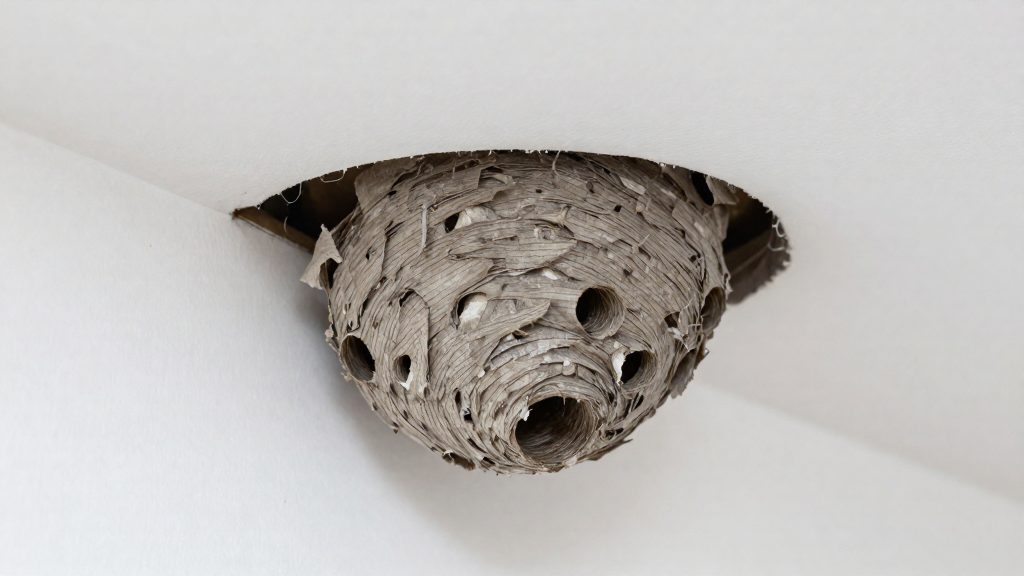
Once treatment is finished, the remaining work is to collect dead wasps, remove nest debris and clean the surfaces they touched. Capped cells can hold larvae that survive treatment, so the nest itself must be removed and destroyed, not left behind.
Bagging and disposing of dead wasps and nest debris
Collect the dead wasps, the nest and any loose paper fragments into a sealed bag. Work over a sheet or tarp so that debris does not scatter onto the ground, gutters or plants below. Seal the bag before carrying it away, and dispose of it with household waste under your local rules. Keep the nest and debris together so that no capped cells are left in the area.
Cleaning surfaces where nest material and dust landed
Insecticidal dust used inside eaves or soffits can settle on the surfaces around the entry openings, and nest residue can stick to the underside of the eave. Wipe these areas to remove visible dust and residue, then hose down the area to remove colony odors. Hosing also rinses away residue that the wipe-down might miss. Clean the ground below the nest location as well, since fragments often fall there.
Checking for surviving wasps before final cleanup
Before the final cleanup, watch the nest location for wasp activity. Paper wasps seldom sting unless disturbed, but approach the site slowly and avoid sudden movements. If any wasps are still flying in and out, do not start the final wipe-down, because disturbing the area can trigger stings. Once no wasps remain, complete the cleanup and remove any leftover debris.
How to prevent new nests under eaves
According to Penn State Extension (2026), prevention relies on structural measures that remove nesting sites: repairing holes in walls, caulking cracks in soffits and eaves, and screening vents and louvers. Done before the nesting season, these steps block entry rather than relying on removing nests later.
Repairing holes in walls
Inspect the exterior wall where it meets the eave line. Any hole that opens into a void behind the siding or soffit is a potential nest site. Fill and patch each opening so the repair sits flush with the surrounding surface, leaving no concealed cavity.
Caulking soffit and eave cracks
Run a bead of caulk along cracks in soffits and eaves, and check the full length of each soffit section, not just the visible corners. Penn State Extension lists caulking these cracks as a direct prevention step, so treat every open joint as an entry point until it is sealed.
Screening vents and louvers
Attic vents, gable louvers and soffit vents are open to the air and can be fitted with screening. A screen blocks wasps while still allowing airflow. Check that the screen is fixed on all sides, with no gap at the frame edges.
Spring inspection of eaves
Inspect the eaves at the start of the season, looking for new nest starts before workers appear. The eaves need checking again every spring, even if the previous season’s nest was removed or left to be abandoned.
When should you call a professional?
Whether to handle a paper wasp nest yourself depends mainly on who is exposed and where the nest sits. According to Penn State Extension (2026-01-19), people with wasp sting allergies, or who receive many stings, should seek medical attention. Otherwise healthy adults usually recover without treatment. Anyone in the first group should leave the nest to a pest professional. Call 911 or seek emergency care right away for a severe reaction after a sting, such as trouble breathing, swelling of the face or throat, or dizziness.
Three conditions point toward calling a professional:
- Allergy or high sting risk: Anyone with a known wasp sting allergy, or anyone likely to be stung repeatedly, should not approach an active nest. Any sting that causes a severe reaction (trouble breathing, swelling of the face or throat, dizziness, widespread hives) is an emergency: call 911. Multiple stings also need prompt medical attention.
- Nest out of safe reach: If the nest cannot be reached from a stable ladder without leaning or overreaching, a professional with suitable equipment is the safer option.
- Nest in an unsafe location: A nest in a spot where people or pets pass frequently is a stronger reason to call for removal than one in a quiet corner.
Where none of these conditions apply, a healthy adult can handle a small, easily reached nest, following the safety steps above.