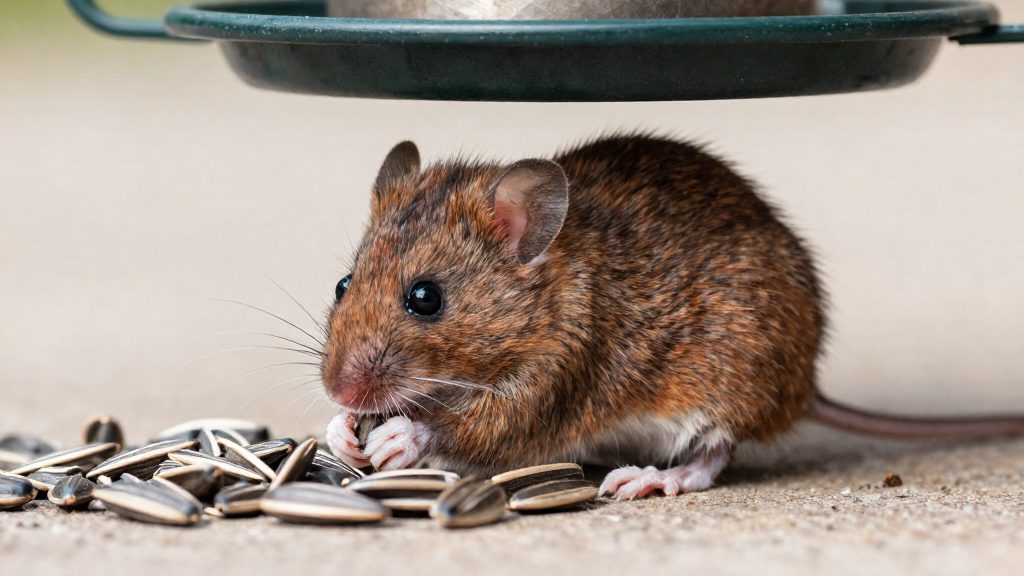
Bird feeders can attract mice, but the main draw is seed that lands on the ground rather than the feeder itself. The scattered seed, hulls and fragments collecting beneath a feeder form a food source that mice find and return to, so controlling what reaches the ground is the most direct way to limit the problem.
Do bird feeders really attract mice?
A feeder becomes a ground-level food source once birds knock or scatter seed beneath it. Rodents forage directly on this spillage, on the soil, lawn or patio below the feeder, so the area underneath matters as much as the feeder.
Some seed types spill more than others: milo, wheat, oats and red millet often end up on the ground and attract rodents.
Hulls, the husks left after a bird opens a seed, are a second source of spillage debris beneath the feeder.
Choose seed that mice leave alone
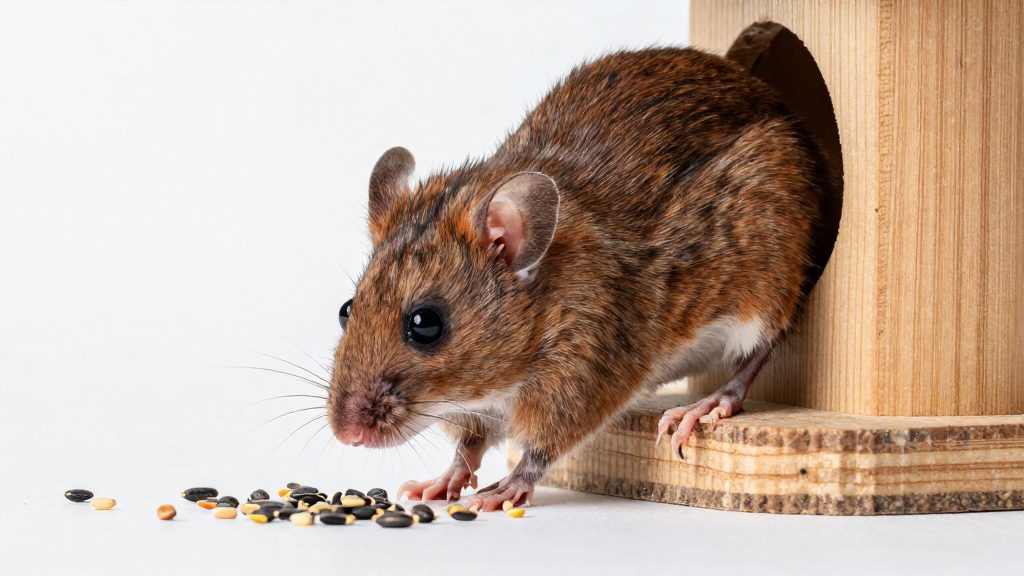
Seed choice determines how much food lands on the ground, and ground food is what draws rodents. Wild Birds Unlimited (2026) advises using seed blends without fillers, since milo, wheat, oats and red millet often end up on the ground and attract rodents. Blends that list these grains as main ingredients should be avoided.
Shell-free foods leave less debris to attract rodents. Wild Birds Unlimited (2026) names no-mess blends, shelled peanuts, suet and mealworms as options that reduce the debris falling below the feeder. Hulled seed works the same way. Today’s Homeowner (2025-03-20) recommends hulled seed such as sunflower hearts, because the hulls are the material that otherwise collects on the ground.
| Food | Ground debris | Rodent appeal |
|---|---|---|
| Milo | Often falls to the ground | Attracts rodents |
| Wheat | Often falls to the ground | Attracts rodents |
| Oats | Often falls to the ground | Attracts rodents |
| Red millet | Often falls to the ground | Attracts rodents |
| No-mess blend | Shell-free, reduced debris | Lower |
| Shelled peanuts | Shell-free, reduced debris | Lower |
| Suet | Shell-free, reduced debris | Lower |
| Mealworms | Shell-free, reduced debris | Lower |
| Hulled sunflower hearts | No hulls left to fall | Lower |
Filler-free blends and shell-free foods address the same problem from two directions: the first removes grains that spill, and the second removes the husks that collect below the feeder. Using both approaches together addresses both sources of ground food.
Clean up spilled seed every day
Daily cleanup is the most important step in keeping rodents away from a bird feeder. Today’s Homeowner (2025) names daily cleanup as the priority and recommends sweeping or vacuuming up both spilled seed and hulls, the husks left after a bird has opened a seed.
Sweeping or vacuuming the ground
Work through the area directly beneath the feeder and any spot where birds scatter seed while feeding. Sweep the debris into a pile and remove it, or use a vacuum to pick up both whole seeds and hulls. Do this every day so debris does not accumulate on the ground between visits.
Storing seed in sealed containers
Keep your seed in sealed, rodent-proof containers rather than in the bag it was sold in. Pour only the amount you need into the feeder so that unused seed is not left within reach of rodents. Check that the container lid closes fully after each refill.
Making the routine consistent
A cleanup done only when the feeder is refilled leaves hulls on the ground for days at a time. Pair the sweep with each refill, and treat the ground under the feeder as a daily task rather than an occasional one. Spilled seed and hulls that go unremoved are the material that remains for rodents to find.
How should you place and mount a feeder?
Placement controls how far rodents can reach the seed. According to Wild Birds Unlimited (2026), a pole-mounted feeder should stand at least 11 ft from anything a rodent could jump from. If the feeder is squirrel-proof, the pole distance can be reduced to 7 ft. Today’s Homeowner (2025) adds two more minimums for any feeder: a height above ground and a distance from the house. These figures are minimums, so placing a feeder farther out or higher up only adds margin.
| Requirement | Minimum | Source |
|---|---|---|
| Pole distance from anything a rodent could jump from | 11 ft | Wild Birds Unlimited (2026) |
| Pole distance for a squirrel-proof feeder | 7 ft | Wild Birds Unlimited (2026) |
| Height above ground | 6 ft | Today’s Homeowner (2025) |
| Distance from the house | 10 ft | Today’s Homeowner (2025) |
Steps for mounting the feeder
- Walk the area around the planned pole position and mark every point a rodent could jump from. Set the pole at least 11 ft from all of them, or 7 ft if the feeder is squirrel-proof.
- Check the distance from the house. Keep the feeder at least 10 ft away from the walls.
- Set the mounting height. Install the feeder at least 6 ft off the ground, which keeps spilled seed further from ground-level foraging.
- Attach a catch tray to the pole. Pole-mounted seed trays collect hulls that would otherwise fall to the ground and attract rodents.
- Choose a weight-sensitive feeder where possible. Today’s Homeowner (2025) recommends feeders that close when a heavy animal lands on them. This limits access for larger animals such as squirrels, but it does not stop light mice, so it works only alongside the other measures.
Mark the pole position on the ground before digging or fixing the base, so the distances can be checked again after installation.
Which feeders and baffles block mice?
On a pole-mounted feeder, two settings control rodent access: baffle height and feeder clearance. Wild Birds Unlimited (2026) places the baffle 5 ft above the ground and requires the feeder to hang above the top of the baffle. A feeder positioned at or below the baffle’s top edge can be reached around the barrier.
| Setting | Recommendation | Source |
|---|---|---|
| Baffle height | 5 ft above the ground | Wild Birds Unlimited (2026) |
| Feeder position | Hung above the top of the baffle | Wild Birds Unlimited (2026) |
The 6 ft minimum from Today’s Homeowner and the baffle guidance from Wild Birds Unlimited are separate rules. Whatever height you choose, the feeder must still hang above the top of the baffle.
Choosing a baffle-compatible feeder
Choose a pole-mounted feeder that can hang above the top of a baffle set 5 ft above the ground, and add a weight-sensitive feeder and a catch tray where possible.
Do repellents and hot pepper seed work?
Hot pepper seed is the repellent approach covered by the guidance reviewed here. According to Wild Birds Unlimited (2026), most rodents avoid hot pepper bird food, which makes it a practical way to deter mice and rats from feeding at the feeder. Its effect depends on how it is offered and handled.
Offer it alone
Hot pepper seed should be offered alone, not mixed with non-pepper foods (Wild Birds Unlimited, 2026). Keep it in its own feeder or tray so that the pepper is the only food on offer at that station.
Handle it with gloves
The active ingredient, capsaicin, irritates the eyes, nose and mouth. Wild Birds Unlimited (2026) advises wearing gloves whenever you handle hot pepper seed, including when opening bags and refilling feeders. Keep hands away from your face during the task.
Limits of the repellent
Hot pepper seed addresses feeding by rodents at the feeder only. It does not remove the debris that collects below it, so pepper seed works best alongside regular cleanup rather than in place of it.
Is your house the real attraction?
Rodents near a bird feeder are often fed by food sources that have nothing to do with the birdseed. Household trash, pet food and barbecue residue give mice and rats a steady supply in the same yard. According to Wild Birds Unlimited (2026), three household habits remove these competing food sources, which reduces the reasons rodents stay close to the feeder.
Keep trash in closed metal containers. Household waste stored in closed metal containers is out of reach of rodents. Check the bin area as well as the feeder area, since a food source a few yards away draws the same animals.
Feed pets indoors. Pet food left outside is a ready meal for mice and rats, and it sits within the same yard as the feeder. Moving pet meals indoors removes that food from the outdoor area entirely.
Clean barbecue grills after each use. Food left on a grill after cooking is another food source for rodents. Cleaning the grill after every use, rather than occasionally, keeps this source from building up between cookouts.
These steps only address food outside the feeder. Spilled seed under the feeder still needs its own cleanup, and the feeder’s placement and design determine whether rodents can reach it in the first place.
What to do if mice keep coming
When activity continues, work through the feeder setup in a fixed order and change one thing at a time. If you change several variables at once, you cannot tell which measure worked.
- Re-check placement first. If the feeder is closer than 10 ft to the house, lower than 6 ft, or within 11 ft (7 ft if squirrel-proof) of anything a rodent could jump from, move it before changing anything else.
- Then re-check the seed. Confirm the blend contains none of milo, wheat, oats or red millet. Replace any blend that contains them before adding new measures.
- Then re-check cleanup. Confirm that spilled seed and hulls are swept or vacuumed up every day, that a catch tray is in place, and that seed is kept in sealed, rodent-proof containers.
Signs that activity persists despite measures
After all three checks are correct, the following indicate that the problem is still active:
- Hulls or seed remain under the feeder after each daily cleanup.
- Seed bags or containers stored near the feeder show gnaw marks.
- Droppings or burrow entries appear in the feeder area.
- Rodents are seen at the feeder during the day.
Adding measures one at a time
If the checks are correct and activity continues, add one measure, then observe the results before adding another.
Escalation when feeder fixes fail
If activity continues after the placement, seed, cleanup and feeder changes, take the feeders down temporarily so that no seed is available in the yard. Clean the ground under the former feeder area thoroughly, then monitor it for several days before reinstalling a feeder. If rodent signs continue or mice are found inside the home, contact a licensed pest control professional, because feeder adjustments alone will not resolve an established infestation.
Frequently asked questions
Should I stop feeding birds if mice keep showing up?
No. Start by removing ground-level spillage, which Today’s Homeowner (2025-03-20) identifies as the most important step, through daily sweeping or vacuuming of spilled seed and hulls. Store seed in sealed, rodent-proof containers so the feeder is not a second food source.
Will hot pepper seed keep mice away from my feeder?
Wild Birds Unlimited (2026) says most rodents avoid hot pepper bird food, which should be offered on its own rather than mixed with other seed. Wear gloves when handling it, because its capsaicin irritates the eyes, nose and mouth.
Do seed trays help control hulls under a feeder?
Yes. Today’s Homeowner (2025-03-20) recommends pole-mounted seed trays to catch hulls before they reach the ground. It also suggests weight-sensitive feeders that close when a heavy animal lands on them.