Signs of rats living under your deck
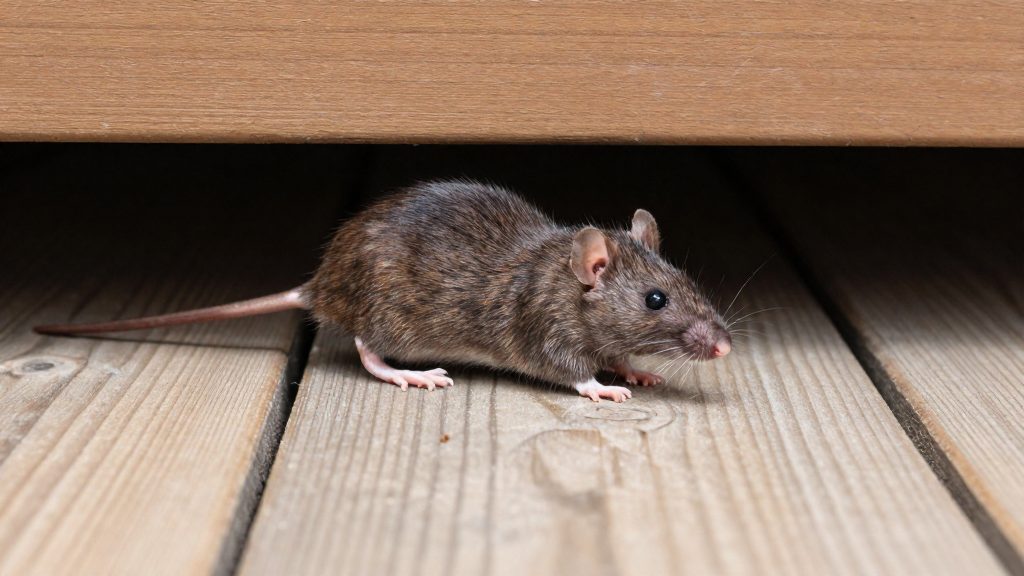
Rats under a deck leave a consistent set of signs at ground level and on the structure above it. Checking the perimeter, the foundation edge and the underside of the boards for these signs helps confirm rats rather than another pest.
-
Droppings are the most direct evidence. Rat droppings are larger and more elongated than mouse droppings. They collect along the routes rats use between the ground and the deck, so look under the boards, near steps and against support posts. Fresh droppings are typically dark and soft, while old ones are dry, hard and crumbly. Do not touch or sweep droppings dry: wear gloves and a mask, and wet them with disinfectant before cleaning them up, since rodent droppings can carry disease.
-
Gnaw marks appear on the deck frame, lattice panels, skirting and any stored material beneath the deck. Fresh marks have pale, sharply cut edges, and chewed material near openings is a sign of recent activity.
-
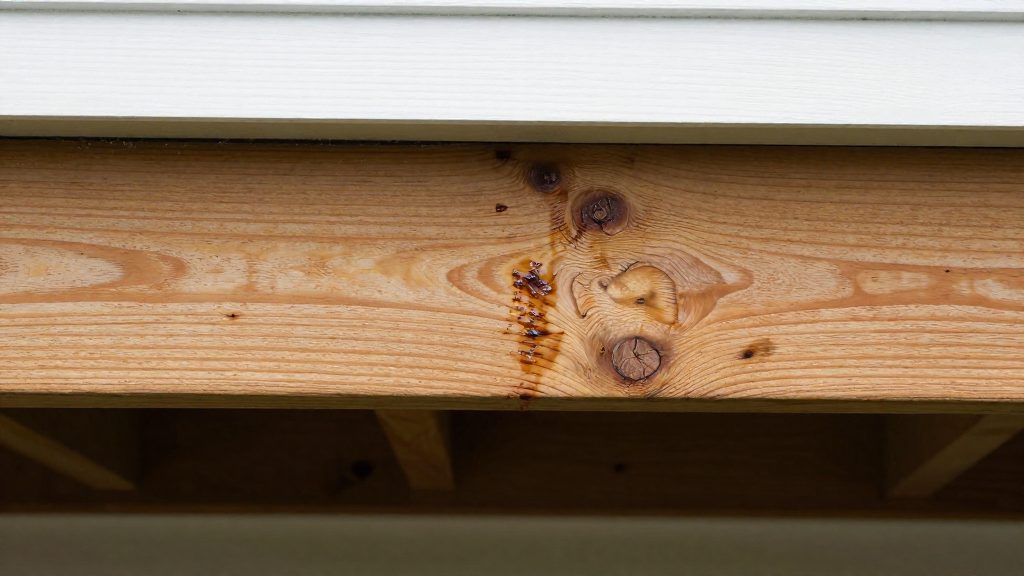
Grease trails are dark, smeared lines along the paths rats follow. They form when oils from the fur rub repeatedly against the same surfaces, typically on joists, beams and the base of posts.
-
Burrow holes are a strong sign of rat activity. Look for small holes and larger openings at the edge of the deck or under the skirting, and for fresh, loose soil piled at an entrance, which indicates recent digging.
-
Nocturnal activity is rarely seen directly. Scratching, gnawing or movement under the deck after dark points to rats, since they are nocturnal and most active at night.
Why do rats nest under decks?
A deck creates a sheltered void that rats can use as a nest site. The most reliable check is an inspection of the space itself. Look for the conditions described below to understand why rats chose this spot, and inspect the space with a flashlight before assuming the area is empty.
Dark, sheltered voids are the main draw. The gap between the deck boards and the ground is out of sight, out of the weather, and rarely disturbed. Check for:
- Openings along the perimeter and around the posts
- Areas that stay undisturbed for long periods
- Enclosed corners where a nest can be built away from light and foot traffic
Ground-level clearance and soil cover make burrowing easy. Where the gap under the deck is low and the ground is loose, bare or covered with soil or mulch, rats can dig in directly beneath the structure. Look for shallow holes, tunnels and smoothed paths in the soil, and check whether earth near the openings has been pushed back or worn down.
Nesting material is usually gathered from the immediate surroundings. Fallen leaves, shredded paper and insulation found inside or near the void give rats what they need to line a nest. Note where this material sits in relation to burrow entrances and openings, since a nest is most often built close to the spot where the material is stored.
Remove food, water and shelter
Rats under a deck are drawn by three things: a food supply, a water source and a sheltered space. Removing the first two and clearing the third makes the area less attractive, but it only supports trapping, which is what actually removes the rats.
Secure food sources
Pet food is one of the most common attractants. Feed pets indoors where possible. If feeding outside, pick up bowls once the animal has finished rather than leaving food out overnight. Store dry pet food and bird seed in sealed containers with tight lids, not in paper or thin plastic bags.
Sweep up spilled seed under bird feeders every day, and hang feeders away from the deck edge so that dropped seed does not collect beneath the structure.
Compost bins need the same care. Use a bin with a closed lid, and keep meat, dairy and oily food scraps out of it. Bury fresh material under finished compost so it is not left exposed on the surface.
Fix leaks and remove standing water
Leaking outdoor taps, hoses and pipes supply water that persists in the dark space under a deck. Repair dripping taps, and drain and coil outdoor hoses after each use. Empty pet water bowls at night and refill them in the morning.
After rain, check for puddles beneath the deck. Fill or regrade low spots in the soil so that standing water drains away from the structure.
Clear shelter and debris
Rats use stacked material for cover and nesting. Move firewood away from the deck and raise it off the ground on a rack, so the underside stays open and visible. Remove old cardboard, tarps, plant pots and building offcuts from beneath the deck.
Cut back shrubs, ivy and other dense vegetation that touches the frame. Clear space between the ground and the deck boards, so that stacked debris and thick plant growth do not give rats cover close to the structure.
What are the best traps for rats under a deck?
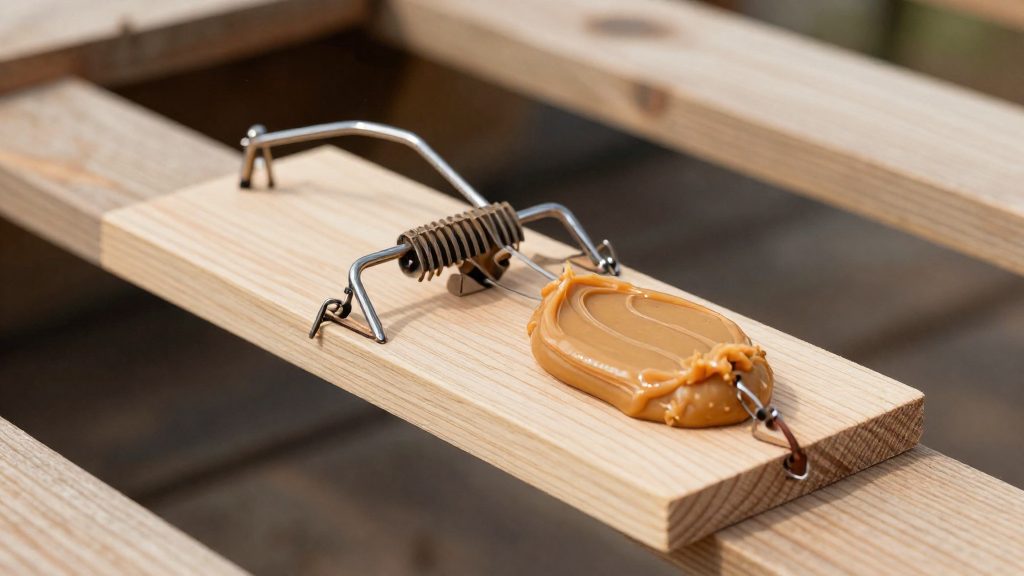
According to House Digest (2024), a humane approach is to trap rats near the opening under the porch or deck. Trapping works best as a routine that continues until the colony is removed, not as a single placement, because one trap rarely catches every animal using the space.
Placing traps at the opening and along runways
Start by locating the entry point, which is usually where rats move in and out of the crawl space. Set the first traps close to that opening. Then look for runways, the worn paths that rats leave in dust, soil or debris beneath the deck, and place traps along them. Keep each trap level and stable so it does not tip, and position it where rats will cross it rather than walk around it. Keep traps away from areas where children or pets can reach them.
Checking traps every morning
Check the traps each morning, remove any catch promptly, and reset or rebait the empty traps so the setup stays active for the next night. A trap left unchecked for a full day is not humane, because a trapped animal suffers, and a dead rat left in the crawl space will decompose and attract other pests. Wear gloves when removing any catch.
Continuing until no catches or droppings remain
Keep trapping until no more rats are caught and no droppings remain near the opening or along the runways. A single night without catches is not enough to conclude that the colony is gone. Keep trapping until no more rats are caught and no droppings remain near the opening or along the runways.
Is rat poison safe to use under a deck?
No. House Digest (2024) advises against placing rat poison under a porch or deck. The enclosed space beneath a deck is one of the worst places for bait, because it is hidden from view and hard to reach. You cannot easily see where bait has been taken, moved or left, and you cannot easily remove leftover bait once the rats stop feeding.
Secondary poisoning is the main risk. A rat that has eaten bait can be caught by a predator such as an owl, fox, hawk, cat or dog that hunts in the yard, and the poison can pass to that animal (secondary poisoning). Predatory wildlife that feeds on poisoned rodents is exposed even when it never touches the bait itself.
Accidental access is the second risk. The gap under a deck is reachable by children and pets, who can dig, push through openings or follow a rat’s path into the space. Bait placed in a void can be found and eaten by a dog or toddler long after it was set, and the person treating the problem often has no way of knowing it has been moved.
For these reasons, use the trapping method described above instead. Trapping removes each rat physically, so the number of animals caught gives a clear measure of progress, and it avoids leaving toxic material in a space that people and animals can access.
How to seal and rat-proof your deck
Permanent exclusion starts only once the rats have been removed. Sealing the openings while rats are still inside can trap them under the deck. According to House Digest (May 2024), this step consists of filling every gap that rats used to enter, so the material you choose depends on the size of each opening.
| Opening | Material | Method |
|---|---|---|
| Small burrows | Steel wool | Pack the steel wool into the hole and secure it with spray foam or caulk |
| Larger holes or an extra barrier | Lath screen, chicken wire or hardware cloth | Cut the material to size and fasten it over the opening |
| Ground line along the deck edge | ¼-inch hardware cloth | Install a buried trench barrier, described below |
Steel wool on its own will not stay in place, so the spray foam or caulk is what holds it. Lath screen, chicken wire and hardware cloth work over larger openings and also add a physical barrier where a burrow is too large to fill.
Building a 12-inch L-shaped trench barrier
The most important permanent measure is the barrier at ground level, because rats often dig in beneath the deck edge. Critter Control describes the following method:
- Dig a trench 12 inches deep along the outside edge of the deck.
- Bend a strip of ¼-inch hardware cloth into an L-shape, so that the cloth extends 12 inches out from the deck.
- Fasten the cloth to the deck.
- Backfill the trench so the cloth is buried.
Critter Control notes that ½-inch hardware cloth is used for larger animals such as raccoons, skunks and opossums. For rats, the ¼-inch mesh is the size to use, since it keeps out rodents.
When should you call a pest control pro?
Do-it-yourself control works when rats stay confined to the area under the deck and activity stops once the entry points are closed. Three conditions indicate that the problem has outgrown that approach.
Reinfestation after the barrier is installed
If rats return after an exclusion barrier is in place, the reinfestation usually means an entry point was missed or rats are reaching the space by another route. A professional can inspect the full perimeter of the foundation for gaps that are hard to spot and identify access points that a homeowner may overlook.
Activity spreading into the house
Rats that move from under the deck into the living space, garage or crawl space indicate an established colony rather than a few animals passing through. Warning signs include droppings or gnaw marks inside walls, scratching or movement in ceiling and wall voids, and rodents seen indoors during the day. Once rats have reached the interior, closing the deck opening will not resolve the problem, and a professional should survey the whole structure.
Gnawing damage to framing, joists and utility lines
Fresh gnaw marks on deck framing, joists or utility lines show that rats are actively using those materials, and the damage will continue as long as the animals remain. Gnawed electrical cable is a fire hazard, and damaged gas or water lines require immediate attention. Any gnawed wiring should be inspected by a licensed electrician, and any weakened joist should be assessed by a qualified contractor before the deck is used again.
Calling a professional is the appropriate next step whenever one of these three conditions appears, even if the original opening has been sealed.
Frequently asked questions
Can I use rat poison to get rid of rats under my deck?
No. According to House Digest (2024), rat poison should not be used under a porch or deck, so trapping is the approach to use in that space. Check the traps each morning, because rats are nocturnal.
What mesh should I use to keep rats out from under a deck?
Use ¼-inch hardware cloth in an L-shaped barrier, dug 12 inches deep and extended 12 inches out from the deck, then fastened to the deck and backfilled, as described by Critter Control. ½-inch cloth is meant for larger animals such as raccoons, skunks and opossums.
How long should I keep trapping rats under my deck?
Keep setting traps near the opening under the deck until no more rats are caught and no new droppings appear. Empty and reset the traps each morning, since the trap check is the step that tells you whether activity has stopped.