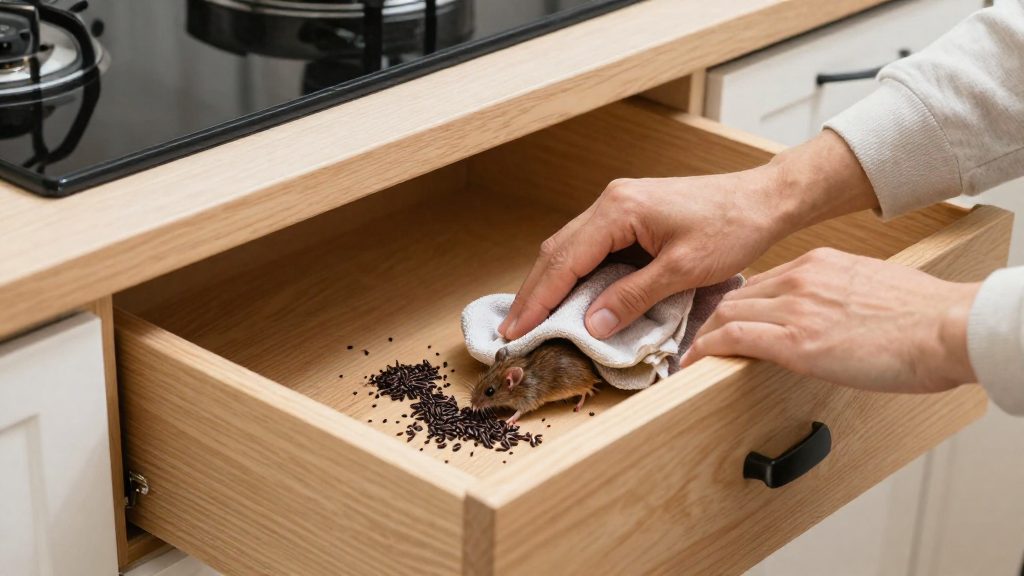
Immediately after finding mouse droppings in a kitchen drawer, open the doors and windows of the room and leave the area. The Centers for Disease Control and Prevention (CDC, 2024) advises opening doors and windows for 30 minutes before cleaning, and leaving the area during that ventilation. Keep the room unoccupied for that period, and do not touch the drawer or its contents until the air has cleared.
What should you do immediately after finding mouse droppings?
Leave the room during ventilation
Keep people and pets out of the room for the full 30 minutes. Do not return to check on the drawer during this period, since each re-entry can stir up settled material.
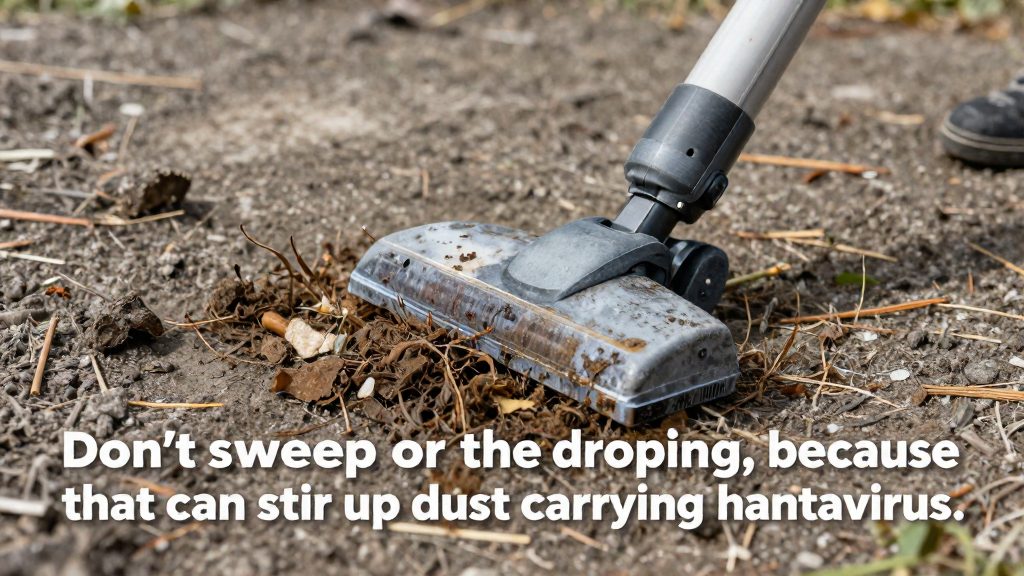
Never sweep or vacuum
Dry removal is the most common mistake in this situation because it looks like the quickest way to clean up. Nesting material found in the same drawer falls under the same rule.
How do you safely clean a kitchen drawer?
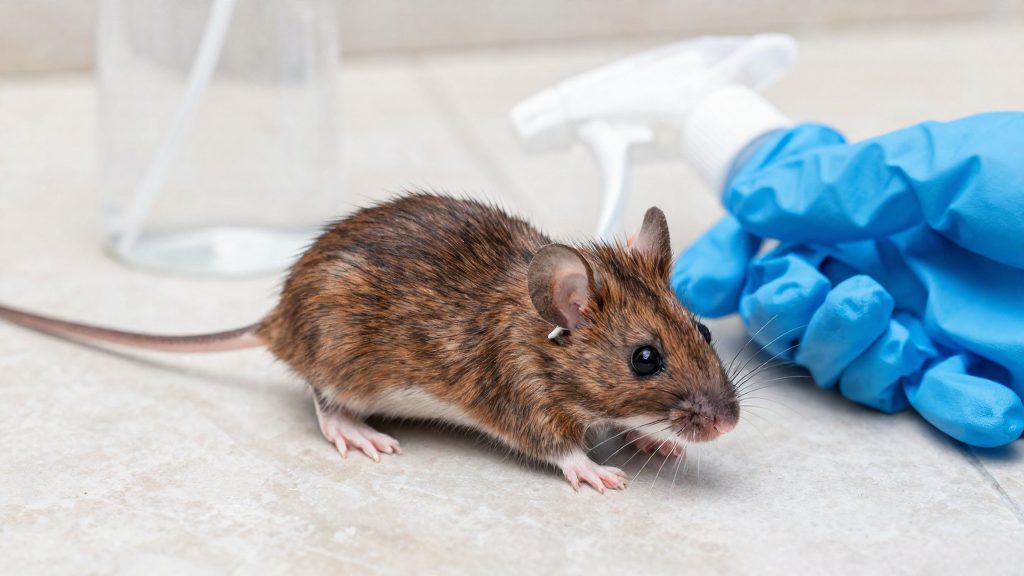
Work with rubber or plastic gloves on before touching anything in the drawer. Then thoroughly wet the droppings with a bleach solution or an EPA-registered disinfectant. Wetting first keeps the waste from becoming airborne when it is handled. According to the Centers for Disease Control and Prevention (CDC, 2024), the droppings must be fully soaked, and the disinfectant must stay on them for five minutes or for the contact time stated on the product label, whichever applies to your product.
- Put on gloves. Use rubber or plastic gloves only.
- Soak the droppings. Saturate every dropping and the area around it with the bleach solution or EPA-registered disinfectant.
- Wait for contact time. Leave the disinfectant on for five minutes, or for the contact time specified on the product label.
- Wipe up the waste. Pick up the soaked waste with paper towels.
- Bin the towels. Put the paper towels in a covered garbage can and close the lid.
- Disinfect the drawer. Treat the drawer’s hard surfaces with the disinfectant, following the label for contact time.
- Wash your hands. Wash the gloved hands before removing the gloves. Then remove the gloves and wash bare hands with soap and warm water.
What should you discard from a contaminated kitchen drawer?
Discard porous materials that rodent waste has soaked into. Hard items can usually be kept, once they are disinfected. The CDC (2024) gives the basic split: cardboard and paper contaminated with rodent waste go in the bin, while hard, nonporous items can be cleaned and reused.
| Item | Action |
|---|---|
| Paper and cardboard contaminated with droppings or urine | Discard in a covered garbage can |
| Hard, nonporous items: plastic, glass, or metal containers | Disinfect, then reuse |
| Drawer surfaces | Disinfect after wiping up the wetted waste |
| Food packaging with gnaw marks, droppings, or urine | Check the contents and replace any food that was exposed |
Inspect each food item before returning it to the drawer. Discard food in paper or plastic packaging exposed to rodent contamination, and food in packaging damaged by chewing. Commercially prepared food in undamaged all-metal cans or hermetically sealed jars may be retained only after following the appropriate cleaning and sanitizing procedure. Open dry goods are the most likely to be contaminated, so check them first.
Check nearby cabinets and drawers for mouse activity
Mouse activity in a kitchen drawer rarely stays there. Other signs in the surrounding cabinets show whether mice are feeding and nesting nearby. Droppings alone are hard to date, so these signs help you judge how recent the activity is. According to the U.S. Environmental Protection Agency (2026), look for:
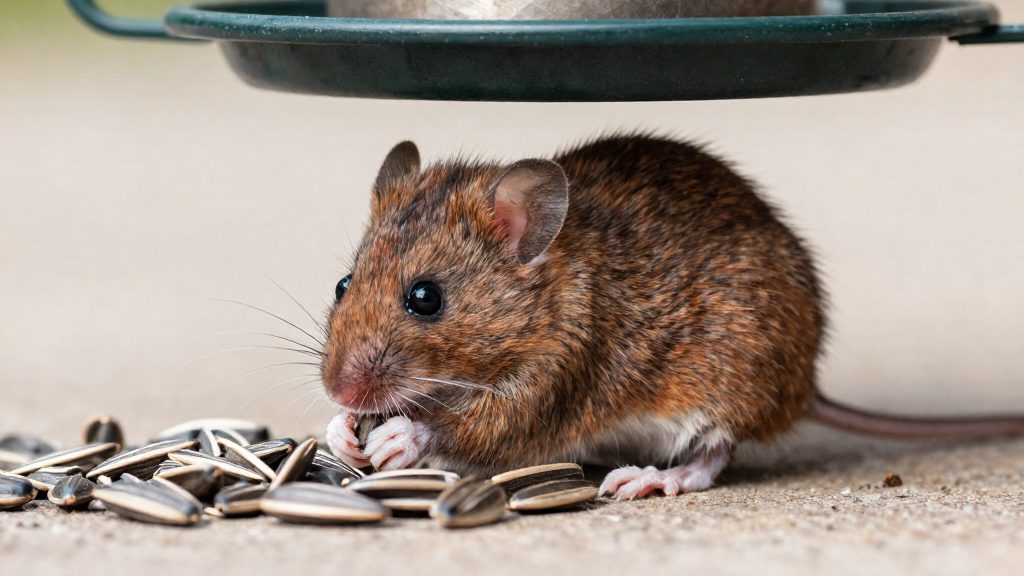
- Chewed food packaging in cabinets, pantries, and drawers, such as gnawed cereal boxes, pasta bags, or biscuit packets.
- Shredded nesting material, which appears as torn fibres gathered into a pile, usually in hidden corners.
- Holes through walls or floors, including openings at the back of cabinets or along the base of the wall.
- Stale smells in hidden areas, such as a musty odour inside closed cabinets or behind appliances.
Inspect the back and corners of each cabinet and the underside of drawers, since these are the spots where nesting and gnawing are most likely to be missed.
Use reappearing droppings as an activity test
The Centers for Disease Control and Prevention (2024) states that droppings appearing after a safe cleanup indicate an active rodent presence. A safe cleanup here means wetting the droppings with disinfectant before wiping them up. Once the area is cleared, check the same spots at regular intervals. Fresh droppings in a cleared area confirm that mice are still active. A cleared area that stays free of new droppings and signs is the outcome to look for.
Set mouse traps safely and check them daily
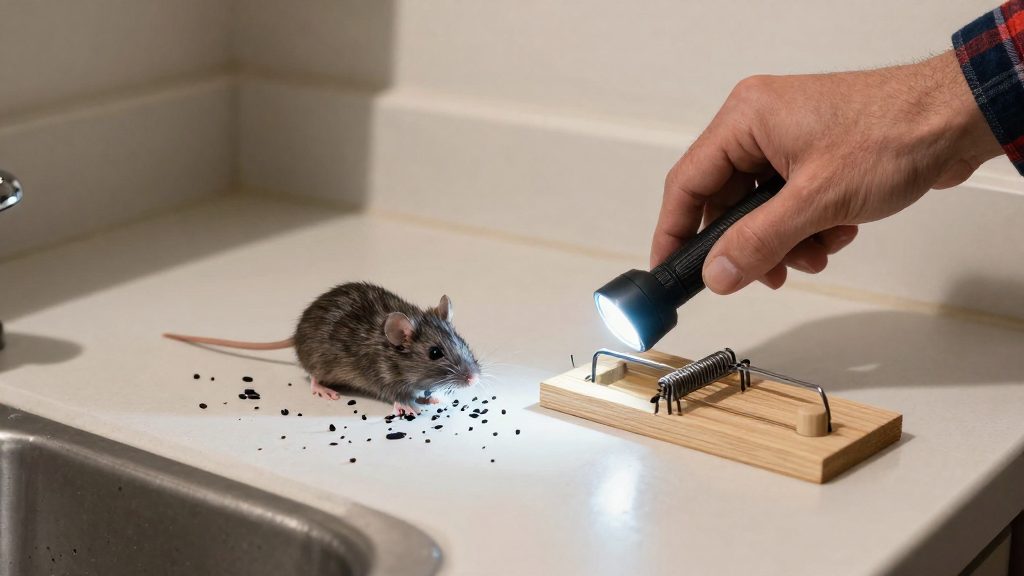
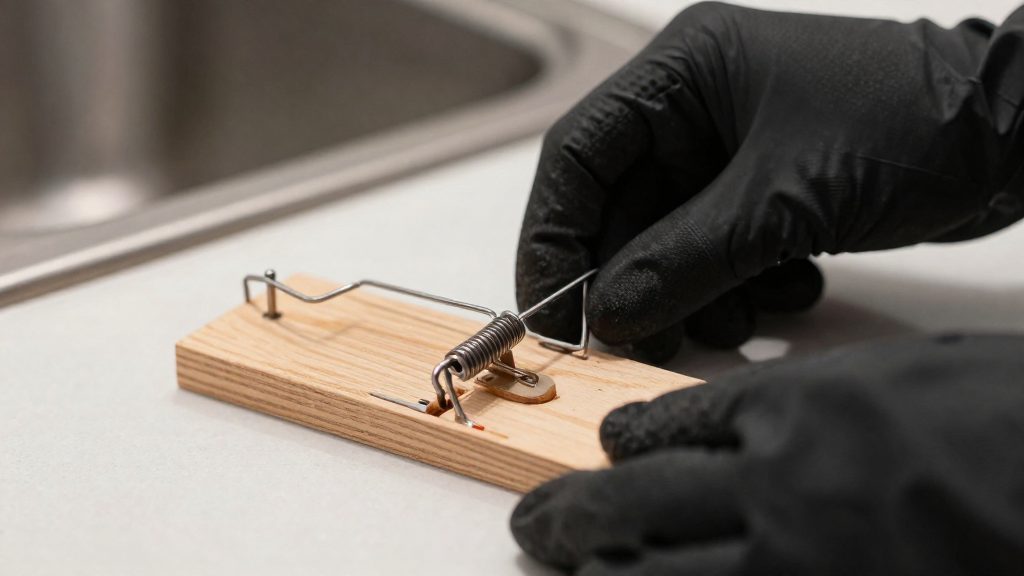
According to the CDC (2024), snap traps sized for mice are the recommended option. The CDC advises against glue traps and live traps, because frightened rodents may urinate and increase exposure risk.
Placement along walls and drawer edges
- Set traps where mouse activity occurs, not at random points in the kitchen.
- Along a wall, place the baited end against the wall so the trap forms a T shape with the wall.
- At a drawer, use the same T orientation against the drawer’s inner side wall, near the droppings.
Check every trap daily
Inspect each trap once a day, including traps that have not been triggered. Replace any trap that has sprung, and reset or relocate traps that show no activity.
Handle caught mice safely
- Put on rubber or plastic gloves before touching the trap or the mouse.
- Wet the dead mouse, trap, and surrounding area with disinfectant and wait five minutes or the label-directed contact time. Place the mouse and disposable trap in a plastic bag, seal it, then seal it inside a second bag before placing it in a covered garbage can, subject to local disposal rules.
- Wash gloved hands before removing the gloves, then wash bare hands with soap and warm water.
Seal entry points and remove food sources
According to the U.S. Environmental Protection Agency (2026), prevention relies on two measures: sealing entry points inside and outside the home, and removing accessible food and water. In a kitchen drawer, this means closing the routes into the cabinet and eliminating what draws mice there.
Sealing holes in walls, floors and cabinet backs
- Inspect the back panel and base of the cabinet, the wall behind the drawer unit, and the gaps around pipes and wiring under the sink.
- Seal every opening found, so that no alternate route leads into the cabinet.
- Re-check the seals after any repair, since a reopened gap restores access.
Storing food in sealed containers
- Move dry goods such as cereal, flour, pasta, nuts and pet food into rigid containers with tight-fitting lids.
- Keep kitchen garbage in tightly covered containers, as the EPA recommends.
- Do not keep open bags or packets in drawers.
Removing crumbs and food left in drawers
- Empty each drawer completely and wipe every compartment, corner and seam to remove crumbs.
- Use a damp cloth rather than a dry brush.
- Relocate any remaining food stored in the drawer, such as snacks or baking supplies, to sealed containers elsewhere in the kitchen.
When should you call a pest control professional?
Do-it-yourself control is failing when rodent signs keep appearing after the drawer has been cleaned and the obvious openings have been closed. Finding such signs outside the drawer means the infestation has spread beyond a single spot.
Signs that the infestation has spread
- Chewed food packaging or shredded nesting material in cupboards, on pantry shelves, or in other rooms
- Holes through walls or floors, including on other floors of the home
- Stale smells coming from hidden areas rather than from the drawer itself
Check each room and floor for these signs before concluding that the problem is limited to the kitchen.
When structural access is needed
Holes through walls or floors often lead to gaps that cannot be reached from the kitchen. When the openings sit inside walls, under floors, or on the outside of the building, the repair requires access that a drawer-level treatment cannot provide, and a licensed pest professional or a building contractor should assess them.
When to escalate to professional help
If trapping does not resolve the infestation, the Centers for Disease Control and Prevention (2024) suggests considering a poison bait station or professional help. Poison baits must be used according to their labels, so read the product label before placing any bait in a kitchen. If you cannot determine the entry points or the extent of the infestation, contact your local pest control service for an inspection.