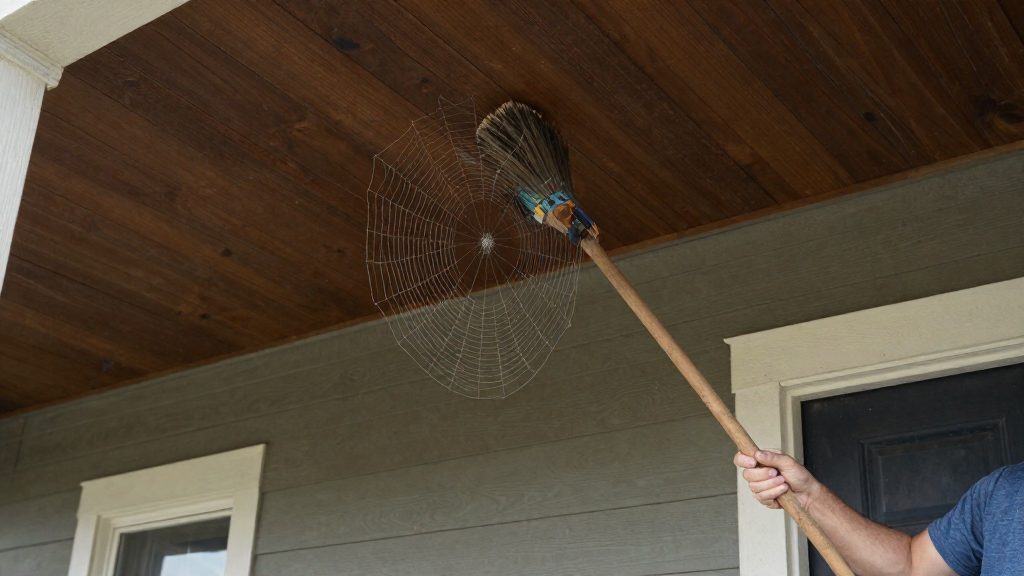
Web-building spiders settle on porches because the lights, windows, and water there concentrate the insects they eat. Porch webs therefore usually reflect where insects are gathering, not a random choice of location. Removing a web clears one spot, but the spiders are drawn by the insect activity that caused the web in the first place.
Why do spiders build webs on porches?
Outdoor lighting attracts insects that spiders feed on. According to University of California Statewide IPM Program (2020), outdoor lighting attracts insects, which in turn attract spiders. A lit fixture becomes a feeding point, and the spiders that hunt there anchor their webs in the surrounding corners and frames.
Spiders follow their prey, so webs cluster where insects are most active. Door frames, window corners, and the spaces around a light fixture all sit along the path insects take toward the light, which explains why the same spots reappear after each cleaning.
Windows and water sources create the same effect. NC State Extension lists both among the places where web-building spiders gather, so a porch near a window, a rain gutter, or an outdoor tap tends to collect more webs than a dry, unlit section of wall.
Because the attraction starts with insects drawn to light, reducing the light’s pull addresses the cause, while removing webs only clears the current site.
How to remove spider webs from your porch
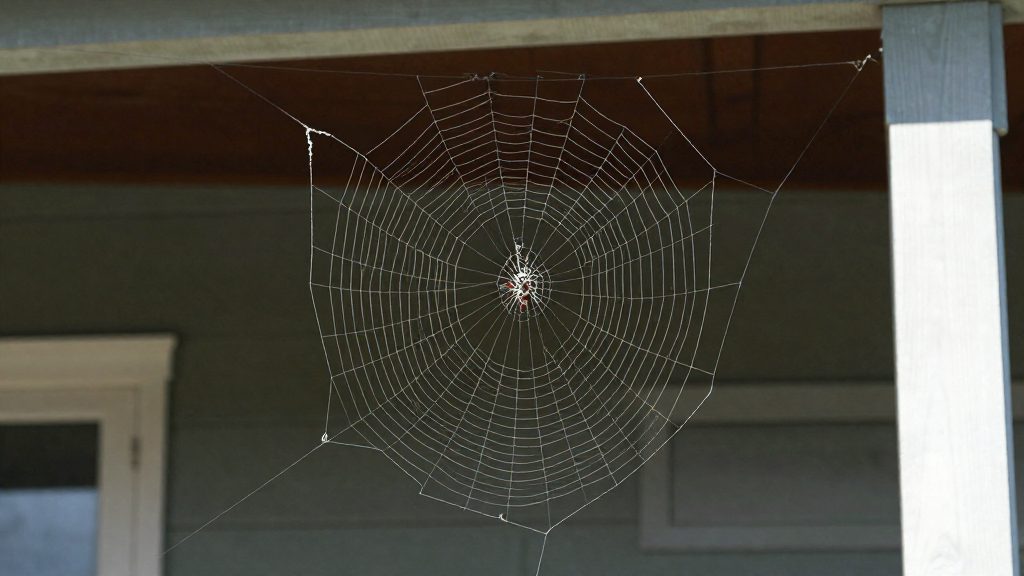
Active webs can be cleared with three tools: a broom, a vacuum or a strong spray of water, according to University of Minnesota Extension (2019). Work from the top of the porch downward so that loosened silk and debris don’t fall onto areas you have already cleared.
Sweep and vacuum active webs
Use a broom to take webs off ceilings, corners, light fixtures and railings. Then pass a vacuum with a brush or crevice attachment over the same spots to pick up the remaining silk and debris. Vacuuming collects the material in one pass instead of leaving it on the floor. Empty the canister or bag away from the house once the job is done.
Clear eaves, ceilings and corners
Webs are anchored where two surfaces meet, so check eaves, the underside of the porch roof, the tops of door frames and the corners of window casings.
Spray with water
A strong spray of water reaches high anchor points that a broom cannot. Follow the equipment manufacturer’s instructions for spray direction and surface compatibility. Keep water away from light fixtures, outlets and other electrical equipment; use a broom or vacuum where spraying could wet them. Use the lowest pressure that dislodges the web.
Clear egg sacs and hidden webbing
Check each web for egg sacs before you brush it away. The University of Minnesota Extension (2019) recommends removing and destroying spider egg sacs found while clearing outdoor webs. Crush each sac, seal it in a bag, and discard it in a closed outdoor bin.
Inspect concealed areas first
Look into dark gaps and concealed areas before you put your hand in. Wear work gloves whenever you handle stored items such as firewood, lumber, or cardboard boxes, as NC State Extension (2022) advises. Use a stick or flashlight to look before you reach.
Where to check
- Under railings: Look at the underside of the top rail and along each baluster, where webs and sacs often sit out of sight.
- Furniture: Check under cushions, along frame joints, and beneath seats and tables.
- Light fixtures: Inspect the housing, the gap between the fixture and the wall, and the mounting bracket. These spots often hold both webs and sacs.
- Debris at the base of the porch: Remove leaf litter and dense plants near the foundation, since these create hiding places (University of California Statewide IPM Program, 2020).
Reduce insects around porch lights
Porch lights draw insects, and insects draw spiders. Changing the lighting reduces that supply at its source.
Three changes address the problem:
- Switch to yellow lights. Yellow lights attract fewer insects, and the University of Minnesota Extension (2019) lists them as a way to discourage spiders.
- Move fixtures away from the house. Placing lights away from walls, windows, and doorways reduces the attraction at the entrance (UC IPM, 2020).
- Reduce total outdoor lighting. Turning off or cutting back unneeded fixtures also helps discourage spiders (University of Minnesota Extension, 2019).
These changes lower the draw on spiders but do not guarantee that spiders will stay away.
Keep plants and clutter away
Vegetation, leaf litter, and stored materials give spiders hiding places and anchor points near a porch. Clearing them from the area around the house limits where webs can form.
- Trim plants back from the house so they do not grow against walls or the porch (University of Minnesota Extension, 2019).
- Remove leaf litter and debris near foundations, along with dense vegetation there, since these provide hiding places and web-building sites (University of California Statewide IPM Program, 2020).
- Move woodpiles and other clutter, such as stored lumber and boxes, away from the porch.
Do you need a spider spray?
Usually not. Outdoor insecticide treatments generally do not provide lasting spider control. According to the University of California Statewide IPM Program (2020), spraying offers only temporary control unless it is combined with cleaning the webs and the spider-attracting conditions around them.
Why the effect is short-lived
Porch webs form where prey is plentiful. If those conditions stay in place, the spiders and their webs return, so a spray that does not change the site leaves the cause untouched.
Spiders as natural pest control
Spiders help control garden insects. NC State Extension (2022) notes that spraying them can also kill other natural enemies of pests, which can increase pest pressure in the surrounding garden. Spraying a porch therefore has a cost beyond the spiders you intended to remove.
Where extension advice differs
Recommendations are not uniform across regions:
| Publisher | Position on outdoor spider spraying |
|---|---|
| University of California Statewide IPM Program (2020) | Generally discourages outdoor treatments; they do not provide lasting control |
| NC State Extension (2022) | Notes that spraying can kill natural enemies of pests |
| University of Minnesota Extension (2019) | Allows limited exterior treatments against wandering spiders using appropriately labeled products |
Prevent webs with regular porch maintenance
According to University of Minnesota Extension (2019), spider entry is reduced by sealing gaps around doors and windows and repairing damaged screens. These repairs reduce spider entry into the house or an enclosed porch; they do not prevent spiders from reaching an open porch and can be carried out alongside routine web removal.
Seal gaps around doors and windows
Caulk any gap where a window frame meets the wall, and fit a door sweep or weatherstripping so no opening remains at the threshold or along the door sides. At night, have someone shine a flashlight along the outside edges of the closed door or window while you check from a darkened interior for light passing through gaps.
Repair damaged screens
Patch or replace any torn or holed damaged screens on doors and windows. A screen with loose edges or a gap at the frame gives spiders the same entry as an open window.
Schedule recurring checks
Set a fixed inspection routine and follow the same order each time: door thresholds and frames, window frames, then screens and corners. Use a schedule that suits how often the porch is used, since no universal interval is established.
| Checkpoint | What to look for | Action |
|---|---|---|
| Door thresholds and frames | Gaps at the sides or bottom | Caulk, or fit a door sweep |
| Window frames | Gaps where the frame meets the wall | Caulk or weatherstrip |
| Screens | Tears, holes, or loose edges | Patch or replace |