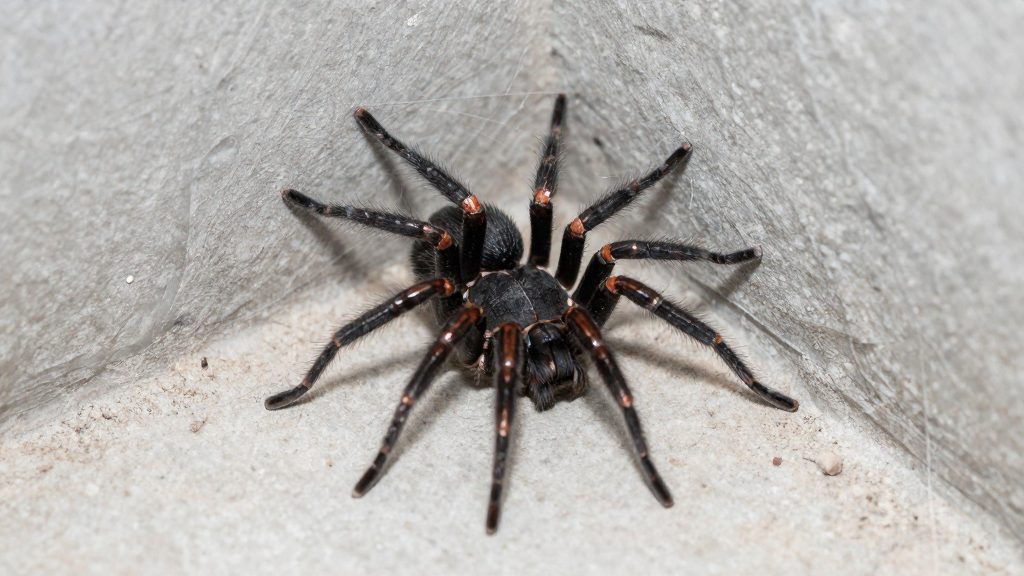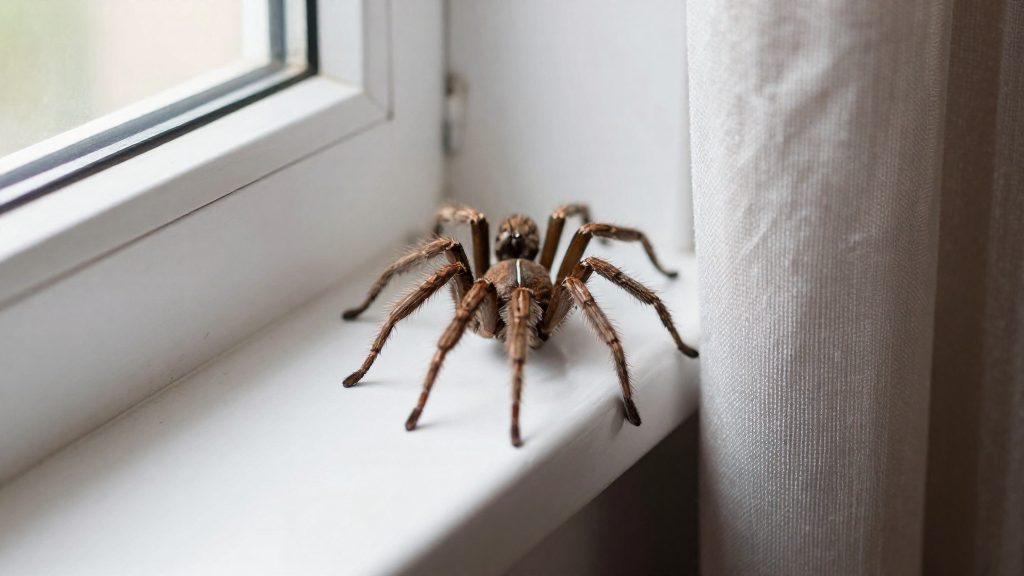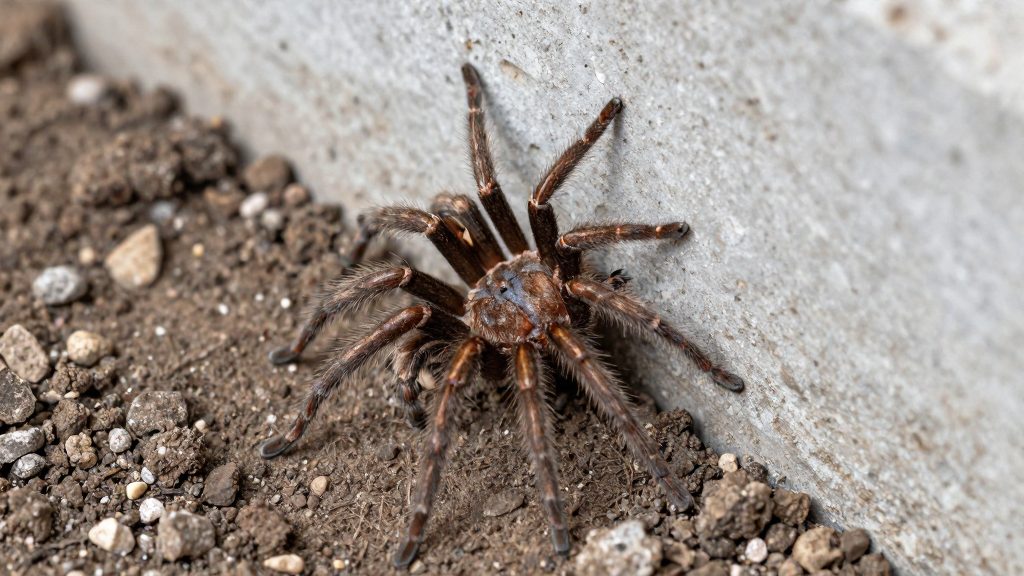
Wolf spiders gather around foundations mainly because the soil, mulch and plant cover along the wall resemble the ground-level habitat they hunt in. They move through leaf litter and low vegetation looking for insects, and a house with planting beds, debris or outdoor lights offers the same conditions. When natural outdoor habitat is lost, as in new developments, the house and its foundation can become one of the few sheltered places left.
Why do wolf spiders gather around your foundation?
Ground hunting in leaf litter and low vegetation
Wolf spiders hunt on the ground. They hunt or ambush their prey rather than trapping it in a web, so they travel through leaf litter and low plants to find it. A bed of groundcover or shrubs pressed against the house gives them that cover right at the wall. According to the UC Statewide IPM Program, lights near doors and windows also draw in the insects that spiders feed on, so the foundation area can become a feeding ground as well as a shelter.
Loss of natural outdoor habitat
The UC Statewide IPM Program notes that wolf spiders sometimes enter homes, especially in new developments where they have lost their usual outdoor living places. Construction removes the leaf litter, vegetation and ground cover these spiders depend on. Displaced animals then settle wherever cover and prey remain, which often means the walls of nearby buildings.
Hiding places created by leaf debris
Leaf debris piled against the foundation gives wolf spiders daytime shelter directly beside the house. AMDRO identifies leaf debris near the foundation as a source of hiding places for them. Leaf debris provides hiding places right beside the house.
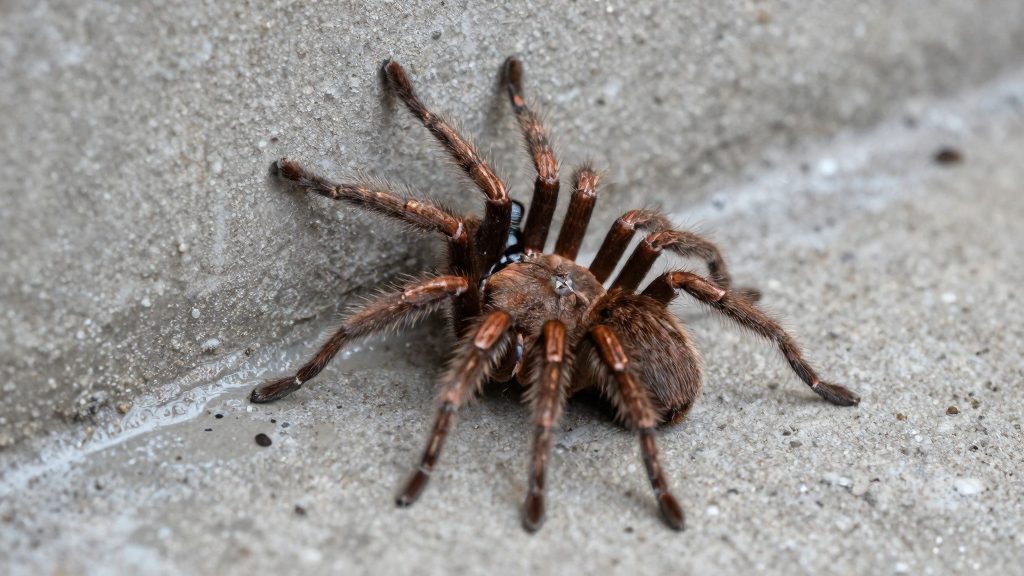
How to tell a wolf spider from a brown recluse
Eye pattern is the most reliable field check, because size and colour overlap between the two. A hand lens or a zoomed phone photo of the head is enough to count the eyes.
- Wolf spiders have eight eyes in three rows.
- Brown recluses have six eyes, arranged in three pairs in a semicircle.
Body length helps only as a secondary check. Wolf spiders reach about 2 inches in body length, so a large, long-legged spider found on the ground near the foundation is more likely a wolf spider, but the eyes should settle the identification.
Web type is the second check. A spider sitting in a funnel or sheet web is not behaving like a wolf spider, so a spider found in a web is worth identifying more carefully.
Location is not a reliable clue. Brown recluses can also be found in basements, crawl spaces and cluttered areas, so rely on the eye count or an expert identification rather than where the spider was found.
Wolf spiders also rarely bite, which is useful context when deciding how to handle one. If the eye count does not match the wolf spider pattern, do not assume the spider is harmless and seek expert identification.
Seal and clear the foundation first
Physical exclusion and clearing come before any chemical step. Hiding places and entry points are the two factors you control.
Complete these steps in order:
- Remove trash, leaf litter and heavy vegetation from the area next to the foundation. Trim plant growth away from the house so that foliage does not touch the wall (UC Statewide IPM Program).
- Inspect the foundation, window frames and door frames for cracks and gaps. Caulk them or otherwise eliminate them. Many spiders can be excluded this way (Purdue Extension Entomology).
- Vacuum the webs, eggs and spiders from the affected surfaces. Vacuuming removes all three (Purdue Extension Entomology). Concentrate on window and door frames, the base of the walls and the corners where debris has collected.
- Check the cleared strip after a few days and repeat the vacuuming where spiders or webs reappear.
Wolf spiders do not build webs to catch prey, so webs usually mean other spider species are present. Vacuuming removes webs, eggs and spiders alike. Once the foundation is free of clutter and sealed, the perimeter can be treated as described later in this guide.
Do outdoor perimeter sprays work?
Outdoor insecticide treatments give limited protection against wolf spiders. According to the UC Statewide IPM Program, insecticides will not provide long-term control and should not generally be used against spiders outdoors. Removing webs, clutter and hiding places works better.
Purdue Extension Entomology takes a different view of spray use. It describes a long-lasting residual pyrethroid spray as effective for spiders and recommends applying it to porches, garages, roof eaves, crawl spaces and basements, following the product label. The two sources take different positions: UC IPM advises against general outdoor insecticide use and favours removing webs, clutter and hiding places, while Purdue describes a residual pyrethroid spray as effective for the listed areas.
| Approach | Where it applies | Source |
|---|---|---|
| Outdoor insecticide treatment | General outdoor use, not recommended for long-term control | UC Statewide IPM Program |
| Long-lasting residual pyrethroid spray | Porches, garages, roof eaves, crawl spaces, basements | Purdue Extension Entomology |
Treatment is most defensible when spiders are repeatedly entering a specific part of the building. Apply it only to the labeled areas, and follow the label for dilution, coverage and reapplication.
For ground-level perimeter products, AMDRO’s Quick Kill Outdoor Insect Killer is labeled for the foundation up to 3 feet high and stays active for up to three months. AMDRO’s Home Perimeter Granules are labeled to create a perimeter barrier for up to three months. These durations are manufacturer claims, so the label governs use. UC IPM advises that insecticides will not give long-term control and should not generally be used against spiders outdoors, so use these products only if the label allows, and only after sealing and clearing have been done.

Are glue boards useful for wolf spiders?
Glue boards work best as monitoring tools rather than control devices. UC Statewide IPM Program advises that removing webs, clutter and hiding places works better than relying on insecticides outdoors, so a board is best treated as a way to see activity, not as a fix.
Spotting indoor entry routes
Because wolf spiders travel along edges, boards placed flat against walls, in corners and at doorways can show which paths they use. Check the boards on a fixed schedule, note where catches cluster, and compare those spots with the gaps around the foundation, windows and doors.
Placement along walls, basements and crawl space edges
- Baseboards and wall-floor joins in rooms next to exterior doors and windows.
- Basement walls and crawl space edges, where spiders may come in from outside.
- Areas near leaf debris or clutter. Boards there show whether spiders are moving toward the house.
Clear clutter before placing boards, since a board hidden among stored items records little.
Sticky surface risks
A glue board holds anything that touches it, including non-target insects such as beneficial species, and it can trap pets that walk across it.
Prevention checklist for fall
Wolf spiders tend to move indoors in late summer and fall, so the checklist works best when it is completed before the cooler months, not after a spider is found inside.
Reduce outdoor lighting near entries
- Reduce outdoor lights near doors and windows. Lights attract the insects that spiders feed on, so fewer lights near an entrance means less prey drawn to the walls where spiders hunt, according to UC Statewide IPM Program.
- Use fewer fixtures at entry points in late summer, when spider movement indoors rises.
Keep screens in good repair
- Inspect every window and door screen and repair tears or gaps before fall.
- Keep screens intact year-round. UC Statewide IPM Program lists this among the measures that discourage spiders from entering.
When to call a pro
Most wolf spider problems can be handled with sealing, clearing and vacuuming. Three situations indicate that DIY measures have not solved the problem.
Persistent sightings after sealing and clearing
If spiders keep appearing indoors after sealing and clearing have been completed thoroughly, an entry point or hiding place has probably been missed. A pest control professional can inspect the building to find it.
Spread across rooms or floors
An infestation that reaches several rooms or floors suggests the spiders are established inside, not just passing through. Purdue Extension recommends a long-lasting residual pyrethroid spray for porches, garages, roof eaves, crawl spaces and basements, and says to follow the label. Applying a residual treatment across a whole building is easier to do correctly with a professional who can assess which areas need it.
Uncertain identification
Before any treatment is chosen, the spider needs to be identified. Check the eye pattern first (eight eyes in three rows for wolf spiders, six eyes in three pairs for brown recluses); behaviour alone is not a reliable test. If you cannot confirm the species, stop applying products and have a professional identify it. Suspected brown recluse sightings should be confirmed by a professional before any further treatment is chosen.
Frequently asked questions
Are wolf spiders dangerous to people or pets?
According to AMDRO, wolf spiders rarely bite, and they can reach about 2 inches in body length. Their size can look alarming, so avoid handling them and remove them with a vacuum or a container.
When are wolf spiders most likely to come indoors?
AMDRO notes that they tend to move indoors in late summer and fall. Check door sills, window screens and foundation cracks before cooler weather arrives.
Do AMDRO products like Quick Kill and Home Perimeter Granules solve the problem?
AMDRO’s Quick Kill Outdoor Insect Killer is labeled for foundations up to 3 feet high and stays active for up to three months, while its Home Perimeter Granules give a perimeter barrier for up to three months. These are manufacturer claims, so the label governs how and where they can be used. The UC Statewide IPM Program states that outdoor insecticides will not provide long-term spider control, so these products work best after sealing and clearing.