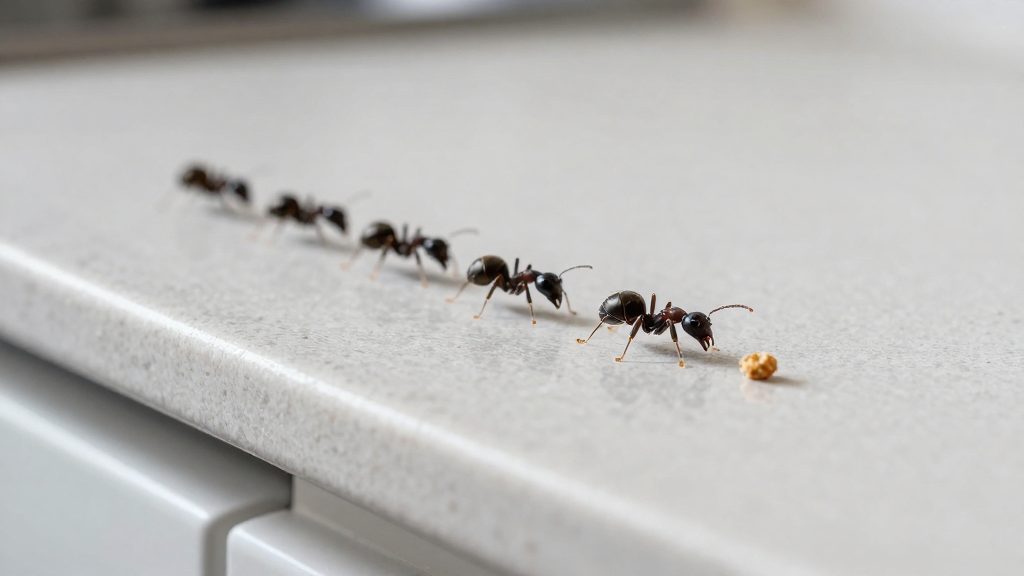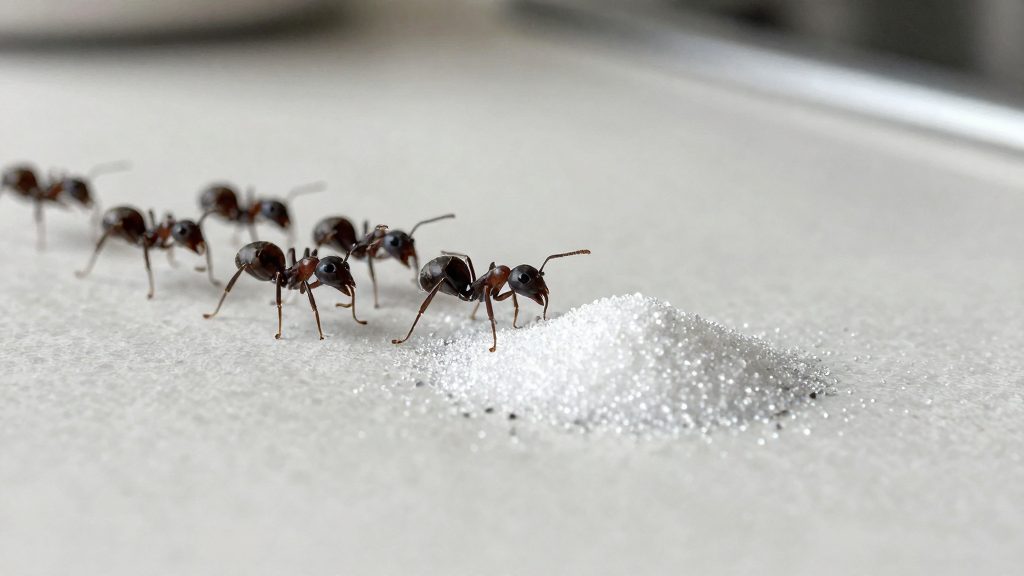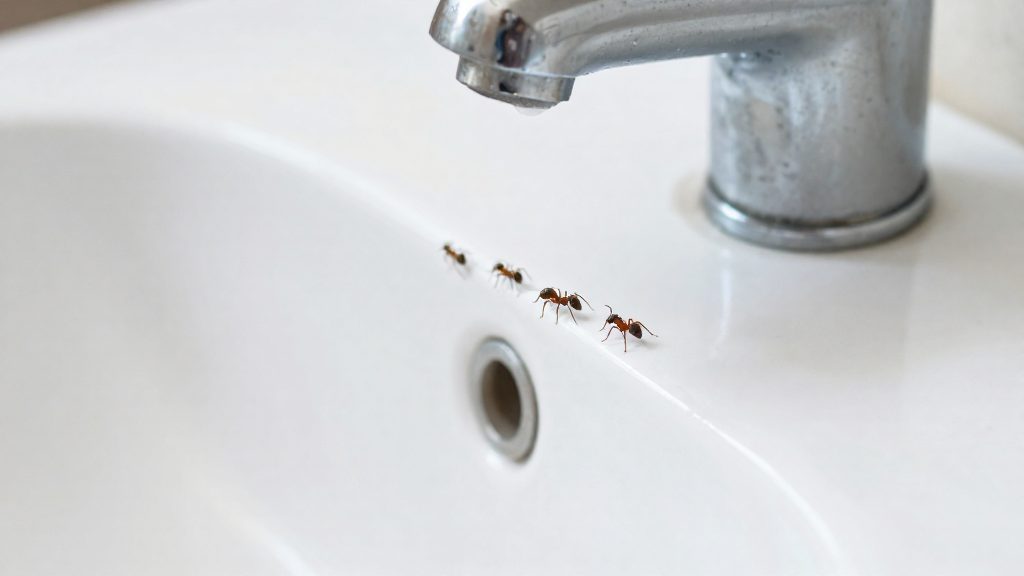
Ants in a bathroom sink are most often drawn by moisture rather than food. According to PestWorld (National Pest Management Association, 2024), pests are attracted mainly to standing water in the basin, plumbing leaks, and damp areas under the sink and around the drain. Pharaoh ants, which measure about 1 mm as adults, favour warm, humid spots and can nest in wall voids or behind baseboards, so a damp sink can lead to a wider colony.
Why Are There Ants in the Bathroom Sink?
Species that favour damp sites
Two species are most often tied to moisture: the pharaoh ant (PestWorld, 2024; Health Canada, 2017) and the carpenter ant (Health Canada, 2016):
| Species | Size and habitat | Signs to check |
|---|---|---|
| Pharaoh ant | Adults about 1 mm; warm, humid areas; nests in wall voids or behind baseboards | Small ants appearing near the sink, baseboards or drain |
| Carpenter ant | Up to about 13 mm; prefers wet, decaying wood | Fine sawdust near galleries, dry rustling at night, winged swarms in spring |
A carpenter ant presence indoors can indicate a moisture problem that needs correcting, and Health Canada advises doing so.
Entry points and attractants
Ants enter through cracks in walls, gaps at baseboard joints and openings around plumbing. Sweet and greasy residues, such as crumbs or spilled toiletries, attract them, as does honeydew from aphids on houseplants placed near the sink.
Removing the moisture source
- Repair leaking pipes and taps.
- Seal gaps in the walls around the basin.
- Replace cracked tiles that hold water.
- Clean the drain.
- Clear the space under the sink and keep it dry.
If ants return after these steps, or if you find sawdust or galleries in wood, call a licensed professional.
Humidity and leaks, the primary cause
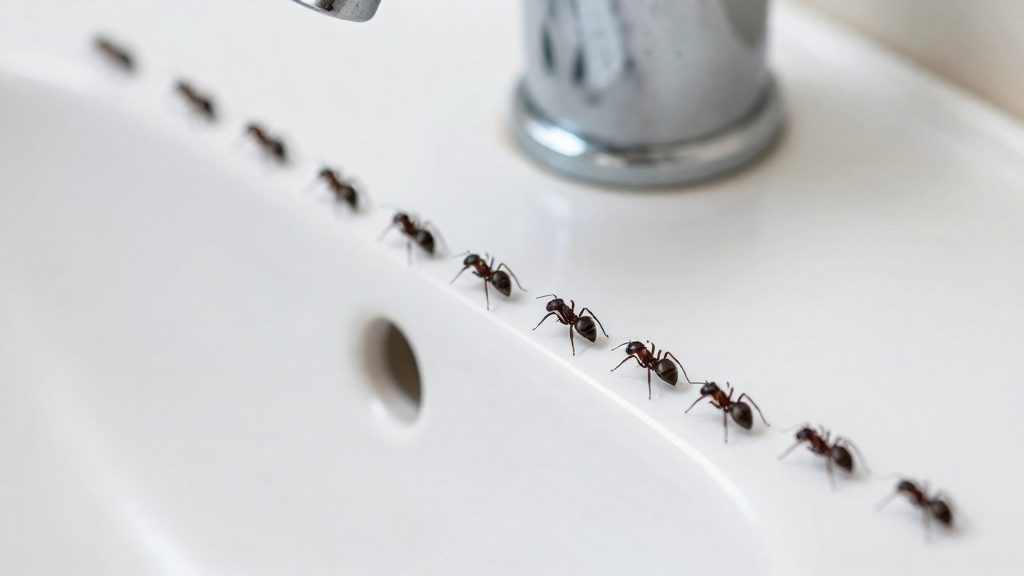
Moisture is the main reason ants appear in a bathroom sink. According to PestWorld (2024), pests around a bathroom sink are mostly drawn to standing water in the basin, plumbing leaks, and damp areas under the vanity and around the drain. Pharaoh ants, which measure about 1 mm as adults according to Health Canada (2017), prefer warm, humid spots according to PestWorld (2024) and nest in wall voids or behind baseboards, so a damp vanity can shelter a colony close to the sink.
Damp conditions can also point to a larger problem. Carpenter ants, which reach about 13 mm in length according to Health Canada (2017), prefer damp, decaying wood. Health Canada (2016) advises correcting the moisture behind an indoor infestation. Signs of carpenter ant activity include fine sawdust near their galleries, a dry rustling sound at night, and winged swarms in spring.
Start by eliminating the moisture sources, using the fixes PestWorld (2024) recommends:
| Moisture source | Action |
|---|---|
| Leaking pipes and faucets | Repair the leak |
| Gaps in the wall around the sink | Seal the gap |
| Broken tiles that hold water | Replace the tile |
| Clogged drain | Clean the drain |
| Items stored under the sink | Clear the space so it can be checked and dried |
If the ants persist after these steps, or if you find sawdust or galleries in wood, contact a licensed pest control professional. Health Canada (2016) also recommends that any pesticide label carry a Health Canada registration number before use.
Which ants are found in the bathroom?
Ants around a bathroom sink are usually drawn by water rather than food. According to Health Canada (2017), the common household ants in Canada include the small black ant, the thief ant, the pharaoh ant, the odorous house ant and the carpenter ant. Most of them are not aggressive. Two species are most often linked to wet areas.
| Species | Adult size | Preferred conditions | Entry or nesting sites |
|---|---|---|---|
| Pharaoh ant | About 1 mm | Warm, humid places | Wall voids and behind baseboards |
| Carpenter ant | Up to about 13 mm | Moist, decaying wood | Window frames, foundation cracks, heating or cooling ducts, cables, firewood brought indoors |
Sources for the table: PestWorld (National Pest Management Association) (2024) for the pharaoh ant, and Health Canada (2016) for the carpenter ant.
Pharaoh ants and sink moisture
PestWorld (National Pest Management Association) (2024) states that pests around a bathroom sink are mainly attracted by moisture. The conditions that matter are standing water in the basin, plumbing leaks, and damp areas under the sink and around the drain. Pharaoh ants favour the same warm, humid spots and nest in wall voids or behind baseboards.
Carpenter ants and damp wood
Carpenter ants prefer wood that is wet and decaying. Health Canada (2016) notes that finding them indoors can point to a moisture problem that should be corrected. Their presence is usually signalled by fine sawdust near their galleries, a dry rustling noise at night, and winged swarms in spring.
Food residue and entry points
Health Canada (2017) also reports that ants are attracted to sweet and fatty residues, such as peanut butter and crumbs, and to honeydew from aphids on indoor plants. Bathroom ants usually come in through cracks in foundations and exterior walls, and through the joints where baseboards meet the wall.
Do ants come from the drain?
The sources do not say that ants climb up through the drain. What draws them is the moisture in the basin, from leaks, and around the drain. Standing water in the basin, plumbing leaks, and damp areas under the sink and around the drain all attract ants, and the pharaoh ant is especially drawn to warm, humid spaces. According to PestWorld (National Pest Management Association, 2024), these ants nest in wall voids and behind baseboards, so the sink is often the place where they are found rather than where they nest.
The species most often found in homes differ in size and in the conditions they need:
| Species | Adult size | Conditions they favour | Typical entry or nesting points |
|---|---|---|---|
| Pharaoh ant | About 1 mm | Warm, humid spaces | Wall voids, behind baseboards |
| Carpenter ant | Up to about 13 mm | Damp, decaying wood | Windows, foundation cracks, heating or cooling ducts, cables, branches touching the house |
Source: Health Canada (2016-12-06 and 2017-02-24) for carpenter ants and common household species; PestWorld (National Pest Management Association, 2024) for pharaoh ants.
Moisture control is the main step. PestWorld (2024) recommends the following actions around a bathroom sink:
- Repair leaks in pipes and faucets.
- Seal gaps in walls around the sink.
- Replace broken tiles that retain water.
- Clean the drain.
- Clear the space under the sink so that any dampness can be seen and dried.
Food and sugary residues near the sink also attract ants, which are drawn to sweet and fatty foods. Health Canada (2017-02-24) advises keeping counters clean and wiping up spills promptly.
If carpenter ants are present, the presence of their galleries in wood can indicate a moisture problem that needs correcting, according to Health Canada (2016-12-06). Health Canada also advises checking that any pesticide label carries a Health Canada registration number. If the infestation persists, a licensed professional should be called, as PestWorld (2024) recommends.
How do ants get into the house?
Ants usually enter through structural gaps and openings, and they are drawn to damp areas once inside. Carpenter ants come in through windows, foundation cracks, heating or air-conditioning ducts, cables, branches touching the house, and firewood brought indoors, according to Health Canada (2016). Other common household ants enter through cracks in foundations and exterior walls and through baseboard joints, according to Health Canada (2017).
Carpenter ants
Carpenter ants prefer damp, decaying wood, so their presence indoors can point to a moisture problem. Adults reach about 13 mm, and the signs of an indoor colony are fine sawdust near their galleries, a dry rustling sound at night, and winged swarms in spring (Health Canada, 2016). Finding them indoors can point to a moisture problem that should be corrected.
Pharaoh ants and wall voids
Pharaoh ants, whose adults measure about 1 mm, favour warm, humid places. They nest in wall voids and behind baseboards, which are places where a colony can hide (PestWorld, 2024).
Moisture near the sink
Ants around a bathroom sink follow water. PestWorld (2024) identifies standing water in the basin, plumbing leaks, and damp zones under the sink and around the drain as the main attractions. If you see ants on the vanity, check these points first.
Prevention: dry out, repair, seal
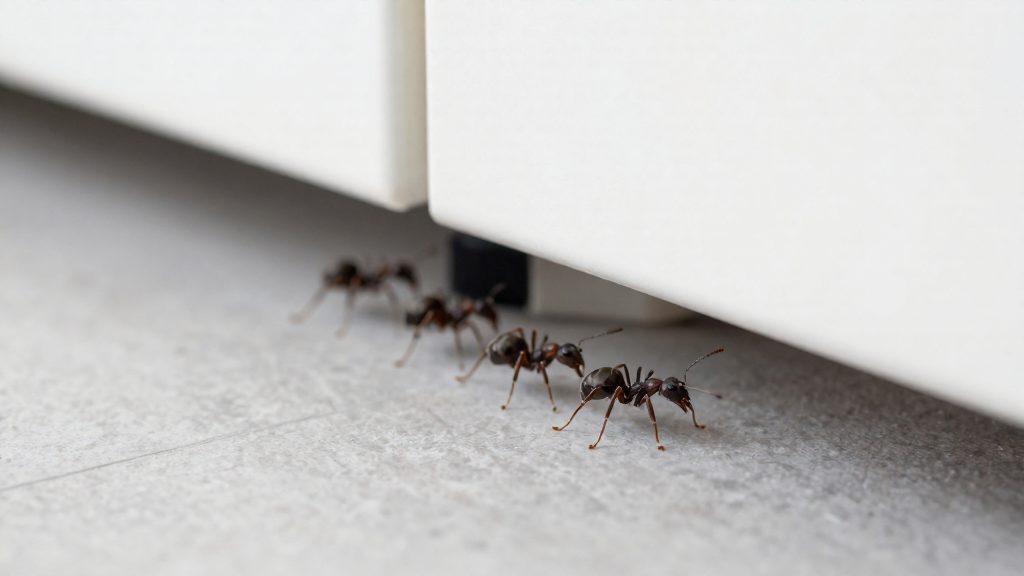
Sink ants are drawn mainly by moisture. Standing water in the basin, plumbing leaks, and damp areas under the sink and around the drain attract them. Pharaoh ants, which are about 1 mm long as adults, prefer warm, humid places and nest in wall voids or behind baseboards. Prevention therefore means removing water first, then closing the routes ants use to reach it, as PestWorld (2024) recommends.
| Measure | Action |
|---|---|
| Fix leaks | Repair leaking pipes and taps |
| Clean the drain | Clean the drain to remove the damp residue it holds |
| Replace tiles | Replace broken tiles that retain moisture |
| Clear the cabinet | Keep the space under the sink tidy and free of clutter |
| Seal gaps | Caulk gaps in the walls around the sink |
Sealing covers the entry points that the table does not reach. Ants enter through cracks in exterior walls and at the joints where baseboards meet the floor and wall. Caulking those joints closes common routes into the room. Health Canada (2017) also advises wiping up sweet or fatty spills near the sink, because ants are drawn to them.
Some ants signal a deeper problem. Carpenter ants prefer damp, decaying wood, so their presence indoors suggests that moisture needs correcting, according to Health Canada (2016). Look for fine sawdust near their galleries, a dry rustling sound at night, and winged swarms in spring. If ants persist after the steps above, call a licensed professional, as PestWorld (2024) advises.
How to get rid of them
Removing ants from a bathroom sink starts with cutting off the standing water they depend on. Ants gather at sinks because of water pooling in the basin, leaks from pipes or taps, and damp zones around the drain and under the vanity. Wiping visible ants without removing these conditions usually leads to a return.
| Source of attraction | Action |
|---|---|
| Leaking pipes or taps | Repair the leak so the area stays dry |
| Gaps in walls around the basin | Seal them with caulk |
| Broken tiles that hold moisture | Replace the tile |
| Residue and debris in the drain | Clean the drain |
| Cabinet under the sink | Clear stored items and keep the space dry |
Pharaoh ants, which are about 1 mm long as adults, favour warm, humid spots. Their nests often sit inside wall voids or behind skirting boards, so cleaning the sink alone may not end the problem. Check the surrounding wall and skirting areas for entry points.
Carpenter ants require a different approach. Their satellite colonies are best eliminated by finding and destroying the parent colony, according to Health Canada (2016). If a pesticide is used, confirm its label carries a Health Canada registration number. Where the infestation is difficult to resolve, a licensed professional should be called in, as advised by PestWorld (National Pest Management Association) (2024).
When to Call an Exterminator
If ants keep appearing around a bathroom sink after the basic fixes, call a licensed professional. According to PestWorld (National Pest Management Association, 2024), the basic fixes are to repair leaking pipes and faucets, seal wall gaps, replace cracked tiles that hold moisture, clean the drain and clear the space under the sink. Sink infestations are driven mainly by standing water, plumbing leaks and damp areas around the drain, so these steps should come first. If the problem continues after them, an exterminator should inspect the area.
Carpenter ants call for a different response. They prefer damp, decaying wood, so their presence indoors can point to a moisture problem that needs correcting. Signs of an established colony include fine sawdust near their galleries, a dry rustling sound at night and winged swarms in spring. Carpenter ants can enter through windows, foundation cracks, heating or air-conditioning ducts, cables, tree branches touching the house and stored firewood.
For a satellite colony of carpenter ants, the most effective method is to find and destroy the parent colony. Any pesticide used must carry a Health Canada registration number on its label. In difficult cases, the recommended option is to call an exterminator.
Frequently asked questions
Are ants in a bathroom sink dangerous?
Most ant species that invade homes in Canada are not aggressive, according to Health Canada (2017). The one to watch is the carpenter ant, which nests in damp, decaying wood and can be found indoors.
Do houseplants or pet bowls near the sink attract ants?
They can. Ants feed on the honeydew that aphids leave on indoor plants, so a plant on the vanity may draw them toward the basin. Health Canada also recommends placing pet bowls in a shallow dish of water as a prevention measure (Health Canada, 2017).
Should I spray a pesticide under the sink?
Only a product whose label shows a Health Canada registration number should be used against carpenter ants (Health Canada, 2016). For a satellite colony, the most effective approach is to find and destroy the parent colony, and an exterminator is worth calling in difficult cases.