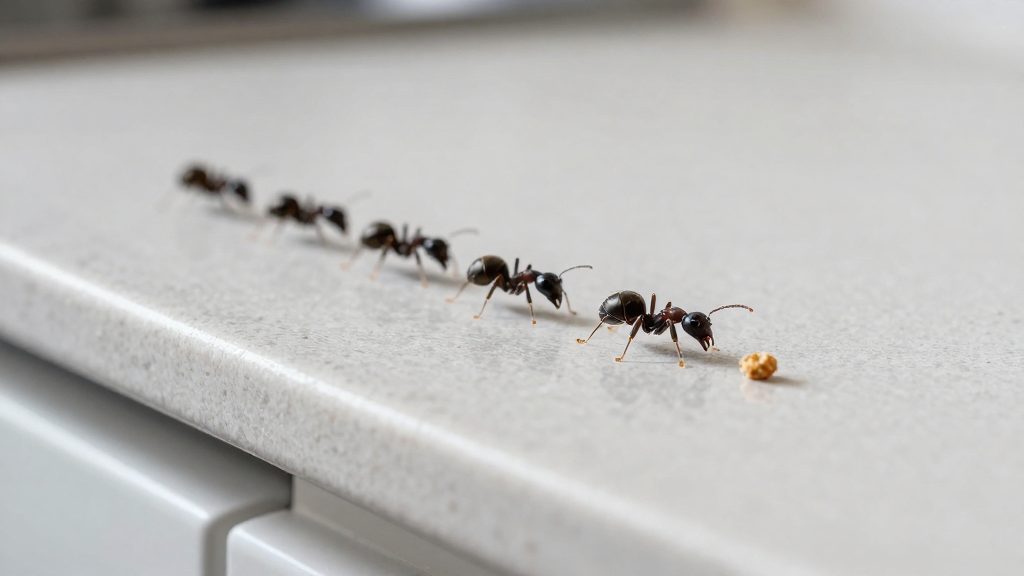
Why are there ants in your kitchen?
Sugar, grease and crumbs
According to City of Calgary (2026), sugar, grease and crumbs all attract foraging ants. Because workers follow scent trails, residue left on counters, in cabinet corners and around appliances can bring them back repeatedly to the same spot. Food left out in a kitchen therefore affects more than the place where it sits, since it marks a route into the room.
Aphid honeydew
Aphids excrete honeydew, a sugary waste product, and ants feed on it. According to City of Calgary (2026), the plants themselves do not produce honeydew. Houseplants infested with aphids therefore act as a sugar source even when no food is left out. Checking indoor plants for aphids is a useful step when ants keep appearing near the same spot, even in a kitchen with clean counters.
Water and moisture near sinks
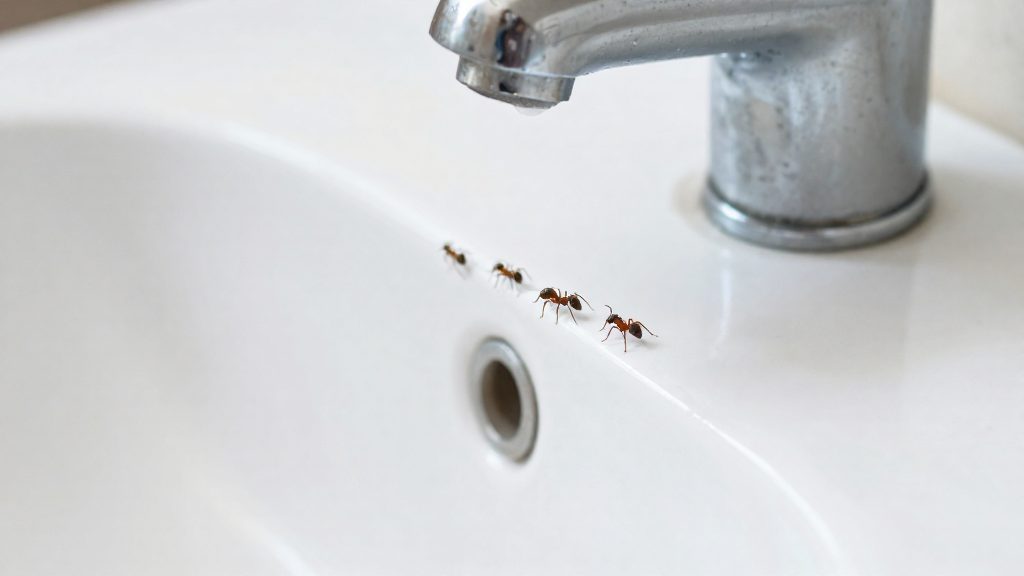
Water draws ants in addition to food residue. According to Terminix Canada (2023-07-27), the main sources are leaky faucets, dishwashers and condensation. Sinks, dishwashers and the surfaces around them are the first places to inspect when ants gather near water, because a constant moisture source keeps foraging workers in the area even when food is absent.
Three control methods from the sources, compared by effect on the colony and by application requirements.
| Method | Effect on the colony | Application and precautions |
|---|---|---|
| Bait with boric acid or hydramethylnon | Slowly eliminates the colony (City of Calgary, 2026) | Place stations in the path of foraging ants, such as along baseboards, carpet edges and cabinet corners. Keep away from children and pets (City of Calgary, 2026) |
| Indoor spraying of ant trails | Can split the colony. If it does, switch to baits (City of Calgary, 2026) | Check that the product is labelled for indoor or outdoor use (City of Calgary, 2026) |
| Diatomaceous earth | Non-chemical option (City of Calgary, 2026) | Apply in cracks and crevices (City of Calgary, 2026) |
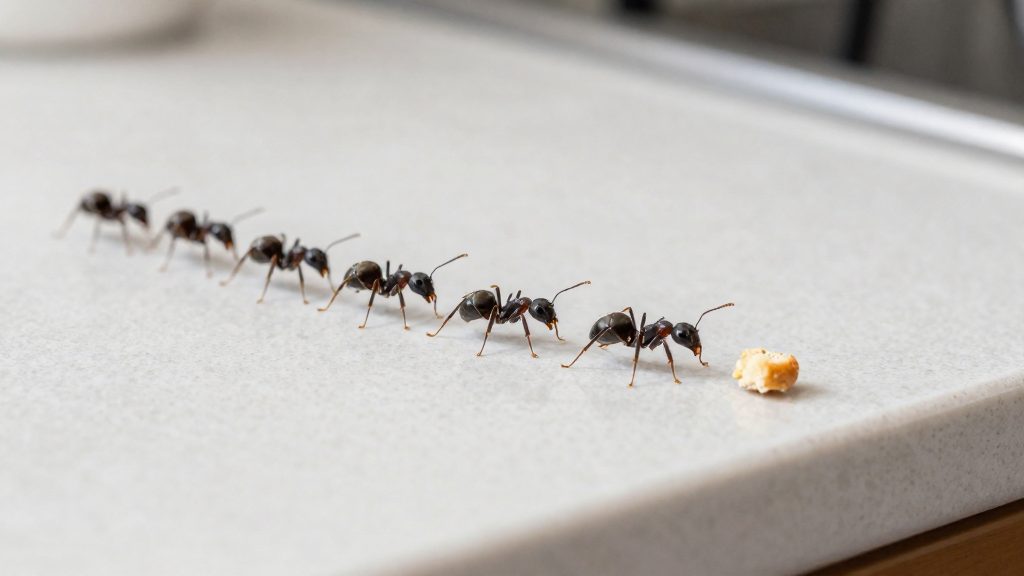
Which ants are common in Canadian kitchens?
Four tiny species are common in kitchens: the little black ant, the pharaoh ant, the odorous house ant and the pavement ant, according to Terminix Canada (2023). They are mostly a nuisance, and they can contaminate food. Carpenter ants are the exception and need to be told apart from these four, because they damage the building itself rather than only the food supply.
The four kitchen species
All four are drawn to food residue. Because the species are small and look alike, confirm the species before treating the problem:
- Collect a dead specimen and compare it with identification photos of the four species, or have it identified by a professional.
- Note where the trails run. Kitchen species usually follow routes between food or water sources and their nest, so trails along counters, baseboards and around the sink show where the activity is concentrated.
- Record whether the ants appear near the dishwasher, sink or other damp areas.
Carpenter ants and wood damage
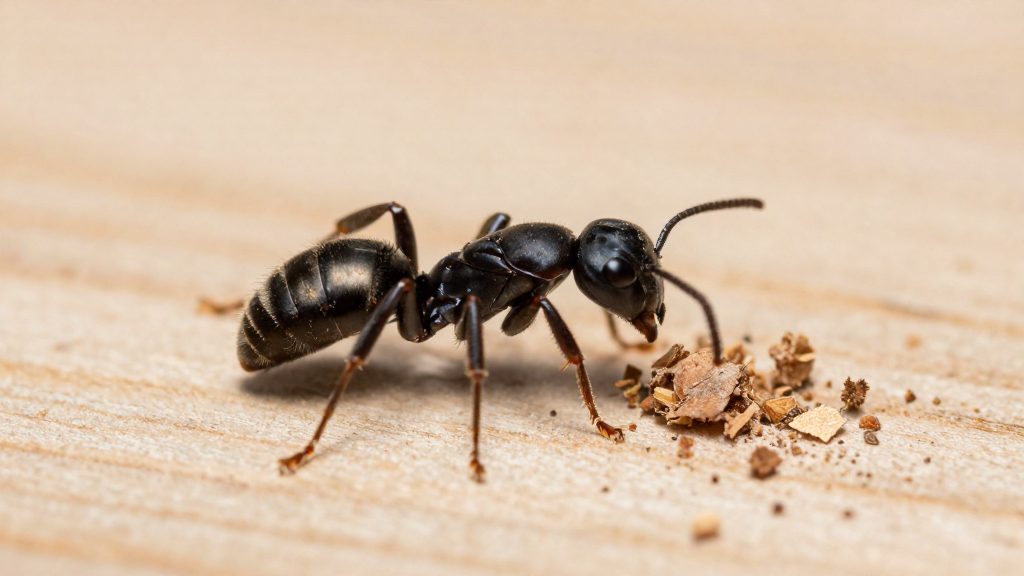
Carpenter ants hollow out wood to nest, and over time this can weaken a structure (Terminix Canada, 2023).
To separate the two, inspect the wood near the kitchen, such as cabinet bases and window frames, for hollowed or tunnelled areas. A trail that leads only to food or water points to a kitchen species. Hollowed wood, with or without visible ants, points to carpenter ants, and that situation calls for a different response than a food-trail infestation.
How do you kill ants in the kitchen with baits?
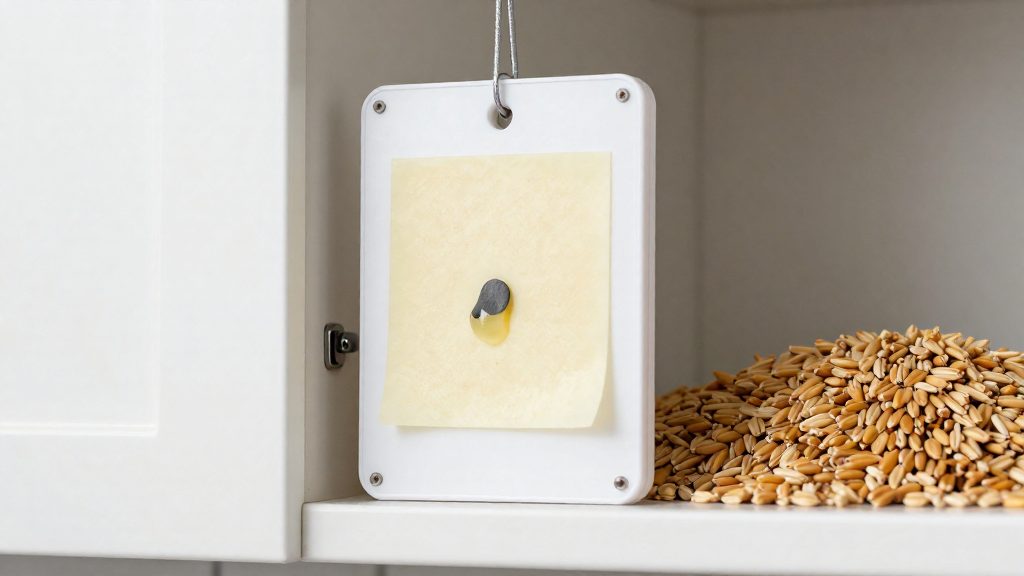
Baits work on the colony rather than on the ants you can see. According to City of Calgary (2026), baits containing boric acid or hydramethylnon slowly eliminate the colony, so the effect is gradual rather than immediate. Success depends on two steps: choosing a bait with the right active ingredient and placing the stations where foraging ants already travel.
Choosing the bait
- Confirm that the active ingredient listed on the label is boric acid or hydramethylnon.
- Check that the label states whether the product is for indoor or outdoor use.
Placing bait stations
Stations need to sit on the scent trails ants already use. Place them:
- Along baseboards
- At carpet edges
- In cabinet corners
Stations in these spots meet ants already moving through the kitchen, rather than ants that have not yet found a route.
Keeping stations away from children and pets
Keep bait stations away from children and pets. Baseboards and carpet edges sit at floor level, so check each station’s position regularly. If a pet or child can reach a station, move it to a spot where access is blocked, such as the back of a cabinet corner.
Can sprays make an ant problem worse?
Yes. Spraying ant trails indoors can cause the colony to split, so a kitchen that looks cleared may still have active foraging groups elsewhere. When you spray a trail, you remove the ants you can see but may not reach the nest that sends them.
Recognising a split colony
A split colony usually shows up as new trails appearing in different spots after you have sprayed.
Switching to baits
If spraying splits the colony, switch to baits. Stop spraying the trails you are baiting, so the ants can feed on the bait without being disturbed by the spray.
Checking the label before you spray
Check that a product is labelled for indoor or outdoor use before applying it in the kitchen. The label determines where the product may be used, so an outdoor-labelled product should not be applied to indoor trails. Follow these steps:
- Read the label and confirm it is approved for indoor use.
- Apply the product only to the places the label permits.
- Watch for new or shifting trails over the following days.
- If the colony has split, switch to baits.
Spraying trails indoors can split the colony (City of Calgary, 2026), so watching for new trails and switching to baits if they appear is the safer course.
Natural remedies and what they can and can’t do
Non-chemical remedies help with ants you can see, but they rarely reach the source of the problem. According to the City of Calgary (2026), diatomaceous earth in cracks and crevices is a non-chemical option for indoor ants.
Applying diatomaceous earth
- Dust a thin layer into cracks and crevices where ants travel: along baseboards, at cabinet corners and behind the fridge or dishwasher.
- Check treated spots regularly and dust again wherever ants still pass.
- Keep the powder out of food preparation areas and away from pet bowls.
Where home remedies fall short
- Nest location: Treating the indoor trail does not reach the nest, so ants keep returning.
- Colony splitting: Spraying ant trails indoors can cause the colony to split, in which case baits are the next step.
- Water sources: A dusting or spray on a food spill does nothing about a steady water supply, so the leak must be repaired.
- Carpenter ants: Surface remedies cannot reach a nest inside timber, so an inspection and targeted treatment are required.
Home remedies work best as a supplement to food storage, cleaning and water repair, not as a standalone solution once a colony is established.
How to keep ants out of the kitchen
Prevention works by removing what attracts ants and blocking the routes they use, so the steps below cover food storage, cleaning, pet feeding areas, garbage and the building structure.
Food storage
- Store sugary foods in sealed glass or snap-lid containers. An open or loosely closed package gives foragers access.
- Keep counters clean and wipe up crumbs and food residue.
Pet dishes and garbage
- Sweep or vacuum often, paying particular attention to the area around pet dishes. Food spilled there attracts ants.
- Empty kitchen garbage frequently so that food odours do not build up in the bin.
Water sources
Repairing leaks and drying wet areas under sinks and around appliances removes the moisture that draws ants.
Sealing the structure
- Seal cracks around moldings and plumbing so that ants cannot use them as entry points. City of Calgary (2026) recommends sealing cracks around moldings and plumbing.
When should you call a pest control professional?
Most kitchen ant problems can be handled with baits, sealed cracks and better food storage. A professional is the better choice in two cases: when ants keep returning after these measures, and when the ants are carpenter ants, which damage the building itself.
Infestations that persist after baiting and sealing
Ants that remain visible in the first days after baiting do not by themselves show that the treatment has failed. Continued activity after sustained baiting, sealing of cracks around moldings and plumbing, and improved food storage is a different situation. It suggests the nest is not being reached. The nest may sit outside the kitchen, where a homeowner cannot see or treat it.
Carpenter ants and structural damage
Any sign of carpenter ant activity in framing, beams, subfloors or other structural wood warrants a professional inspection, because the problem lies in the building rather than in the food area.
Assessing structural weakening before and after treatment
A professional can assess how far the damage extends and whether the wood needs repair, and can check afterwards that no active ants remain. A homeowner who notices sagging, soft or crumbling wood near a known carpenter ant nest should contact a professional rather than attempt repairs over the damage.
Frequently asked questions
Should I use bait or spray to get rid of ants in my kitchen?
Use bait rather than spraying. Baits containing boric acid or hydramethylnon slowly eliminate the whole colony, while spraying trails indoors can split the colony into several smaller groups that stay in the house (City of Calgary, 2026).
Do carpenter ants in the kitchen need urgent treatment?
Carpenter ants are the exception to the rule that kitchen ants are mostly a nuisance. They hollow out wood to build their nests, so an infestation in or near wooden kitchen structures can weaken them over time (Terminix Canada, 2023-07-27).
Where should I place ant bait, and is it safe around pets?
Put bait stations where foraging ants already travel, such as along baseboards, carpet edges and cabinet corners. Keep them out of reach of children and pets, since the active ingredients are toxic if swallowed (City of Calgary, 2026).